
An open rack is usually the quicker choice for boards that stay in one club room; individual tubes are usually better when boards travel or need protection from crowded storage. Neither format fixes a badly rolled board, and neither should be purchased before the club measures its rolled boards, available shelf space, and transport route.
This comparison is for clubs managing several flexible chess boards. It is not a claim that every vinyl, silicone, mousepad-style, or printed board should be rolled: follow the board maker’s own care and storage instructions first. If rolling is permitted, roll each board consistently and avoid a bend or tight fastener that can leave a crease.
As an Amazon Associate, The Good Chess & Checkers may earn from qualifying purchases.
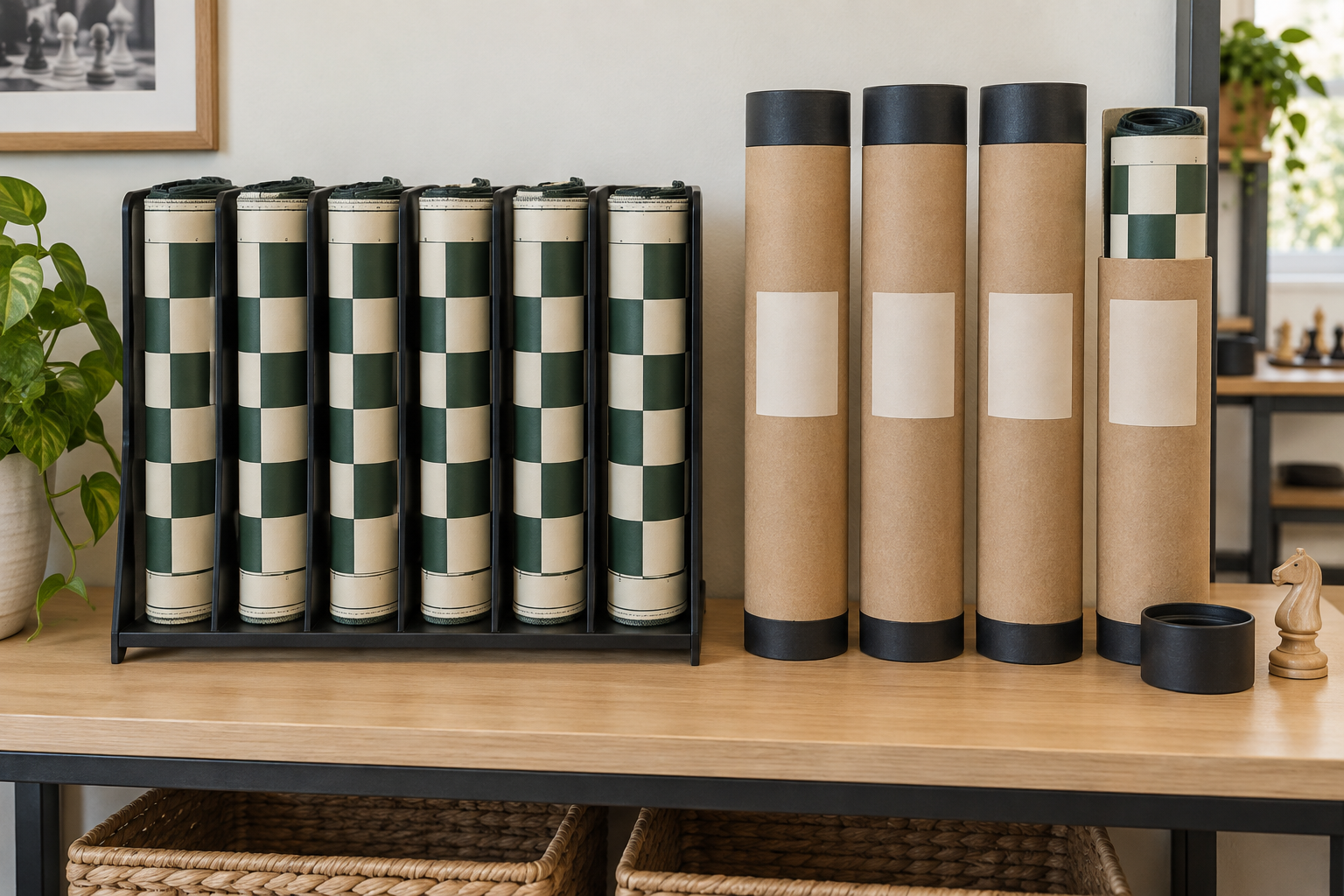
Quick decision aid
Measure the rolled boards and the complete route
For a rack, verify slot width, usable height, base footprint, capacity, and whether boards can be removed without disturbing neighbors. For tubes, verify inside diameter and length, cap clearance, label area, and whether the filled tubes fit the club’s shelf and carrying plan.
Quick decision
- Choose a rack when several compatible rolled boards stay in one dry, approved room and helpers need fast visual counting and retrieval.
- Choose individual tubes when boards travel, share a crowded cupboard, or need separate labels and protection from nearby equipment.
- Use a mixed system when everyday boards belong in an open rack but loaner or event boards travel in tubes.
- Skip both when the maker recommends flat storage, the club owns only one or two boards, or an existing shelf and loose straps already keep the boards orderly.
The practical difference
A rack treats the boards as one visible inventory. Separate slots keep rolls from collapsing into a pile, and an empty slot can reveal that a board has not been returned. The tradeoff is exposure: the roll is not enclosed, and the rack normally adds a fixed footprint even when several boards are in use.
Tubes treat every board as its own package. A cap helps separate the board from pieces, books, and other equipment, while a label can identify a set number or destination. The tradeoffs are more containers, more caps to manage, and slower retrieval when the outside labels are unclear.
Measure before comparing products
Measure one board only after rolling it according to its maker’s guidance. Record the roll’s length and widest diameter without squeezing it. Check more than one board because material thickness and how tightly helpers roll them can change the packed size.
For a rack, compare that diameter with the usable opening of each slot, not the organizer’s outside dimensions. Leave enough hand clearance to lift a board without scraping its printed surface. Confirm the rack’s full width and depth on the intended shelf or counter, including any feet or side panels.
For a tube, compare the roll with the tube’s inside diameter and usable length after the cap is fitted. A telescoping tube can accommodate different board lengths, but its locking method and fully adjusted exterior length still have to fit the shelf, cabinet, or vehicle. Do not force a roll into a narrow tube merely because the nominal length is sufficient.
When an open rack works better
A rack favors a repeated in-room routine. Helpers can return boards by numbered slot, count the visible rolls, and take the next board without opening several containers. That can be useful when a club sets up the same room every week and keeps pieces in separately numbered bags or boxes.
Look for a stable base, smooth contact surfaces, and dividers that keep each roll upright without pinching it. Decide whether the organizer should sit on a low shelf, inside a cabinet, or on a return table. A general-purpose roll organizer may fit, but the club must verify dimensions rather than assume it was designed for chess boards.
A rack is less attractive when the storage area is dusty, exposed to spills, or shared with objects that may press against the boards. It is also awkward for clubs that move all equipment between buildings. In those cases, easy access may not outweigh enclosure and portability.
When individual tubes work better
Tubes suit boards that travel separately or move through a loan system. A large, readable label can connect each board to its pieces, clock, room, or borrower record. An enclosed tube also keeps a rolled board from unrolling inside a vehicle or crowded equipment closet.
Inspect the whole closure. A cap that detaches easily may become a new inventory problem, while a shoulder strap can snag or tangle if every tube is stored upright together. Check whether the tube stands securely, lies safely on a shelf, and can be opened without dumping the board onto the floor.
Tubes are not automatically protective in every circumstance. A tube that is crushed, left in unsuitable heat, or packed with unrelated hard objects may still damage its contents. Follow the board and tube makers’ storage guidance and avoid unsupported claims about archival, weatherproof, or impact protection.
Labeling and inventory
Give each board a simple identifier that matches the club’s other equipment. With a rack, put the identifier on the slot and use a board-safe removable tag only if the maker permits it. With tubes, place the label on the container where it remains visible on the shelf.
A rack makes quantity visible, but it does not prove that pieces or clocks were returned. A tube keeps one board contained, but an opaque tube can hide whether it is empty. Pair either format with a short checkout or return checklist. For a fuller inventory routine, compare a piece counting tray with a checklist.
Run a no-spend trial first
- Confirm which boards may be rolled and record each packed length and diameter.
- Mark the proposed rack footprint and tube footprint on the actual shelf with removable paper.
- Use clean temporary dividers to simulate rack slots, and use existing suitable containers to simulate separate tubes without forcing a fit.
- Have helpers retrieve and return six boards during two normal sessions.
- Record missing labels, slow steps, caps or straps that get misplaced, and any board that is rolled inconsistently.
If the trial shows that the club mainly needs faster visual counting, a rack has the clearer advantage. If the difficulty occurs during transport or mixed storage, tubes solve the more relevant problem. If neither trial improves the routine, keep the current system and spend nothing.
Bottom line
Choose by workflow, not by the appearance of the organizer. A measured open rack is the practical default for many compatible boards that stay in one room. Properly fitted, clearly labeled tubes make more sense for transport, loans, and crowded shared storage. Keep flat any board whose maker does not recommend rolling, and use a small trial to prove the storage change before outfitting the entire club.