
A classroom checker tray should make one complete set easy to see and count before it goes back on the shelf. The useful choice is not necessarily the tray with the most compartments: it is the format that holds 12 pieces of each color, supports stacked kings during cleanup, fits the cabinet, and can be reset without slowing the next group.
This is a product-category comparison, not a named-product ranking or a claim of hands-on testing. Generic craft, food-service, and classroom organizers vary widely. Measure your actual checkers and storage space, then verify current interior dimensions, materials, lid design, care instructions, and included quantities before buying.
The Good Chess & Checkers may earn commissions from qualifying purchases.
Quick decision aid
Match the tray to the classroom reset
Start with one complete 24-piece set. Compare usable compartment dimensions, count visibility, closure, stackability, label space, cleaning guidance, and the tray's full shelf footprint.
Quick choice
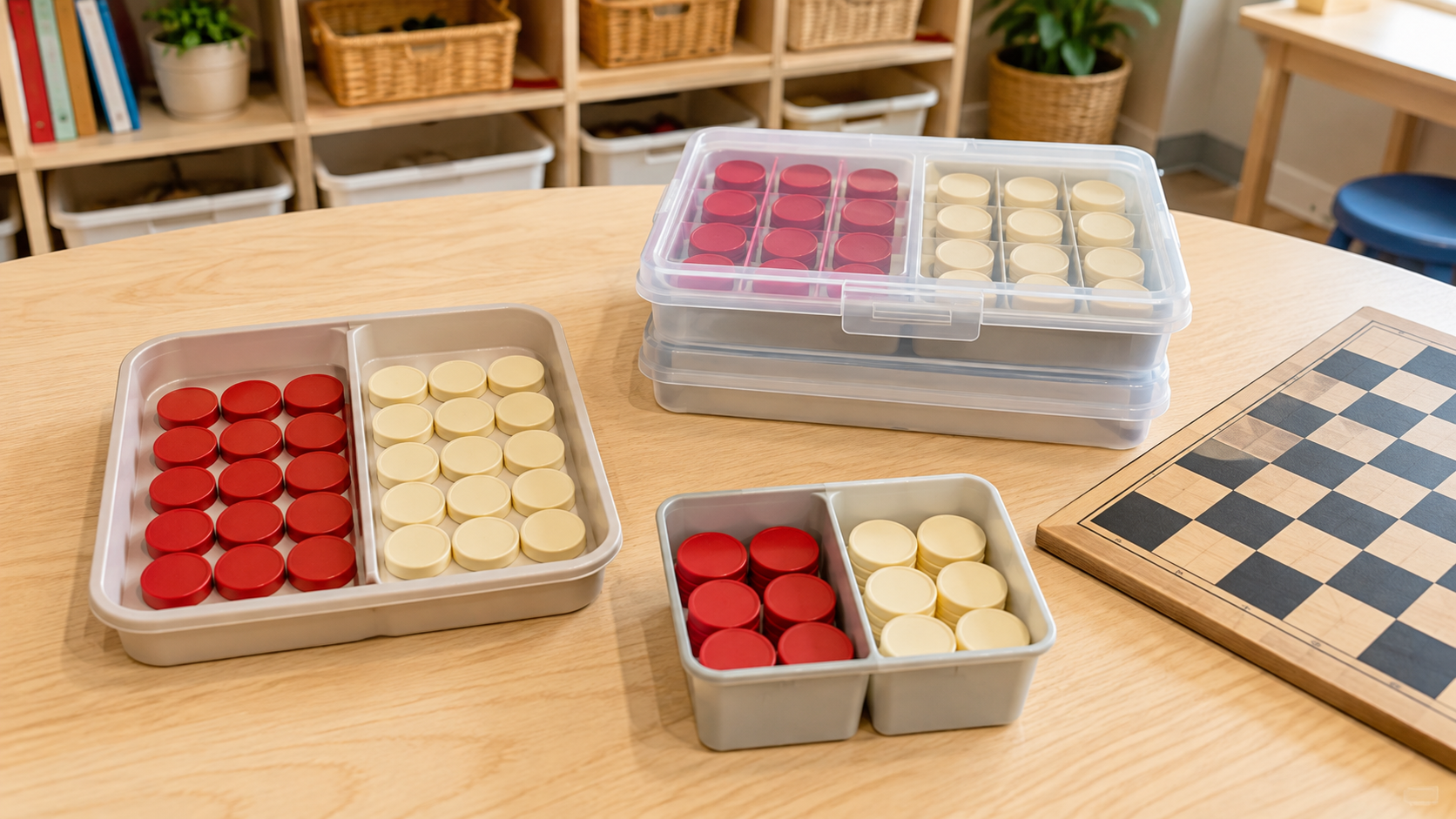
- Choose a shallow two-section tray when students or helpers need to see 12 pieces of each color at a glance.
- Choose a lidded compartment tray when sets move on a cart or shelf and pieces need closed containment.
- Choose removable color bins when each player should carry one side to the board and return it independently.
- Keep labeled drawstring bags when cabinet space is tight and the existing count routine already works.
Selection criteria that matter
Capacity for a complete set
Standard American checkers uses 12 pieces per side, but classroom sets often include spares. Count what each tray must hold and decide whether replacements belong inside every set or in one separate supply bin. A product photo with checker-like discs does not establish capacity.
Usable compartment dimensions
Measure checker diameter and thickness, then measure a short stack as it is likely to be returned. Compare those numbers with each compartment's inside width, length, and depth. Exterior tray dimensions cannot prove that a divider layout fits the pieces.
Count visibility
Two broad color sections are usually easier to audit than many tiny cells. If the goal is a fast 12-and-12 check, test a paper outline of the proposed tray and confirm that pieces can sit in consistent rows without being wedged together.
Lid, latch, and carry orientation
An open tray fits a nearby cabinet-to-table routine. A tray that travels on a cart or in a tote needs a lid that remains closed in the orientation in which it will be carried. Verify the maker's closure details; do not assume a snap-on cover is intended for vertical transport.
Stacking and shelf footprint
Measure the complete stack, not one empty tray. Check whether lids, handles, flared sides, or label clips change the stacked height. Nesting saves room only while trays are empty, which may not match how sets are stored between sessions.
Cleaning and labels
Use the manufacturer's cleaning instructions for the stated material. A smooth removable insert may simplify ordinary wipe-downs, while fixed narrow cells can trap debris. Give every tray and its matching board the same short set number using a label type suitable for the surface.
How the main tray formats differ
Shallow two-section trays for visible counts
One section per color keeps the reset obvious and lets two players return pieces at once. This works best when each side can form three rows of four without stacking high. It is less useful when an open tray must travel or when the shelf cannot protect pieces from being knocked out.
Lidded compartment trays for contained storage
A clear or opaque lid can keep a set together between rooms. Fewer, larger compartments are generally more adaptable than 24 exact cells because checker diameters and spare-piece counts vary. Confirm that the closed lid clears stacked discs and that dividers meet the lid closely enough to prevent pieces migrating between sections.
Removable color bins for table setup
Two small bins let each player carry one color and can double as captured-piece containers during a game. The pair still needs one labeled home on the shelf so bins are not mixed across sets. Check that the bins fit together inside the board box, tote, or larger tray before standardizing them.
Full-set molded inserts
A fitted insert can make missing pieces immediately visible when every recess matches the checker size. It is also the least flexible option: replacement discs with a different diameter may not fit, and a deeply molded layout can take more shelf space than a simple divided tray.
A one-set trial before buying several
- Count 12 checkers of each color plus the program's planned spares.
- Measure disc diameter, thickness, and the tallest ordinary return stack.
- Measure the cabinet opening, shelf depth, tote, and cart clearance.
- Verify current usable compartment dimensions, lid, material, care instructions, and units per order.
- Label one tray and run the real distribute, play, count, close, carry, and shelve routine.
- Buy multiples only if helpers can identify a complete set and return it without creating a new bottleneck.
Tray, bag, or shared supply bin?
Use a tray when visible counting and repeatable set-by-set organization justify rigid shelf space. Families deciding between tabletop access and compact piece storage can compare an open checker tray with a zippered pouch. Use a closed checker bag or case when equipment moves frequently and compact containment matters more than seeing every piece. Use one labeled shared supply bin for replacements rather than overfilling every tray when only an occasional spare is needed.
The named classroom-and-club pillar is not built yet. For the broader equipment decision, use the prebuilt kit vs DIY classroom setup guide; for complete playable sets, compare checkers sets for classrooms.
Who should skip a dedicated tray?
Skip new trays if labeled pouches already make missing pieces easy to spot, boards have secure built-in storage, or the cabinet cannot accept another rigid footprint. Also skip products that omit usable compartment dimensions, show no reliable way to keep paired color bins together, or require a cleaning method unsuitable for the classroom routine.
Bottom line
For most classroom checkers sets, a shallow two-section tray gives the clearest 12-and-12 count. Add a verified lid when sets move, choose removable bins when players carry colors separately, and use fitted inserts only when the dimensions match the exact pieces. Trial one complete reset cycle before buying a classroom quantity.