
Choose an open tray when the pieces stay near one table and quick visibility matters most. Choose a zippered pouch when the set must fit inside a box, travel between rooms, or survive being stored on its side. A tray improves access during play; a pouch improves containment after play.
This is a product-category comparison, not a named-product ranking or hands-on test. Measure the actual checkers, board box, shelf, and route through the home, then verify current interior dimensions, closure details, materials, and care instructions before buying.
As an Amazon Associate, The Good Chess & Checkers may earn from qualifying purchases.
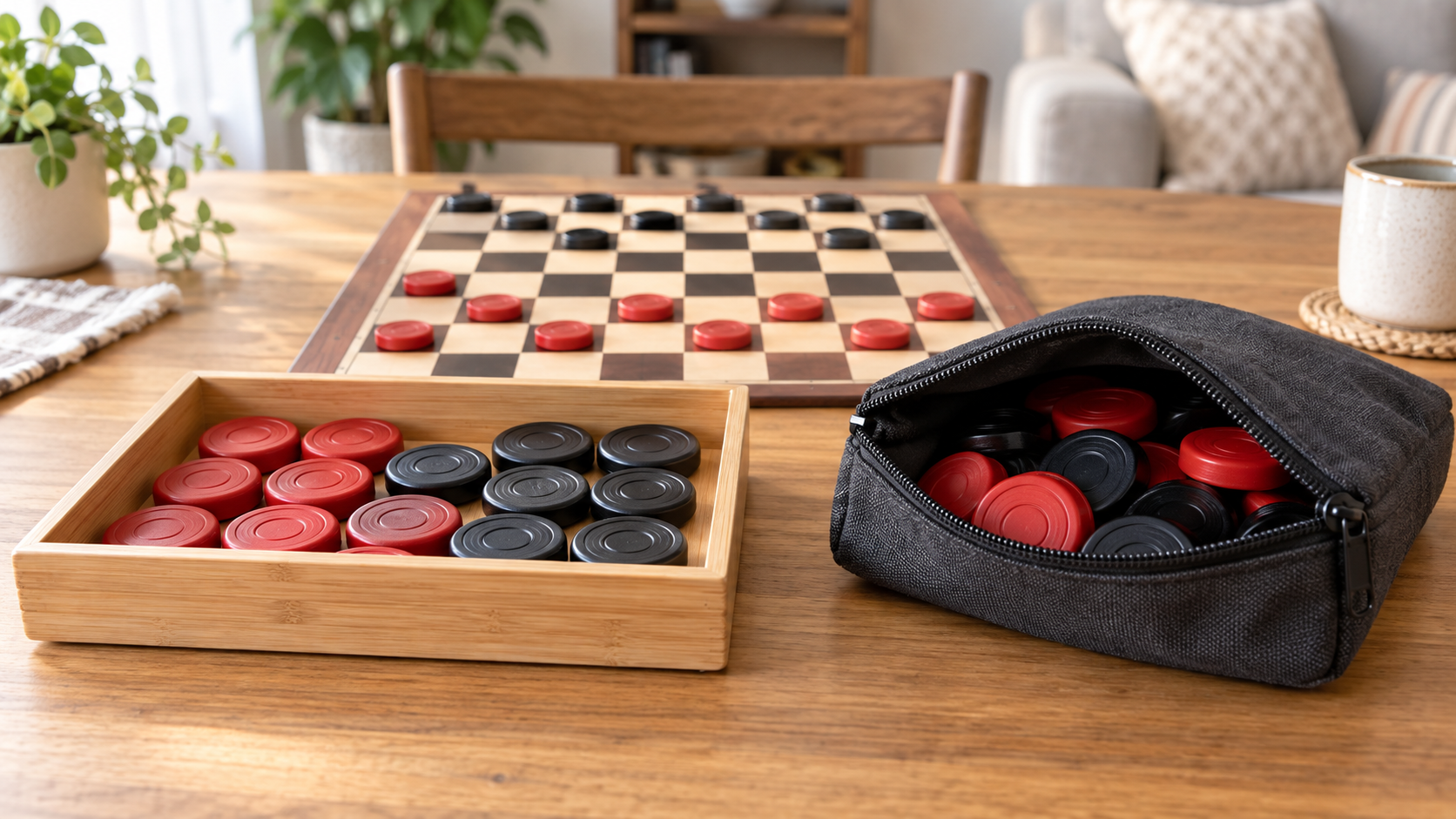
Table access or closed storage
Compare both storage formats
For a tray, check usable interior dimensions, wall height, surface grip, and board-box fit. For a pouch, check filled capacity, zipper opening, seam construction, label space, and whether it lies flat enough to share the table.
Quick decision
- Choose an open tray for a stable family table, easy 12-and-12 counts, and pieces that should stay visible during setup and cleanup.
- Choose a zippered pouch for a set stored vertically, carried between rooms, or packed into a board box with limited spare space.
- Use both only when the roles are clear: the pouch transports the pieces and the tray stages them during play.
- Skip a new organizer when the set's existing compartment or drawstring bag already keeps all 24 pieces together and setup is easy.
How the two formats change family setup
A shallow tray turns storage into a visible staging area. Family members can separate the two colors, check for 12 pieces per side, and take pieces without reaching into a deep container. It does, however, need a level surface and protected shelf space; an open tray is a poor fit for a box stored upright.
A zippered pouch prioritizes containment. It compresses around flat checkers, can fit irregular gaps inside a set box, and stays closed while being carried. Its tradeoff is visibility: pieces collect in a pile, so the family must empty or sort them to confirm that a complete set came back.
Who each option fits
An open tray fits a ready-to-play game area
Choose the tray when a board lives on a game shelf near the table and setup follows the same route each time. Two broad sections—one for each color—are more useful for checkers than many tiny compartments. Low walls make pieces easy to pinch and lift, while walls still need enough height to contain a short stack.
A tray also works as a captured-piece area during play. Put it beside the board rather than beyond a child's reach, and confirm that the combined board-and-tray footprint leaves room for elbows, drinks, and the unused pieces.
A zippered pouch fits mobile or compact storage
Choose the pouch when the set moves to another room, visits relatives, or shares a crowded cabinet. A wide zipper opening matters more than the pouch's outside appearance: a narrow opening slows counting and can make family members shake pieces onto the table.
Check the pouch at its filled thickness. A flexible bag that looks small while empty may press against a folding board or prevent the set box from closing once it contains 24 checkers and any spares.
Measurements to check before buying
- Piece dimensions: measure checker diameter and thickness, then measure a stack of 12 as a rough capacity reference.
- Complete inventory: allow for 24 playing pieces plus only the spares the family actually stores with the set.
- Tray interior: compare usable inside length, width, and wall height—not just exterior dimensions—with two separated color groups.
- Pouch opening: verify that an adult hand and the intended handful of pieces can pass through without stressing the zipper.
- Packed space: measure the board box or shelf after the board and rules are in place.
- Table footprint: include the open tray or flattened pouch in a full board setup, not as an isolated product.
Setup, cleanup, and maintenance
With a tray, divide the colors before play and return each side to its section afterward. The visible layout makes a missing piece easier to notice. Carry the tray with two hands if it has no lid, and follow the maker's cleaning guidance for wood, plastic, felt, or coated surfaces.
With a pouch, count the two colors before closing it. Do not rely on the pouch feeling “full.” Keep checker dust and crumbs away from the zipper teeth, avoid forcing an overfilled closure, and use only the care method stated for the fabric and lining. Let any cleaned organizer dry fully before sealing the pieces inside.
A two-format routine can help families who travel: use a compact pouch for transport and an existing shallow household tray at the destination. Buying a dedicated tray and pouch for every set adds objects to track, so start with the single problem that repeats most often.
A no-buy trial
- Put all 24 checkers and planned spares into a shallow household container and run one setup, game, count, and cleanup.
- Repeat with a zippered pouch already in the home, without forcing the zipper or using one meant for food or personal-care items.
- Time is less important than friction: note spills, reaching, missed pieces, table crowding, and whether the set returns to its shelf easily.
- Measure the better trial container and use those working dimensions to screen current listings.
Who should skip each option?
Skip an open tray if the set is carried often, stored vertically, or used where the table is easily bumped. Also skip a tray that cannot fit two clearly separated color groups or cannot be protected on the shelf.
Skip a zippered pouch if someone in the family struggles with the zipper or reaching into a soft container, or if visual counting is the main goal. Skip any pouch whose current listing omits useful dimensions or whose opening is narrower than the pieces-and-hand routine requires.
Bottom line
An open tray is the stronger family choice for visible counts, easy reach, and a game area that stays level. A zippered pouch is better for compact closed storage and carrying the set. Measure the pieces and complete storage space, trial both routines with containers you already own, and buy only the format that removes a repeated setup or cleanup problem.
The planned family-and-gift pillar is not built yet. For the broader set decision, continue with checkers boards for families or learn how to set up a checkers board correctly.