
Opening flash cards are useful when a beginner wants a five-minute prompt instead of another chapter to read. The right deck shows a clear position, asks one focused question, and explains the idea on the reverse; it should not turn the opening into a pile of moves to memorize.
This is a category comparison, not a ranking of named decks or products we tested. No approved current named-product feed is configured, so use the framework below to inspect listings, sample cards, publisher details, and the exact edition before buying.
The Good Chess & Checkers may earn commissions from qualifying purchases.
Quick decision aid
Start with position-and-plan cards
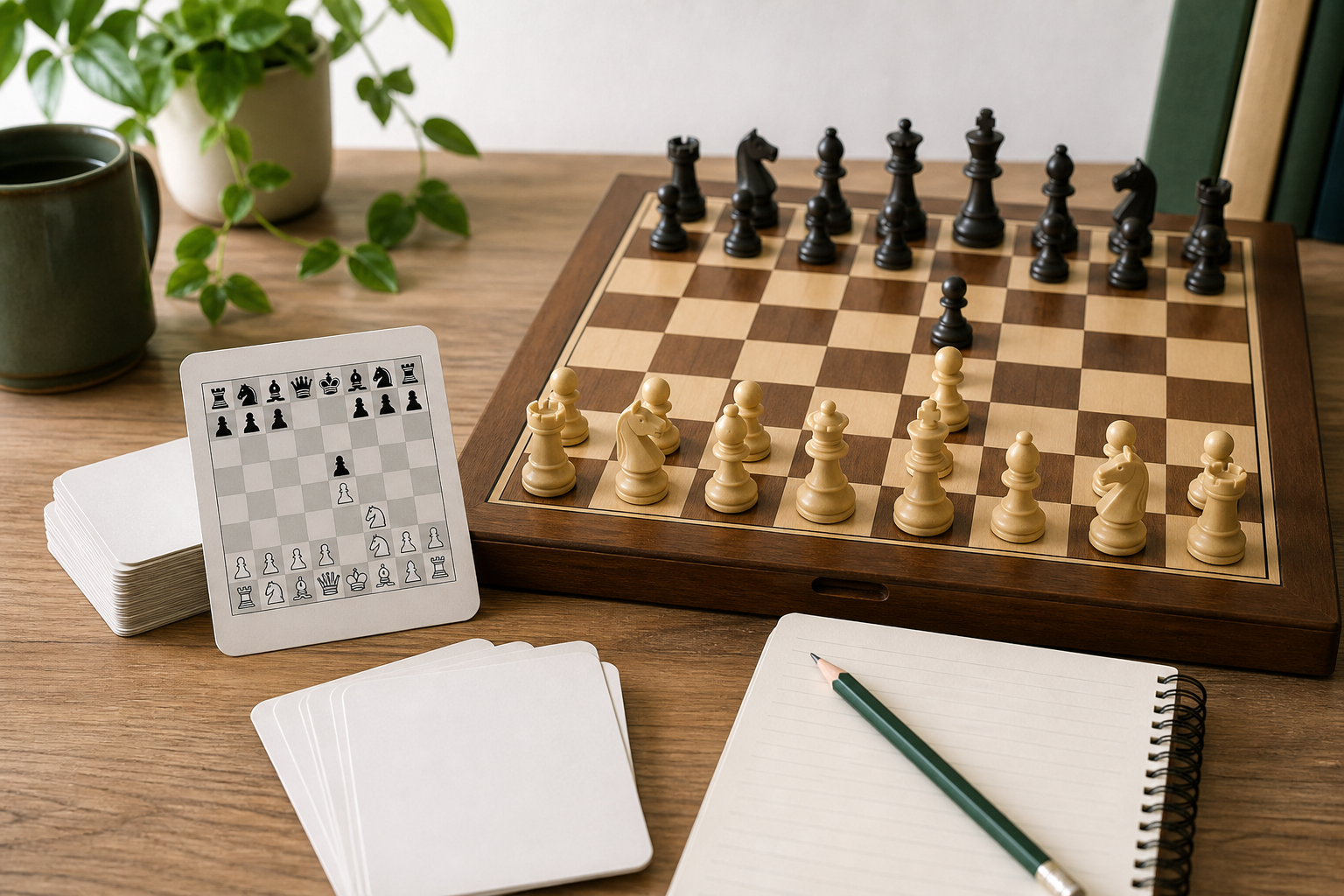
Look for beginner cards that pair a large board diagram with one question about development, center control, king safety, or the opponent's threat. Confirm that the reverse explains the reason, not only a move.
Selection criteria that matter
- Diagram clarity: pieces, square colors, orientation, and the side to move should be easy to identify at a glance.
- Notation level: absolute beginners need either a short notation key or enough visual support to answer without reconstructing a position from text.
- One job per card: prompts should ask for a plan, threat, developing move, or mistake—not several unrelated facts.
- Explanatory answers: the reverse should say why an idea helps and mention a reasonable alternative when the position allows more than one sound choice.
- Sequence: a numbered or color-grouped path from principles to common positions is easier to use than an unsorted collection.
- Physical usability: check card dimensions, print size, finish, storage box, and whether the deck will stay readable under ordinary room light.
- Exact edition: match the publisher, language, contents, and edition in the listing; search results can mix cards, ebooks, posters, and tactics decks.
Comparison framework: which card format fits?
Principles-first position cards
Choose them when: the learner knows legal moves but still develops the queen too early, moves one piece repeatedly, or forgets king safety. The answer should identify the principle and connect it to the pictured position.
Skip them when: the deck gives only slogans such as “control the center” without showing how the pieces make that happen.
Opening-sequence cards
Choose them when: the learner already understands basic principles and wants to rehearse a short, flexible setup. Check that cards explain what changes when an opponent chooses a different reply.
Skip them when: success depends on recalling a long exact move order or the product promises an automatic win.
Mistake-and-response cards
Choose them when: the prompt shows a common early mistake and asks how to respond without overreaching. A useful answer distinguishes a sound advantage from a trap that works only after further cooperation.
Skip them when: the deck is mostly “gotcha” traps. That trains hope for an opponent's mistake more than reliable opening decisions.
Blank reusable study cards
Choose them when: a learner or teacher wants to turn positions from actual games into a small personal review deck. Confirm the surface works with the stated pen or marker and that cards can be cleaned as directed.
Skip them when: creating every prompt will prevent practice from happening. A plain notebook may be simpler.
Preflight a deck before buying
- Find a publisher description or sample that shows both the question side and the answer side.
- Check whether positions use algebraic notation, diagrams, or both, and whether orientation is stated.
- Read one answer. It should explain a plan or threat rather than provide only a move.
- Confirm that the set is about openings, not a tactics-only puzzle deck returned by a broad search.
- Verify the number of cards, organization, language, physical format, and exact edition in the current listing.
- Look for limitations: a compact deck may introduce patterns, but it cannot cover every opponent reply or replace practice with complete games.
How to use opening flash cards
Use three to five cards at a time. Set up each position on a board, name the side to move, and answer with a reason before turning the card over. Sort the cards into “clear,” “uncertain,” and “rebuild later” piles; repeat the uncertain pile rather than racing through the whole deck.
Then play a short game and record the first opening decision that felt unclear. A card is most useful when it sends the learner back to a real position. If the explanation needs several pages, switch to the opening-book comparison. If the recurring problem is a fork, pin, or hanging piece, the tactics-workbook guide is a better path.
The broad beginner chess rules-and-strategy pillar is not built yet, so this guide links to the closest opening and tactics resources rather than inventing a missing hub. Teachers choosing a format for group instruction can also compare a chess lesson poster with flash cards.
Who should skip opening flash cards?
Skip them for now if piece movement, check, checkmate, or castling is still confusing; start with how chess pieces move. Also skip a purchase if you already have index cards and a coach, teacher, book, or game record that supplies accurate positions. Players who want complete explanations will usually get more value from a beginner book, while players who already analyze their games may need a focused repertoire resource rather than general cards.
Bottom line
For most beginners, the strongest flash-card category uses large diagrams, one position-level question, and a short answer that explains the plan. Choose sequence cards only after the principles make sense, mistake cards only when they teach sound responses, and reusable blanks only when making the deck will support rather than replace practice. Verify samples and the exact edition before buying.