
Choose a dust cover when a chess board can stay in one safe place and you want the next game or study position ready quickly. Choose a full storage case when the table must be cleared, the set moves between rooms, or keeping every piece contained matters more than instant access. The real decision is not which container looks more substantial; it is whether your routine is display-and-resume or pack-and-relocate.
This is a product-category comparison, not a named-product ranking or hands-on test. Verify current internal dimensions, materials, closures, care directions, and the measurements of your own board, pieces, and tallest king before buying.
As an Amazon Associate, The Good Chess & Checkers may earn from qualifying purchases.
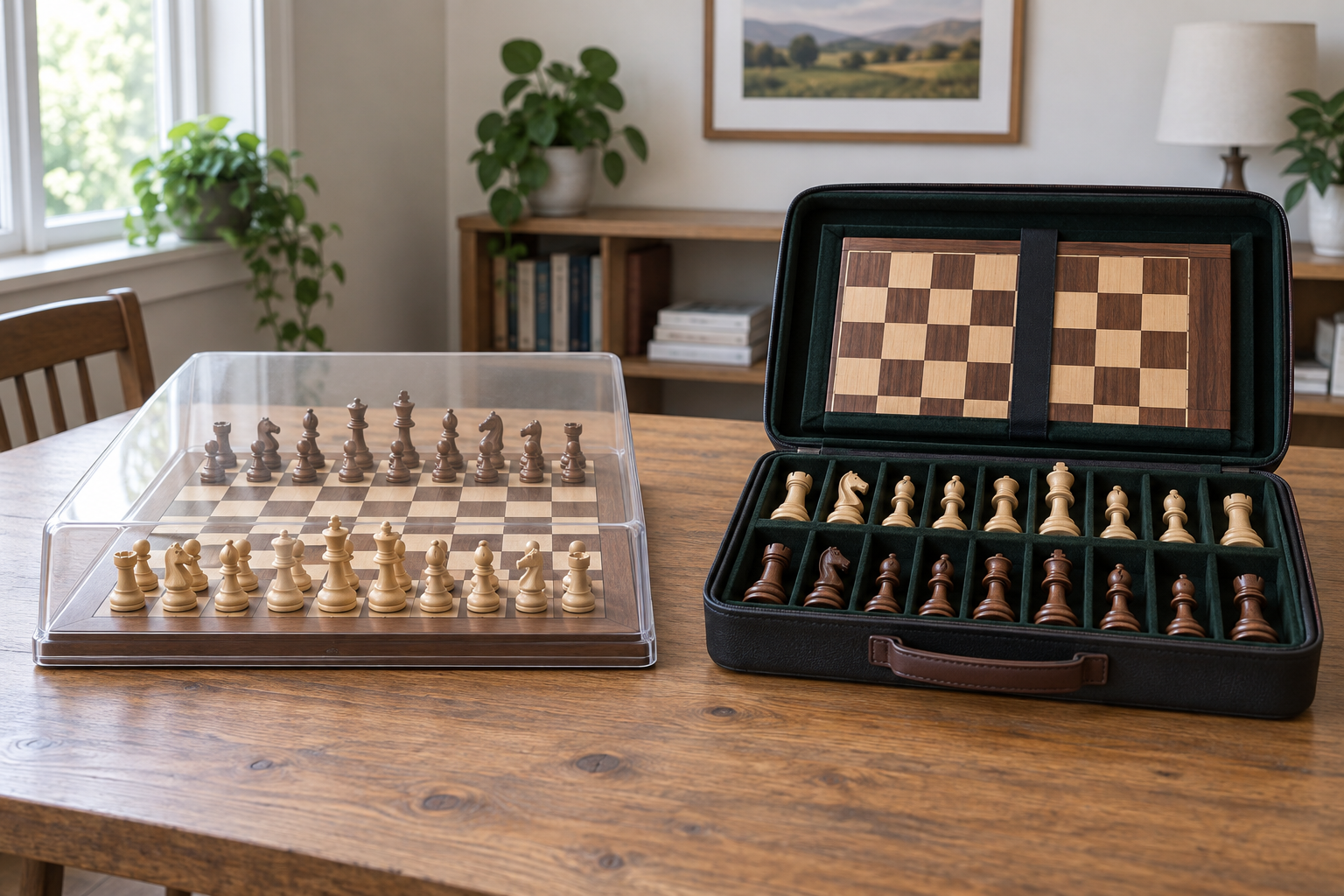
Choose for your between-game routine
Compare covered access with complete containment
For a cover, measure the assembled board and tallest piece. For a case, measure the board in its stored form, every piece compartment, and the closed case where it will live.
Quick decision
- Choose a dust cover when the board has a permanent, low-traffic surface and you play or study often enough to value a ready position.
- Choose a full storage case when the table serves other purposes, the set changes rooms, or loose pieces are regularly misplaced.
- Skip both for now when the original box closes securely, fits the shelf, and makes setup easy enough.
- Choose neither as a safety barrier. Ordinary covers and cases should not be assumed to protect against impacts, moisture, pets, children, theft, or long-term conservation needs.
The core tradeoff: resume quickly or clear the table
A fitted cover lets a finished setup or paused position remain visible. Removing one piece of covering is faster than rebuilding a position, and there is no packing order to remember. The cost is dedicated horizontal space: the covered board still occupies the full table or cabinet top.
A full case returns the surface to other uses and keeps the board and pieces together. It adds a setup and pack-away step, and a useful case must fit the board in its actual stored form. A folding board, sectional board, and one-piece rigid board create very different case dimensions.
Compare the practical tradeoffs
| Criterion | Dust cover | Full storage case |
|---|---|---|
| Next-game access | Position can remain assembled | Board and pieces must be unpacked |
| Surface use | Board keeps occupying the surface | Table can be cleared completely |
| Piece containment | Pieces remain upright, not individually secured | Compartments or bags can keep pieces together |
| Fit check | Internal width, depth, and height over the assembled set | Board format, piece compartments, closure clearance, and closed size |
| Relocation | Usually awkward with the position assembled | Designed around packed movement or shelf storage |
| Upkeep | Clean the cover and the exposed surface beneath it as directed | Recount pieces, inspect lining and closure, and air the case as its maker directs |
Measure a dust cover around the complete position
Measure the board's outside width and depth, including any frame or coordinate border. Then measure from the table surface to the top of the tallest king. Add only the clearance required by the cover maker or seller; do not assume an unverified allowance. Check whether seams, handles, sloped sides, or an inward lip reduce the usable interior.
Plan how you will lift and place the cover without touching pieces. A flexible cover may fold for storage but can drape inward. A rigid cover holds its shape but needs somewhere safe to sit during play. Neither format fixes an unstable table or a location where the board is likely to be bumped.
Measure a case around the packed set
Start with the board. Record the length, width, and thickness when it is folded, sectioned, rolled, or left rigid. Next, count all 32 starting pieces and any extra queens, markers, rule cards, or clock you expect the case to hold. Compare the tallest and widest pieces with stated compartment dimensions rather than relying on a generic “standard chess set” label.
Inspect the closure and carrying orientation. If pieces share an open compartment, ask what stops them from moving into the board space when the case turns upright. If every piece has a slot, make sure the shapes and base diameters match. A snug-looking product photo is not a measurement.
Who fits a dust cover?
A cover fits a home study desk, game table, or display surface that can remain dedicated to chess. It is especially useful when someone replays a game over several sessions or when frequent family play makes repeated setup irritating. For display-first choices, continue to the chess display-case guide, which addresses rigid enclosures rather than simple removable covers.
Skip a dust cover when the table must be cleared daily, the board sits near an edge or busy walkway, the cover lacks verified clearance, or you expect it to provide protection its maker does not claim. Also skip it if the empty cover would have no practical place to go during play.
Who fits a full storage case?
A complete case fits multipurpose dining tables, apartments with limited display surfaces, and homes where a set moves between a shelf and a playing area. It can also simplify a complete-piece check if compartments make empty positions obvious.
Skip a full case when your one-piece board exceeds available case sizes, the listed compartments do not match the pieces, or an original box already stores everything reliably. If only the loose pieces need organization, a chess piece storage bag may solve the problem without replacing the board's storage.
Setup and maintenance
For a covered board, remove ordinary surface dust according to the board, piece, and cover makers' instructions before replacing the cover. Do not trap damp cleaning residue beneath it. Lift rather than drag a rigid cover across the board, and inspect contact edges for debris that could mark a finished surface.
For a cased set, use the same packing order every time and count before closing. Let cleaned pieces dry fully before storage, follow material-specific care guidance, and inspect zippers, latches, straps, lining, and dividers before carrying the set. A case makes inventory easier only when every item has a known place.
Try the routine before buying
For one week, note how often the board is used, how often the surface must be cleared, and whether unfinished positions need to remain intact. Mock the cover's outside footprint with a clean box or measured paper outline; do not place an unsuitable container over valuable pieces. For a case, pack the current set into its original box and time the setup and return count.
If fast access matters and the surface stays free, a measured cover is the stronger fit. If reclaiming the surface and containing the complete inventory matter more, a measured case wins. If the current box already handles both jobs, keep it and spend nothing.
Bottom line
A chess board dust cover is for stationary, ready-to-resume play. A full storage case is for clearing, containing, and relocating the complete set. Measure the assembled shape for a cover and the packed inventory for a case, treat ordinary products as dust and organization tools rather than guaranteed protection, and skip the purchase when the original storage already supports your routine. For the wider decision about board format, pieces, readability, and storage, continue to the chess and checkers set buying guide.