
Giant chess and checkers pieces create a storage problem that ordinary board-game bins do not solve. The tallest chess piece, the total volume of every piece, and the route from the lawn to storage all matter more than a box's advertised gallon count.
This guide compares storage-box categories, not named winners or hands-on tests. An “outdoor” listing does not guarantee that a box, its contents, or its location can tolerate every kind of weather. Verify current internal dimensions, use limits, care directions, and placement instructions before buying.
The Good Chess & Checkers may earn commissions from qualifying purchases.
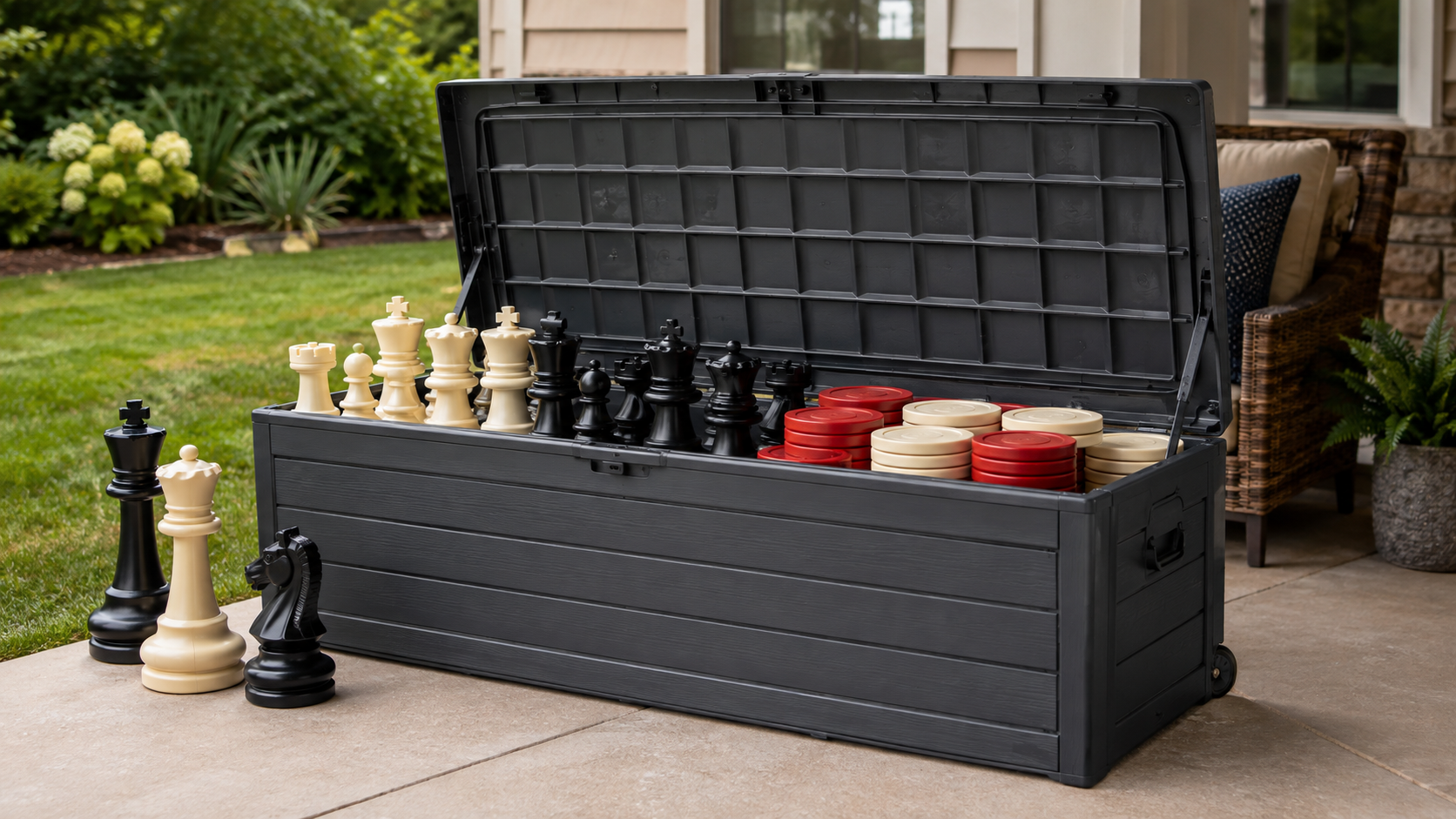
Quick decision aid
Measure the pieces before comparing boxes
Record the tallest piece, widest base or checker diameter, complete inventory volume, lid clearance, and the narrowest doorway on the storage route. Then compare usable internal dimensions, opening, wheels, handles, base design, and maker-approved placement.
Start with a complete inventory and a packing test
Count every chess piece or checker before measuring. Measure the tallest chess piece upright and the widest base, or the diameter and stacked height of the checkers. If the pieces are hollow or nest according to the set maker's directions, test that arrangement indoors in a cardboard mock-up. Do not assume all pieces can be piled without scuffs, deformation, or trapped moisture.
Compare the box's usable internal length, width, and height—not just its exterior measurements or headline capacity. Hinges, wheel housings, lid ribs, and tapered walls can reduce usable space. Leave enough room to lift pieces out without unloading the entire box.
Best for one large set: a wide-opening deck box
A horizontal deck box can keep one complete giant set together and make pieces visible during counting. Prioritize a lid that opens far enough for the tallest piece, an opening wider than the largest base, and internal dimensions that match a real packing plan. A divider or separate soft bins can keep chess colors apart or separate checkers from ground markers.
Best for: a family with one oversized set, nearby covered placement, and a short route to the playing area.
Skip it if: the box would block a walkway, pieces must be carried through stairs or narrow doors, or the maker does not approve the planned location and exposure.
Best for moving between storage and play: a wheeled box
Built-in wheels may help on a smooth, level route, but wheel diameter, handle location, loaded balance, and thresholds matter. Confirm the maker's current load and movement instructions. Measure gates and doors with the lid closed, and remember that a large box can be awkward even when the contents are light.
Best for: level patios, garages, or program spaces where the box moves a short distance as one unit.
Skip it if: the route crosses steps, deep gravel, soft lawn, steep slopes, or tight turns. Smaller labeled totes may be easier to carry in stages.
Best for mixed chess and checkers inventory: a divided system
One large box is only useful if each game can be found and counted. Use removable, breathable inner bags or bins sized to the pieces, and label them by game and color. Keep boards, mats, stakes, rule cards, and repair supplies in their own measured section so hard accessories do not press against the pieces.
Best for: families, clubs, or venues storing giant chess and checkers together.
Skip it if: a single oversized container makes every session an all-or-nothing unpack. Two smaller boxes may create a clearer check-in routine.
Placement, drainage, and care questions to verify
- Approved location: check whether the manufacturer permits the box to remain in the intended covered or exposed area.
- Base and drainage design: inspect the current product information and installation directions; drainage features do not prove that contents will stay dry.
- Ventilation: follow the piece-set and box makers' care guidance. Put pieces away clean and dry when those instructions require it.
- Sun and temperature: do not infer UV, heat, cold, or fade resistance without an explicit current specification.
- Lock provision: a latch or padlock hole is not a security guarantee. Follow the maker's instructions and local site policies.
- Surface: use only the stable, level base and clearances required by the box manufacturer.
Pre-purchase measurement sheet
- Count the full piece inventory and note any board, mat, stakes, or king markers that must share the box.
- Measure the tallest piece, widest piece or checker, and a realistic packed arrangement.
- Record the box's usable internal dimensions, lid opening, exterior footprint, and closed height.
- Measure every door, gate, shelf, corner, and threshold along the route.
- Check current load, placement, assembly, movement, cleaning, and exposure instructions.
- Plan labels and a count-before-close routine so missing pieces are noticed immediately.
Who should skip a dedicated outdoor box?
Skip it when the giant set already includes a fitted carrier, the pieces can be stored safely indoors on an existing shelf, or play happens too rarely to justify the footprint. Also skip one-box storage when several lighter containers would make counting and carrying simpler. For ordinary tabletop equipment, use the family chess and checkers storage guide instead.
Bottom line
The most useful giant-piece storage box is the one proven to fit a complete measured inventory and the real route to play. A wide-opening deck box suits one nearby set, wheels may help on a smooth level path, and internal dividers help mixed-game inventory. Verify dimensions and maker instructions, plan for dry piece storage, and choose smaller containers when a single large box would be harder to move or manage.