
Choose capture puzzles when a beginner needs focused practice finding a required jump or tracing a multi-jump sequence. Choose full-game review when the learner can make legal moves but needs to see how earlier choices created—or prevented—a capture. Neither routine guarantees improvement, and neither requires buying a book or app.
This guide uses English/American checkers rules. Under that ruleset, a capture must be made when available, a capturing piece continues while another capture remains open to it, and a player may choose among available capture routes. One exception to continuation applies when a man reaches the king row during a capturing turn: that turn ends there, and the piece does not make another jump as a king until a later turn. Other draughts variants can handle capture choice, board size, kings, and promotion differently, so label the ruleset on every exercise.
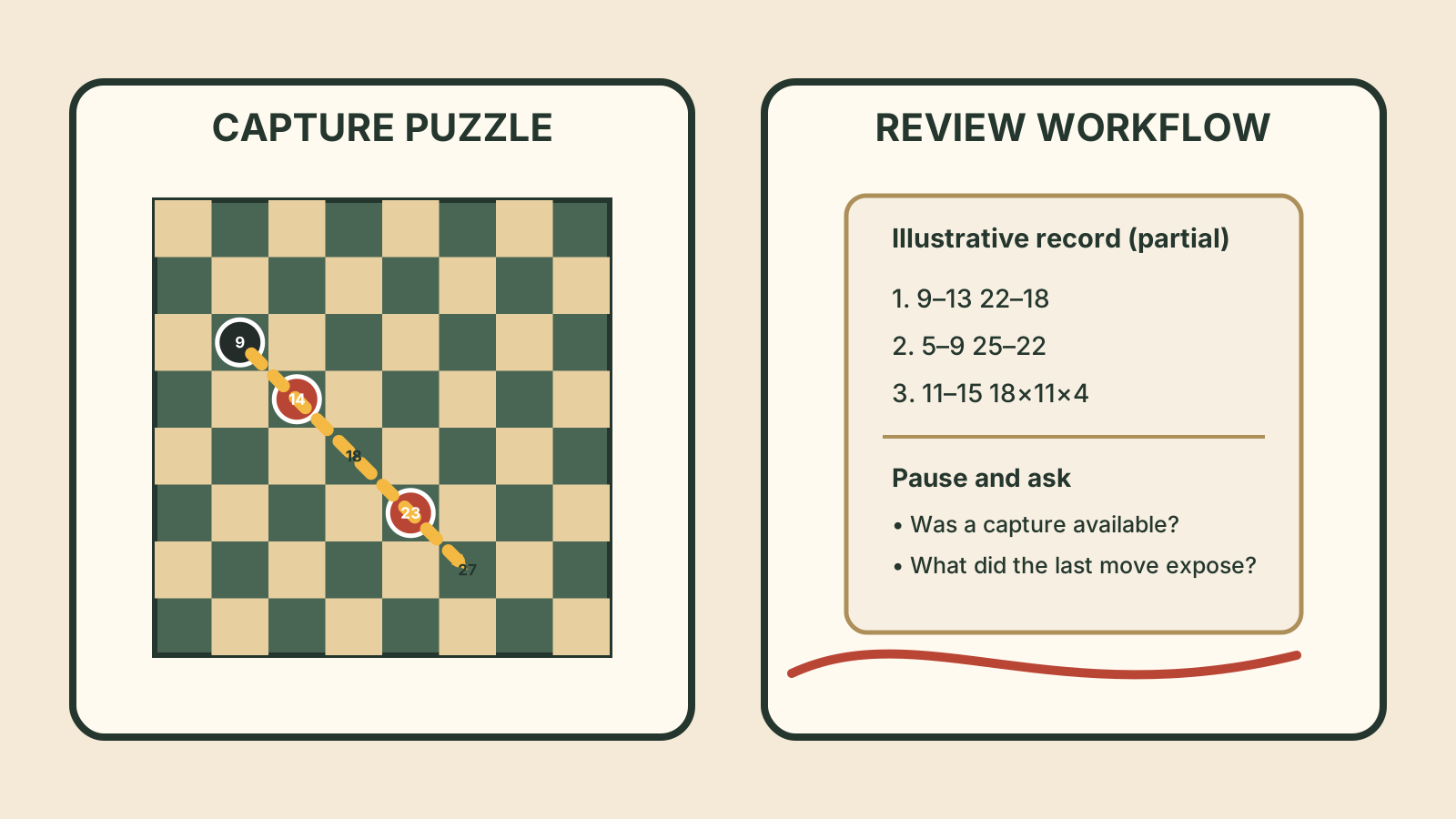
Quick decision
- Use capture puzzles when the learner overlooks available jumps, stops a multiple jump early, or needs a short task with a checkable answer.
- Use full-game review when the learner can spot nearby jumps but cannot explain how pieces became exposed or trapped.
- Combine them by extracting one turning-point position from a game, solving it as a puzzle, then restoring the earlier moves.
- Skip both for now when board orientation, ordinary movement, capture direction, or king movement is still unclear.
Option A: isolated checkers capture puzzles
A capture puzzle begins from a selected position and asks the learner to identify every legal capture, choose a route, or finish a multiple jump. Its strength is a narrow question: whose turn is it, is a jump required, where can the piece land, and can that same piece jump again?
The tradeoff is missing context. A puzzle rarely shows why the vulnerable pieces reached those squares, whether the position arose legally, or what the player gave up one move earlier. A learner can also start expecting every turn to contain a forced capture.
Setup and maintenance
Record the ruleset, side to move, king status, complete piece placement, task, and full answer. On a physical board, leave the captured pieces in place while tracing the complete multiple-capture sequence, then remove all of them when the sequence ends. Reset before trying another route. Retire an exercise if its diagram is ambiguous or its answer does not account for every legal capture.
Option B: move-by-move full-game review
Full-game review starts from the normal opening position and replays a complete recorded game. The learner pauses at a few decisions to ask: Was a capture available? What changed on the previous move? Which piece became exposed? Did the chosen move create a future route to the king row?
The tradeoff is effort. A complete record takes longer to replay, and square-number notation can overwhelm someone who is still learning legal moves. As an editorial starting routine, try three well-chosen pauses on the first pass instead of attempting to annotate the entire game; adjust that number to the learner and the game.
Setup and maintenance
Use a complete record that names its ruleset and notation system. Verify the initial orientation, replay one move at a time, and mark only a few decisions on the first pass. Keep the original record separate from the learner's notes so the game can be reset accurately.
Compare the practice jobs
| Decision | Capture puzzles | Full-game review |
|---|---|---|
| Main task | Find and complete legal captures in one position | Trace how decisions connect across a game |
| Rules prerequisite | Movement, captures, multiple jumps, and kings | The same rules plus the record's square notation |
| Setup | One exact position | Starting position and a complete move record |
| Answer check | All legal capture routes and landing squares | Legal replay plus explanations at selected turns |
| Context | Low unless the source explains the setup | High because earlier and later moves remain visible |
| Best fit | Short, focused capture checks | Longer cause-and-effect discussion |
A rules-safe capture exercise
This is an original teaching position under English/American checkers rules, not a recorded game. Use dark-square numbering with Black moving first: place a black man on square 9 and white men on squares 14 and 23; leave squares 18 and 27 empty. Remove all other pieces.
- Ask whether Black may make an ordinary move. The answer is no: the capture from 9 over 14 to 18 is available.
- Continue the complete sequence from 18 over 23 to 27, leaving both captured checkers on their squares while the move is in progress. Once 9x18x27 is finished, remove the white checkers from 14 and 23.
- Reset the position and ask the learner to name both landing squares before touching the piece.
The exercise isolates the required-capture and continuation rules. It does not teach strategy, prove that this position occurred in a game, or apply unchanged to every draughts variant.
A two-session no-spend trial
- For session one, use three clearly labeled English/American capture positions. Before moving, have the learner list every available first jump and trace each complete route.
- For session two, replay one complete game record under the same ruleset. Pause before three captures or missed opportunities and ask what the previous move changed.
- After each session, record setup time, rules questions, answer-checking problems, and one position the learner can explain without prompts.
- Repeat the routine that produces a clear next question. Alternate the two when focused capture work and game context are both useful.
Original review worksheet
- Ruleset and board-numbering system
- Side to move; man or king
- Every capture available before moving
- Complete route and captured squares
- What the previous move exposed or protected
- What changes after the capture finishes
- One position to reset and explain next time
Answer-quality and skip checks
Reject a puzzle that omits the side to move, king status, ruleset, or complete answer. Reject a game record that cannot be replayed legally or never explains its numbering. Skip capture puzzles when the learner guesses by moving pieces until something works. Skip full-game review when notation and setup consume the whole session. Skip paid resources while the rules guide, a family game record, or a lawful sample is enough to test the routine.
Sources and boundaries
The World Checkers/Draughts Federation Rules of Checkers supports the English/American rules used here: play on numbered dark squares, compulsory capture, continuation of a multiple capture with the same piece, and choice among available capture routes. The source does not support claims that either practice method improves learning, and none are made. The exercise, trial, comparison, prompts, and worksheet are original editorial material.
Next steps
If the learner still needs the rules, start with how to play checkers and the focused guide to forced captures. To choose between English/American rules and a different family of draughts, compare American checkers with international draughts. If the practice method is settled but the print format is not, compare a checkers puzzle book with a strategy book.
Bottom line
Capture puzzles fit short, checkable work on required jumps and complete routes. Full-game review fits a beginner who needs cause, context, and consequences. Use one named ruleset, demand a complete answer or legal record, and test both routines before choosing a paid resource.