
Choose a large poster when the whole group needs the same short reminder at once; choose tabletop cards when pairs need to solve ordinary rule questions without waiting for the teacher. The useful choice depends on viewing distance, the number of boards, which checkers variant you teach, and who distributes and collects the aids.
This is a product-category comparison, not a ranking of named teaching materials or a claim of hands-on testing. Inspect every visible rule before buying, because checkers and draughts traditions can differ on capture priority, king movement, board size, and starting setup.
As an Amazon Associate, The Good Chess & Checkers may earn from qualifying purchases.
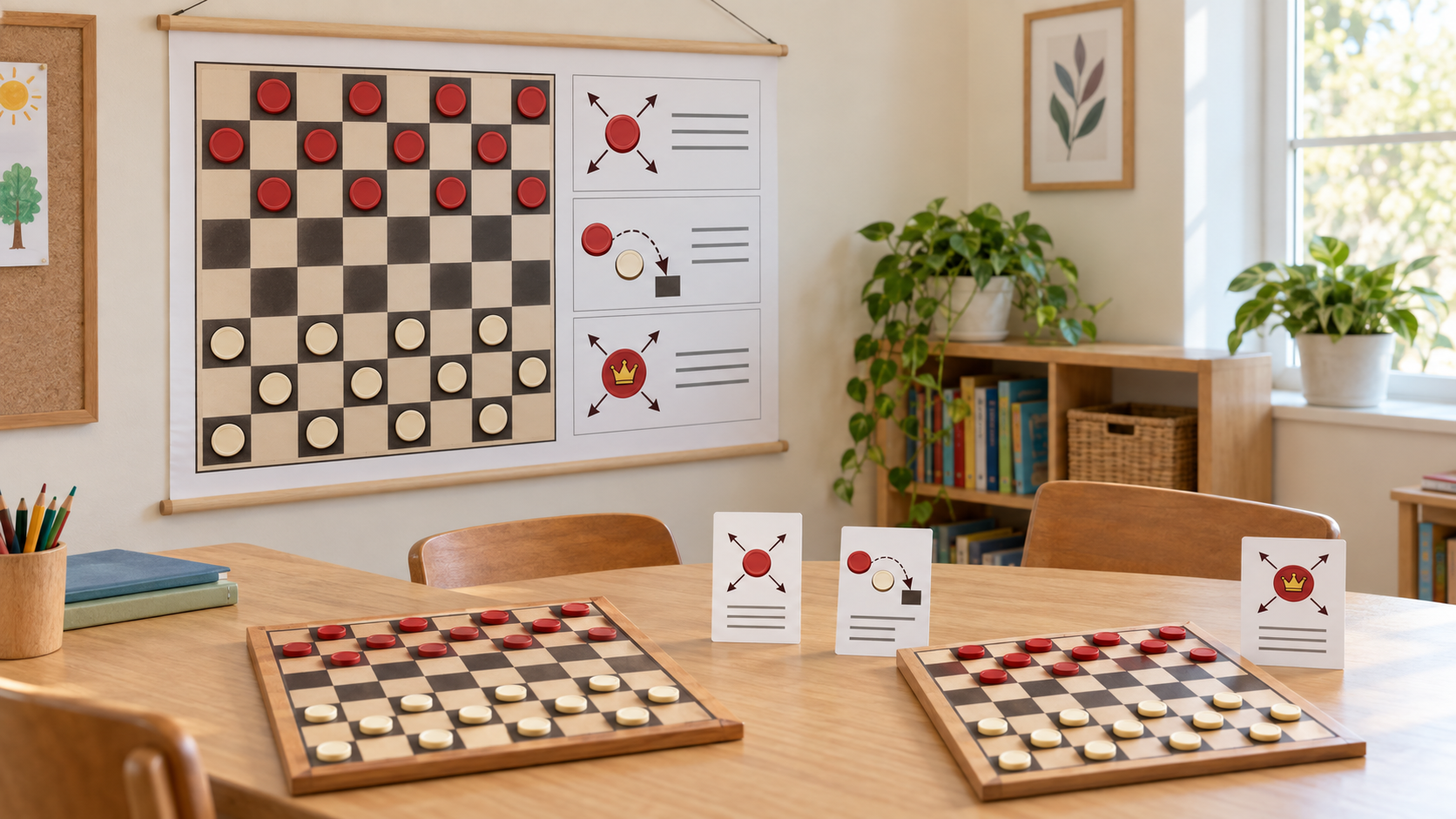
Match the reference to the group
Compare shared displays with board-level prompts
For a poster, verify its board diagram, rule scope, print size, mounting method, and readability from the farthest seat. For cards, check the same rules plus card quantity, diagram size, wipeability, and how each set stays with its board.
Quick decision
- Start with a poster when one instructor demonstrates setup, legal movement, captures, and kinging to several tables at the same time.
- Start with cards when pairs begin at different speeds and need a nearby prompt during play.
- Use both when the poster anchors the shared ruleset and one compact card at each board handles the questions that recur during games.
- Buy neither yet when a clear printed sheet you already control can test the lesson before you purchase multiple aids.
What a poster does well
A large display gives everyone one visual target. It works well for opening instructions, room-wide corrections, and a short reset check before pieces return to their starting squares. Once mounted, it requires little distribution time and cannot go missing inside an individual set box.
The tradeoff is distance. A crowded poster may look comprehensive from the front while its arrows, captions, or dark-square orientation disappear from the far table. It also cannot sit beside every disputed jump. Measure the intended wall space and viewing distance; do not treat “classroom size” as a usable dimension.
What tabletop cards do well
A reference card lets a pair check a move, capture, or king reminder without stopping the entire room. Cards can be distributed only to new players, placed beside selected boards, or arranged in a short teaching sequence. This supports learner independence better than asking everyone to turn toward one wall.
Cards create more moving parts. The group needs enough copies, a consistent location that does not cover board squares, and a count-and-return routine. A small card can also become unreadable when a publisher compresses too many variants or diagrams onto it.
Compare the lesson workflow
| Criterion | Shared poster | Tabletop cards |
|---|---|---|
| Best viewing job | One explanation for the whole room | One prompt for a learner or pair |
| Rule detail | Must stay brief enough to read at distance | Can hold a little more detail at arm's length |
| Setup | Mount or display once in a stable room | Place and collect a card at each selected board |
| Storage | Needs flat or rolled protection | Needs a labeled envelope, ring, box, or pouch |
| Learner independence | Requires looking away from the board | Keeps the reminder beside the position |
| Portability | Awkward unless designed to roll safely | Easy to divide among kits, but easy to misplace |
Verify the ruleset before the format
First confirm the board and starting layout shown on the aid. Then inspect how it explains ordinary diagonal movement, captures, multiple jumps, reaching the king row, and how kings move. The aid should name its variant or clearly state the rules it uses rather than implying that every form of checkers is identical.
Pay special attention to forced captures and capture choice. Local, family, national, and international rules can differ. If the group uses a house rule, add a separate, clearly labeled note instead of silently contradicting the purchased reference. The forced-jump guide for families explains why agreeing on the rule before play matters.
Measure readability in the real room
Print one sample diagram at the proposed poster size and view it from the farthest seat. For cards, print the same diagram at the listed card dimensions and place it beside a board under ordinary room lighting. Check whether players can distinguish playable dark squares, move direction, jump arrows, and king symbols without picking up the aid repeatedly.
Avoid using color alone to carry a rule. Arrows, outlines, piece shapes, and short labels should remain understandable for readers who see the palette differently or when the print is viewed under uneven light.
Setup, care, and maintenance
Posters need a permitted display location and a mounting method appropriate to the product and room. Store an unmounted poster flat or in a tube wide enough to avoid tight curling. Follow the maker's cleaning directions; a laminated surface is not automatically compatible with every marker or cleaner.
Number card sets and their containers, especially when one deck contains several prompts. Keep a full sample set with the instructor's materials and count board-level cards during pack-up. If a card must remain beside each set, confirm that the set's box or bag closes without bending it.
Who should skip each option?
Skip a poster when the group changes rooms often, no approved display space exists, or the farthest learners cannot read the verified print size. Skip tabletop cards when the program cannot reliably distribute and collect them, when diagrams are too small, or when one instructor-led demonstration is the actual lesson need.
Skip both commercial options if their visible rules do not match the variant you teach. A simple instructor-made sheet can be the safer next step because you can state the chosen capture and king rules plainly, test readability, and revise it after one session.
Next steps for a complete group setup
Once the reference format is chosen, use the checkers demonstration-board guide if learners also need to follow positions across the room. For boards, pieces, labels, storage, and reset routines around both games, continue with the classroom and club station guide.
Bottom line
A checkers rules poster is strongest as one stable, readable anchor for shared instruction. Tabletop cards are stronger as compact prompts that keep pairs moving independently. Verify the ruleset, test real viewing distance, plan storage and collection, and choose the format that solves the recurring lesson problem rather than the one that simply contains more information.