
An online chess course can be worth it after you know the legal moves, can finish a slow game, and want a clearer sequence than scattered videos or puzzles provide. It is usually worth delaying when you still need the basic rules, have not used available free lessons consistently, or cannot inspect the syllabus and access terms before paying.
This verdict is about a structured, multi-lesson course—not a general chess-app subscription, one live lesson, or an unconnected collection of videos. A course earns its place by solving a sequence problem: what to learn next, at an understandable level, in a format you will actually revisit.
The Good Chess & Checkers may earn commissions from qualifying purchases.
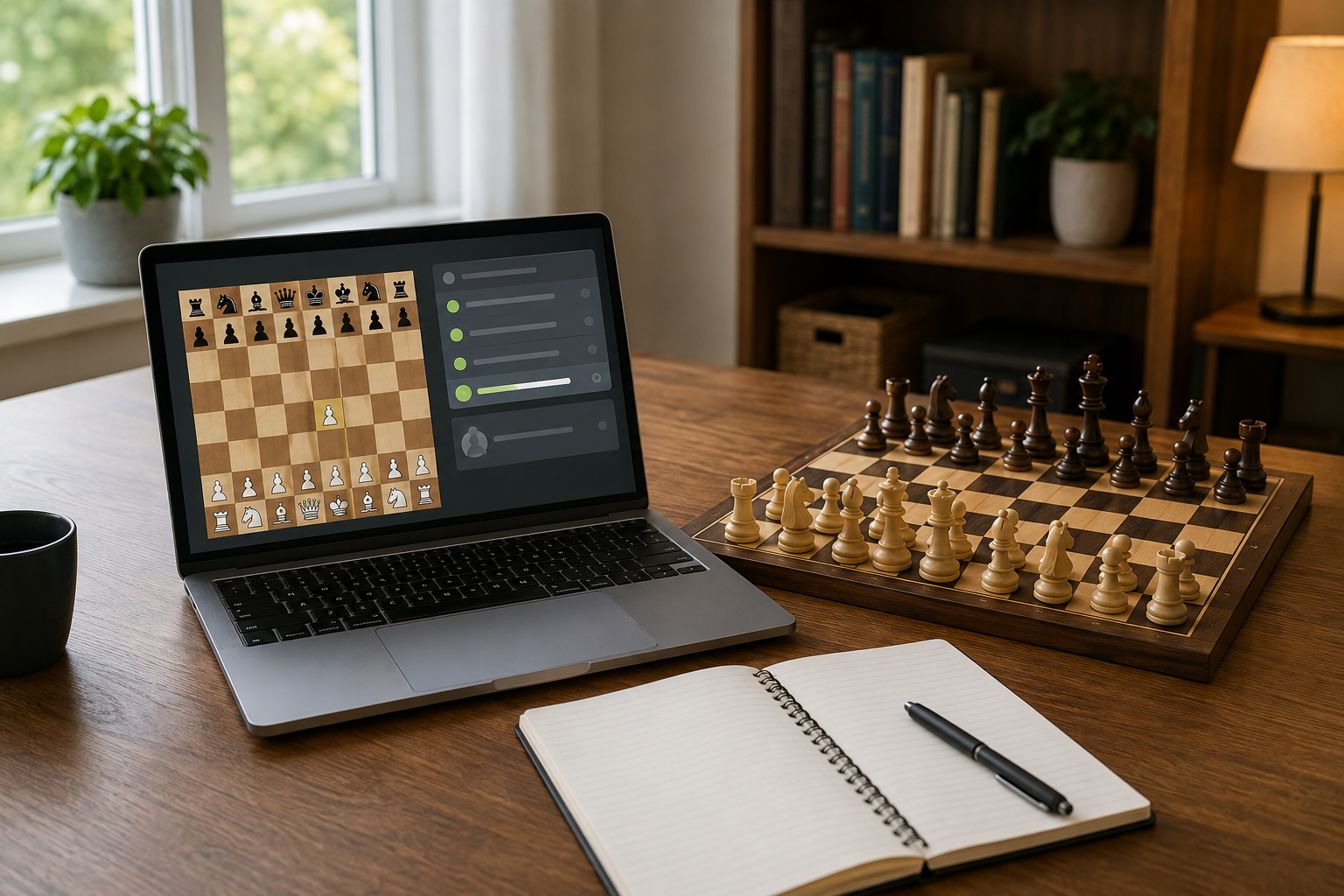
Quick decision aid
Keep a fixed, physical study path in the decision
A beginner book and ordinary board can provide an ordered curriculum without an account or recurring access. Compare the assumed level, diagrams, notation help, exercises, and explained answers rather than choosing by length alone.
Quick verdict: enroll, sample, borrow, delay, or skip
- Enroll when the published syllabus begins at your level, sample teaching makes sense to you, access and payment terms are clear, and you have a scheduled study routine.
- Use a free sample first when you are unsure about the instructor's pace, notation assumptions, video style, or exercise feedback.
- Borrow a beginner book when you want an ordered path but do not need video, interactive checks, or an account.
- Delay when you cannot yet play a complete legal game or have not completed a short free learning plan.
- Skip when you prefer casual play, already have an unused learning backlog, or are buying because of outcome promises rather than a specific curriculum fit.
Six checks before paying
1. Confirm the real starting level
“Beginner” can mean anything from learning the rook's move to studying opening principles and simple tactics. Read the published prerequisites and lesson list. If those are unavailable, you cannot reliably tell whether the first useful lesson is near the beginning or buried inside material you already know.
2. Inspect a complete sample lesson
A trailer shows presentation; a lesson shows teaching. Look for a clear position, a plain-language explanation, a chance to apply the idea, and an answer that explains mistakes. Check whether notation is introduced or assumed. Do not infer the whole course from testimonials or a polished sales page.
3. Match the format to how you learn
Video can demonstrate ideas smoothly, but it is easy to watch without practicing. Interactive questions create pauses, but their feedback may be brief. Downloadable notes can help review, but only if the current course explicitly includes them. Decide whether you will replay positions on a board, take notes, or answer exercises before moving on.
4. Read current access and payment terms
Use the provider's official pages to verify the current charge, billing period, what is included, account requirements, access duration, device support, cancellation process, and any stated refund or trial terms. These details change, so an old review or search snippet is not enough.
5. Check the course boundary
A focused course does not need to cover everything. It should say what it teaches and where it stops. An absolute beginner benefits more from a manageable sequence—legal moves, checks, basic safety, simple tactics, and complete games—than from a huge library with no obvious next lesson.
6. Define a finishable routine
Estimate sessions, not aspiration. A practical plan might be two short lessons per week, with one position replayed on a board after each lesson. If the course assumes more time than you can give, a smaller free guide or book chapter may be the more useful choice.
A free readiness test
- Learn how every chess piece moves, including castling and promotion.
- Play three complete, slow games without needing repeated help for legal moves.
- Choose one basic topic and complete three free lessons or guide sections in order.
- After each session, replay one example on a physical board and write one sentence about it.
- Record where the free route becomes confusing, disorganized, or too shallow.
- Check whether a prospective course's published syllabus and sample lesson directly address that gap.
If you do not complete the free sequence, solve the routine problem before buying more material. If you do complete it and can name the missing structure, you have a much better reason to consider a course.
How this differs from a chess app subscription
A course is primarily a curriculum purchase: a defined path through a subject. An app subscription may bundle games, puzzles, analysis, short lessons, and other tools without making one course the center of the decision. If you mainly want a broad set of recurring app features, use the separate guide to decide whether a chess app subscription is worth it for a beginner.
Either format can use video or interactive exercises, and neither guarantees improvement. Judge the exact current offering by its official syllabus, samples, terms, and fit with your routine.
When a book, private lesson, club, or free guide is better
Choose a book when you want a stable sequence, easy reference beside a board, and no access deadline. First compare a chess book with an online course, then use the beginner chess lesson-book verdict to decide whether print earns shelf space.
Consider a private lesson when the main need is personal feedback on a specific recurring problem, not a general curriculum. Use the separate guide to decide whether private chess lessons are worth it for an absolute beginner.
Choose casual human play when your main gap is making decisions through a whole game. Ask a patient player to review one or two moments afterward rather than turning every move into a lesson.
Use free guides when you are still learning setup, legal moves, checks, and the rhythm of a game. Paid structure is easier to evaluate once you can identify what the free path is missing.
Who should skip an online chess course?
- Absolute beginners who still need frequent help making legal moves.
- People who prefer playing to studying and do not want scheduled lessons.
- Learners with several unfinished books, courses, or saved video series.
- Anyone who cannot view a useful syllabus or sample before purchase.
- Buyers who have not confirmed current billing, access, cancellation, and refund terms on the provider's official pages.
- Anyone expecting enrollment alone to guarantee a rating, result, or fixed pace of improvement.
Bottom line
An online chess course is worth considering when an absolute beginner has moved beyond the legal moves, follows a repeatable study routine, and needs a sequence that a specific, inspectable course supplies. Sample the teaching, verify the syllabus and current terms, and decide how each lesson will turn into board practice.
Delay or skip when the need is still vague. A free guide, borrowed beginner book, ordinary board, and a few complete games can reveal whether your real problem is missing structure, missing practice time, or simply needing more play.
The planned beginner-chess pillar is not yet built. For now, continue with the site's beginner set guide if you need a readable physical board for study.