
A scuffed felt pad and a loose chess-piece base are not the same repair. Felt pads replace the soft contact layer beneath an otherwise sound piece. A full base repair addresses the structure below the piece, which may include a separate base part, weight, cover, or attachment method. Diagnose the defect before shopping: the safest answer may be a matching replacement piece rather than either repair.
This guide is a buying framework, not a restoration tutorial. Chess pieces use different materials and constructions, and a covering can hide hardware or a weight cavity. Follow the set maker’s instructions when available, and do not open a base whose construction you cannot identify.
As an Amazon Associate, The Good Chess & Checkers may earn from qualifying purchases.
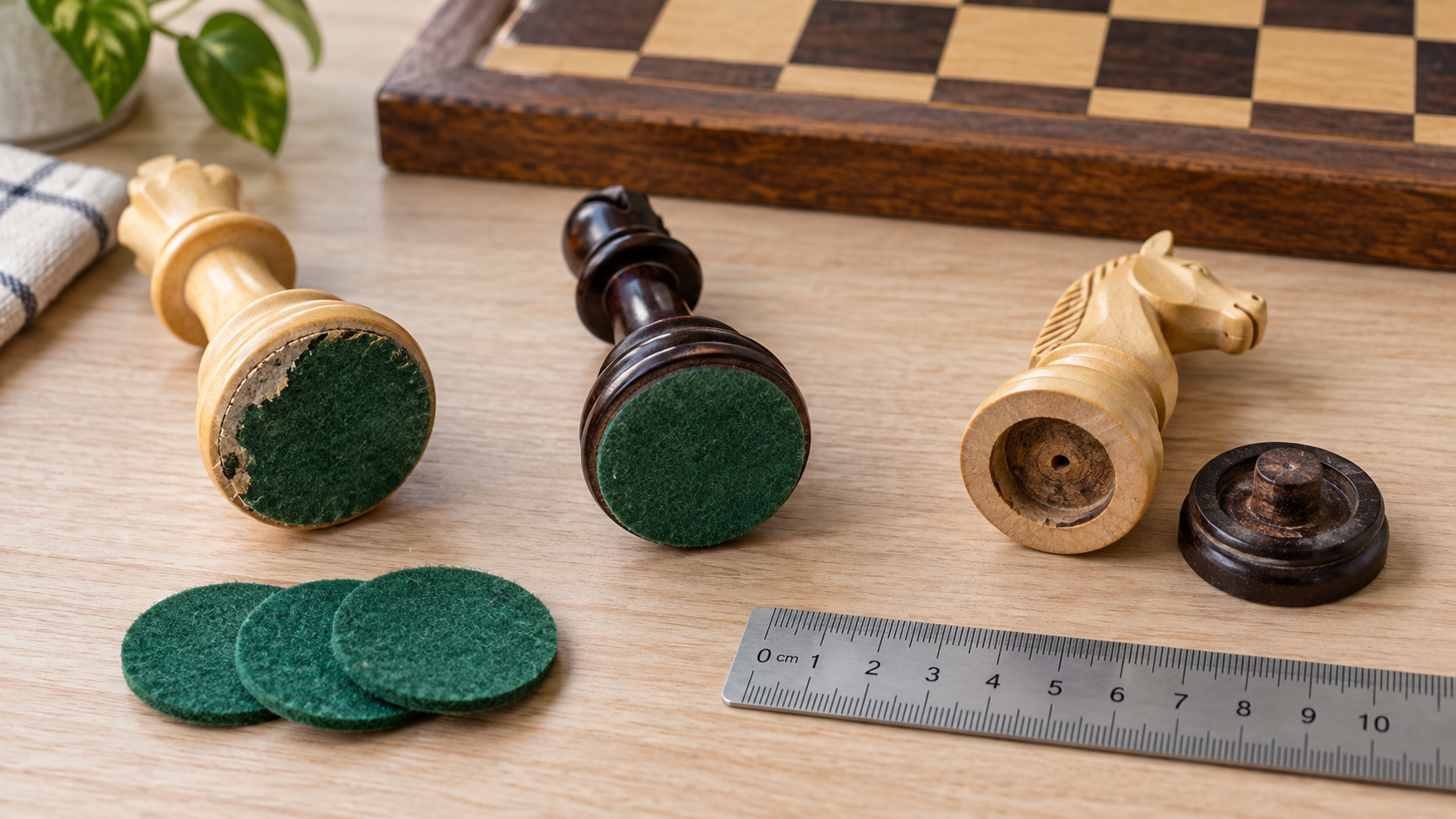
Identify the failed layer first
Compare measured repair parts—not universal-fit labels
For surface wear, compare felt by actual diameter, thickness, material, and attachment instructions. When the base itself is loose, cracked, incomplete, or conceals unknown hardware, look for maker-supported parts or a dimension-matched replacement piece instead of improvising.
Quick decision
- Choose replacement felt pads when only the contact layer is worn or missing and the piece body, base, and any concealed parts remain firm and understood.
- Consider a maker-supported full base repair when a documented removable base part is damaged and the correct compatible assembly and instructions are available.
- Choose a complete replacement piece when the base is cracked, loose, altered, poorly documented, or difficult to match without opening an unknown construction.
- Pause the project when the set may be collectible or the repair would disturb a weight, fastener, finish, or material you cannot identify.
Start with the defect, not the product name
Turn several pieces over on a clean surface and compare them without taking anything apart. A worn contact layer may look thin, frayed, shifted, or partly missing while the surrounding base remains firm. A structural problem may show as a loose lower section, a crack, a wobble that remains after visible debris is removed, or a gap between joined parts.
Do not assume wobble always means the felt is too thin. Uneven felt, a distorted base, a loose assembly, or damage higher in the piece can create a similar symptom. Compare the affected piece with an undamaged piece of the same type before ordering anything.
When felt pads are the smaller, clearer repair
Felt is the more limited choice because it changes only the surface touching the board. Measure the flat contact area on each affected base; pawns and larger pieces may need different diameters. Check the seller’s stated pad diameter, thickness, material, adhesive format, quantity, and application guidance. “For chess pieces” is not a measurement.
A pad should fit inside the base edge rather than overhang it. Replacing one visibly different pad can also leave one piece sitting or sliding differently from its peers, so compare thickness and color with the rest of the set. The dedicated felt-pad buying guide explains pre-cut circles and sheets in more detail.
Why a full base repair needs stronger evidence
“Replacement base” can describe very different parts. Some pieces may have a documented separate lower component; others may combine the base, body, weight, fastener, and covering in ways that are not intended for routine repair. Buy a base assembly only when the maker or seller identifies the compatible piece or supplies every dimension and attachment detail needed to confirm the match.
Compare outer diameter, height, attachment method, color, material, and any stated weight information. A part that physically attaches can still change the piece’s height, balance, appearance, or storage fit. If those facts are missing, a complete replacement piece is the more predictable category to investigate.
Measure a replacement piece as a third option
A matching piece avoids uncertain structural work, but it brings its own fit problem. Record the piece type and color, overall height, base diameter, shape, finish, and any maker or set identifier. Compare photographs carefully and ask whether the seller gives actual dimensions rather than a vague size label.
For a club or classroom with several standardized sets, keeping compatible spare pieces may be simpler than stocking different base assemblies. For a distinctive home set, a visibly imperfect but stable original may be preferable to an obvious mismatch. The replacement-piece guide covers this broader decision.
Comparison checklist
- Failure layer: contact felt, structural base, or the entire piece.
- Measured fit: contact diameter for felt; all listed dimensions for a base or piece.
- Compatibility evidence: maker identification, model details, drawings, and clear underside photos.
- Construction: known material and attachment method without guessing what is hidden.
- Consistency: finished height, base width, color, shape, and feel beside the rest of the set.
- Tools and instructions: only those explicitly supported for the part and piece construction.
- Fallback: a complete matching piece, professional assessment, or leaving a stable piece unchanged.
Who should skip a do-it-yourself base repair?
Skip it when the base is cracked, the piece rattles, a weight or fastener may be involved, the maker offers no compatible part or instructions, or the set has collectible or sentimental value. Also skip any supposed universal base that provides no dimensions or construction details. This is a fit decision, not a place to experiment on an irreplaceable set.
Bottom line
Use felt pads for a clearly isolated surface-layer problem on an otherwise sound piece. Consider a full base assembly only when compatibility and construction are documented. When damage extends beyond the felt or the base design is uncertain, measure for a complete replacement piece instead. For a wider view of piece bases before buying a new set, compare felted and bare-base chess pieces and return to the main set-buying guide.