
Start with piece identification cards when the learner still mixes up piece names or movement patterns. Choose compact rule cards once the six pieces are familiar and the learner needs quick help during a complete game. They look similar on a shopping page, but they solve different stages of learning.
This comparison covers generic printed teaching aids, not named decks we tested. The most useful choice depends on visible card content, accurate movement examples, readable size, and how the cards will be used beside a real board.
The Good Chess & Checkers may earn commissions from qualifying purchases.
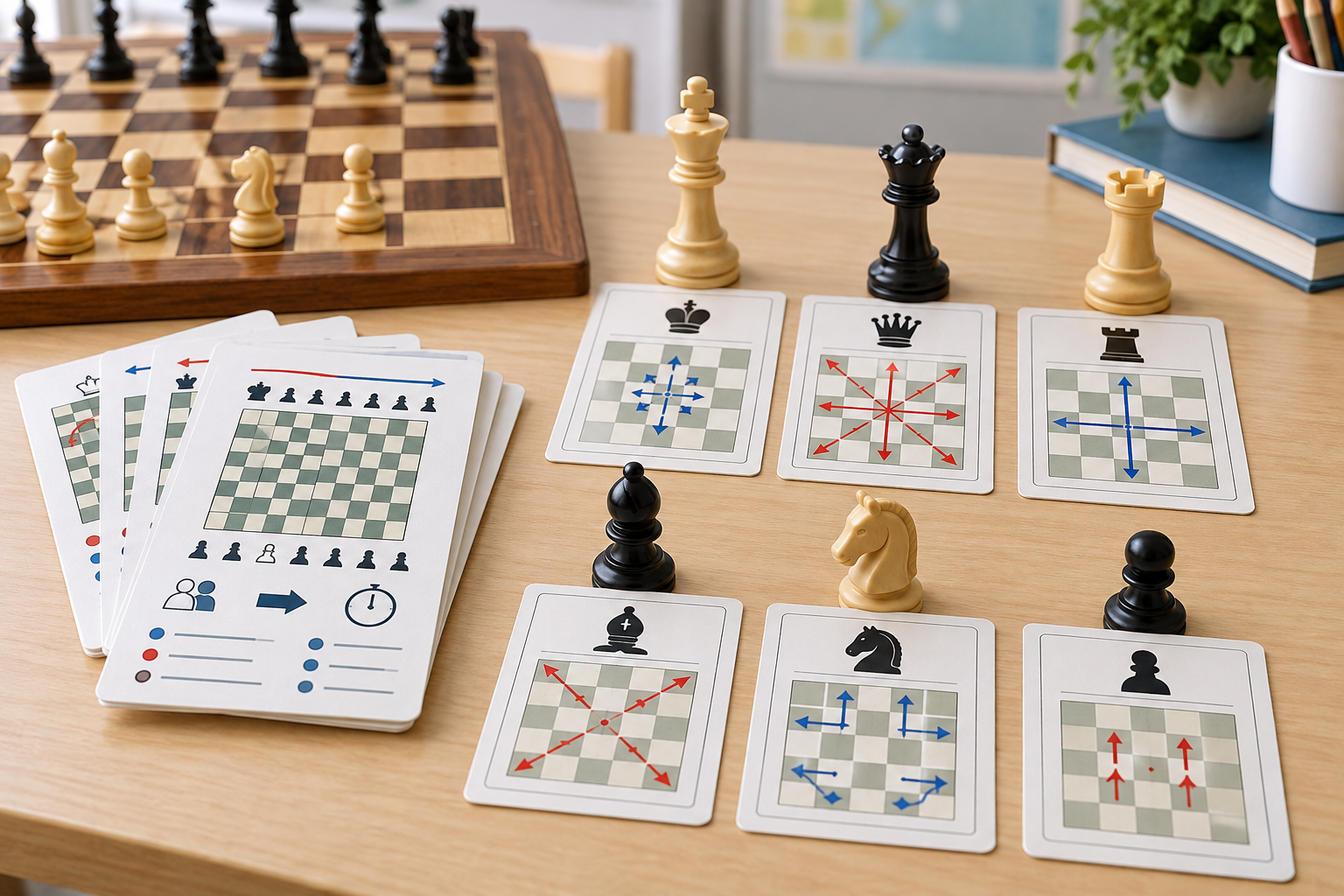
Quick decision aid
Compare both card formats
For rule cards, inspect the full visible reference and make sure it covers the beginner's ruleset without crowding. For piece cards, confirm all six piece types, familiar symbols, accurate movement limits, and a lesson sequence that works beside real pieces.
Quick decision
- Choose piece identification cards first when names, silhouettes, and ordinary legal moves are not yet secure.
- Choose compact rule cards when the learner can move the pieces but forgets setup, captures, check, castling, promotion, or another game rule.
- Use both in sequence for a teaching group: piece cards during short drills, then one rule card beside each board during a first complete game.
- Skip both purchases if a clear printed page and homemade index cards already provide readable, accurate prompts.
How the two card types differ
Piece identification cards isolate one concept. A card typically names a pawn, rook, bishop, knight, queen, or king and shows that piece's ordinary movement. The learner can match the card to a real piece, place it on an uncluttered board, and try a few legal destinations.
Rule cards compress several concepts. A small reference may cover setup, turns, captures, check, checkmate, castling, pawn promotion, and notation. That breadth is useful during a game, but it can overwhelm someone who is still asking which piece is the bishop.
Neither format replaces board practice. A learner needs to move pieces, encounter blockers and captures, and explain why a destination is legal or illegal. Cards are prompts, not a complete course.
Choose by the beginner's next problem
The learner cannot reliably name or move the pieces
Use identification cards. Begin with rook and bishop to contrast straight and diagonal movement, add the queen, then teach king, knight, and pawns. Put only the relevant piece and a few blockers on the board so the card's diagram becomes a physical action.
A general rule card is too dense at this stage. The learner may find the right line of text without building a usable movement pattern.
The learner knows the pieces but stalls during a full game
Use a compact rule reference. It should make common lookups fast without pretending every exception fits into one tiny diagram. A useful first-game card clearly separates ordinary movement from special rules and tells the reader when a fuller explanation is needed.
Piece cards will be repetitive if recognition and ordinary movement are already automatic. Keep one available only for the movement pattern that still causes trouble.
Several beginners are learning together
For direct instruction, larger piece cards can be held up, sorted, and assigned to pairs for short activities. For independent games, one compact rules reference per board is usually easier than distributing six or more piece cards to every pair.
Measure visibility rather than relying on a label such as “classroom size.” A card intended for one reader at arm's length may not work as a group display. For teaching across a room, compare a chess lesson poster with flash cards.
What to verify before buying either format
- Visible contents: inspect actual card faces or a publisher preview, not only the box or title.
- Movement accuracy: pawns move forward and capture diagonally; sliding pieces cannot jump; knights can jump; kings cannot move into check.
- Scope: distinguish piece movement, whole-game rules, tactics, openings, puzzles, and notation. Those are different products.
- Readable dimensions: verify physical card size, print contrast, diagram size, and viewing distance.
- Prerequisites: reject cards that assume algebraic notation or tactical vocabulary the learner has not learned.
- Rules context: a short reference may omit special cases. Keep a reliable full explanation available when a card simplifies a rule.
- Handling and storage: check card count, finish, corners, sorting method, storage box, and maker-provided care instructions.
A simple two-stage lesson
- Lay out six identification cards and ask the learner to match each one to a real piece.
- Practice one piece at a time on an open board, then add blockers and one possible capture.
- Remove a card when the learner can name the piece and explain its ordinary move without looking.
- Set up a small game with only a few learned pieces rather than filling the board immediately.
- When the six movement patterns are comfortable, replace the deck with one compact rule card for whole-game lookups.
- During the first full game, answer the current question and continue playing; do not turn every lookup into a long lecture.
Try a no-spend version first
Fold a sheet of paper into six sections or use six index cards. Draw or print one familiar piece symbol on each card and write only the ordinary movement rule. For the whole-game reference, make a separate single page with setup, turn order, captures, check, and the special rules your learner is ready to use.
Try the homemade aids for two or three short sessions. Notice which questions repeat, whether the print is readable at the table, and whether the learner uses the card independently. Buy a prepared deck only if better diagrams, sturdier handling, easier sorting, or multiple copies solve a real problem.
Who should skip each option?
Skip identification cards when the player already recognizes and moves all six pieces. A puzzle or guided mini-game will create more useful practice. Skip rule cards when the player needs a paced lesson rather than a condensed reference, or when the card's tiny print makes every lookup harder.
Skip buying either when the learning aid duplicates a book, teaching set, or free reference you already use. If the learner is ready for problems rather than movement review, the chess puzzle card guide covers that later stage.
Bottom line
Piece identification cards come first for learners who need one piece and one move at a time. Compact rule cards come later, when the pieces are familiar and a beginner needs quick whole-game reminders. Choose the smallest accurate aid that answers the next question, practice it on a real board, and skip a purchase if a readable homemade reference works just as well.