
Chess piece cards can make a first lesson feel smaller: one card, one piece name, and one movement pattern at a time. The useful cards are not the ones with the most facts. They are the ones a learner can read, match to the pieces on the table, and use to attempt a legal move.
This is a product-category guide, not a ranking of named decks or products we tested. No approved current named-product feed is configured, so compare the visible card contents and current listing details against the checks below before buying.
The Good Chess & Checkers may earn commissions from qualifying purchases.
Quick decision aid
Start with recognition and one-piece moves
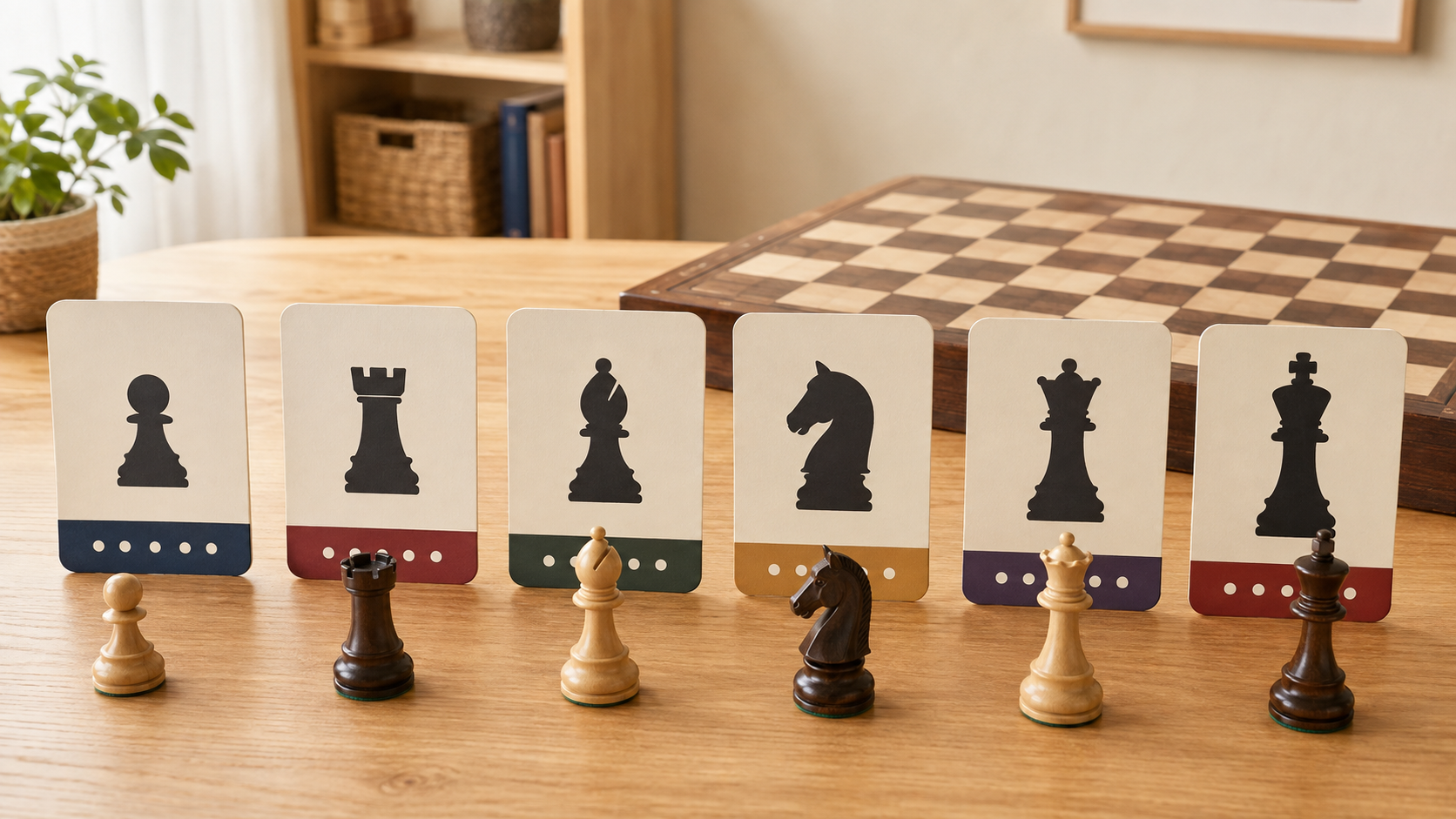
Look for all six piece types, familiar silhouettes, uncluttered movement examples, readable print, and an order that starts with matching before asking the learner to remember rules.
Quick verdict
Choose piece identification cards when a beginner still mixes up piece names or needs a removable prompt while learning legal moves. Skip them when the learner already recognizes every piece and needs tactics, opening ideas, or complete-game practice instead. A printed movement chart or six homemade cards may do the same job.
Selection criteria that matter
- Complete piece set: confirm the deck covers pawn, rook, bishop, knight, queen, and king rather than only tactics or opening positions.
- Recognizable artwork: card symbols should resemble the learner's real pieces closely enough to support matching. Highly themed silhouettes may add another translation step.
- Movement accuracy: inspect sample cards. Pawns need separate movement and capture explanations; sliders cannot jump over pieces; the knight can jump; and the king cannot move into check.
- Board orientation: diagrams should state whose perspective is shown and which side moves. A floating arrow without a board or direction cue can confuse a new learner.
- Readable card size: verify actual dimensions, print size, contrast, and whether the cards will be held individually or seen across a shared table.
- Lesson order: a numbered or color-grouped sequence is easier to teach than a mixed deck containing rules, tactics, trivia, and openings.
- Answer support: prompts should include a correction or explanation so an adult who is also learning can check the activity.
- Physical format: check the finish, corners, storage box, stated care method, and whether the full deck is practical to carry and sort.
Which card format fits the learner?
Picture-and-name matching cards
These are the simplest starting point. Put the six cards face up, hand the learner one real piece at a time, and ask for a match. Choose this format when names and shapes are still unfamiliar.
Skip this format once matching is automatic. Repeating names without moving pieces will not teach legal play.
Piece-and-movement reference cards
These add a small board diagram or concise rule to each piece. They fit learners who can identify the pieces but pause before making a move. Check that the pawn card addresses its unusual forward move and diagonal capture separately.
Skip this format if the diagrams are tiny, crowded, or use arrows without showing blockers and captures. A clear full-page movement guide will be easier to verify.
One-question activity cards
A card might ask the learner to place a rook, make one bishop move, or find two knight destinations. These work after the basic pattern has been introduced because the learner must act instead of recite.
Skip this format if each card combines several rules or expects knowledge of checkmate, notation, or tactics before the movement lesson is secure.
Write-on reusable cards
Reusable cards can let a teacher circle a piece, mark a destination, or adapt a prompt. Verify the intended marker type and cleaning directions in the current product description.
Skip this format if managing markers and cleaning adds more work than printing a worksheet or setting up a position on the board.
Preflight a deck before buying
- Find a current image or publisher sample showing several actual card faces, not only the box.
- Confirm all six piece types appear and that the deck is about identification and legal movement—not opening memorization or tactics.
- Read the pawn, knight, and king examples. These reveal whether exceptions and movement limits are handled carefully.
- Compare the card dimensions with the planned use: one learner can hold a compact card, while a group needs larger shared visuals or several decks.
- Check language, edition, card count, answer format, storage, finish, and current seller terms.
- Reject a deck whose visible examples conflict with the rules reference you plan to teach.
A simple first lesson with the cards
- Start with the rook and bishop so straight and diagonal movement are easy to contrast.
- Add the queen as a combination of those patterns, then the king with its one-square limit.
- Teach the knight separately because its L-shaped move and ability to jump are different.
- Finish with pawns, separating forward movement, diagonal captures, the optional two-square first move, and promotion. Save en passant until the basic pattern is comfortable.
- After each card, place only that piece and a few blockers on the board. Ask the learner to point to legal destinations and explain one square that is not legal.
Move to a mini-game when the learner can use two or three piece types without checking every card. For accurate rule explanations, keep the full beginner movement guide nearby. If the learner may be ready for a whole-game reference, compare chess rule cards with piece identification cards by learning stage. Families choosing between movable prompts and a permanent wall reference can also compare a chess lesson poster with flash cards.
Who should skip identification cards?
Skip a purchase if the learner already names and moves every piece confidently, if the deck repeats information in a book you already use, or if a homemade set will suit a short lesson. Learners ready to solve forks and captures need puzzle cards; learners studying early-game plans need the separate opening flash-card guide. Those products answer later decisions and should not be substituted for basic move instruction.
Bottom line
The best identification cards for a beginner cover all six piece types, use familiar shapes, show accurate uncluttered movement rules, and turn each card into an action beside a real board. Buy them only when removable prompts solve a real recognition problem. Otherwise, print a clear reference and spend the lesson moving pieces.