
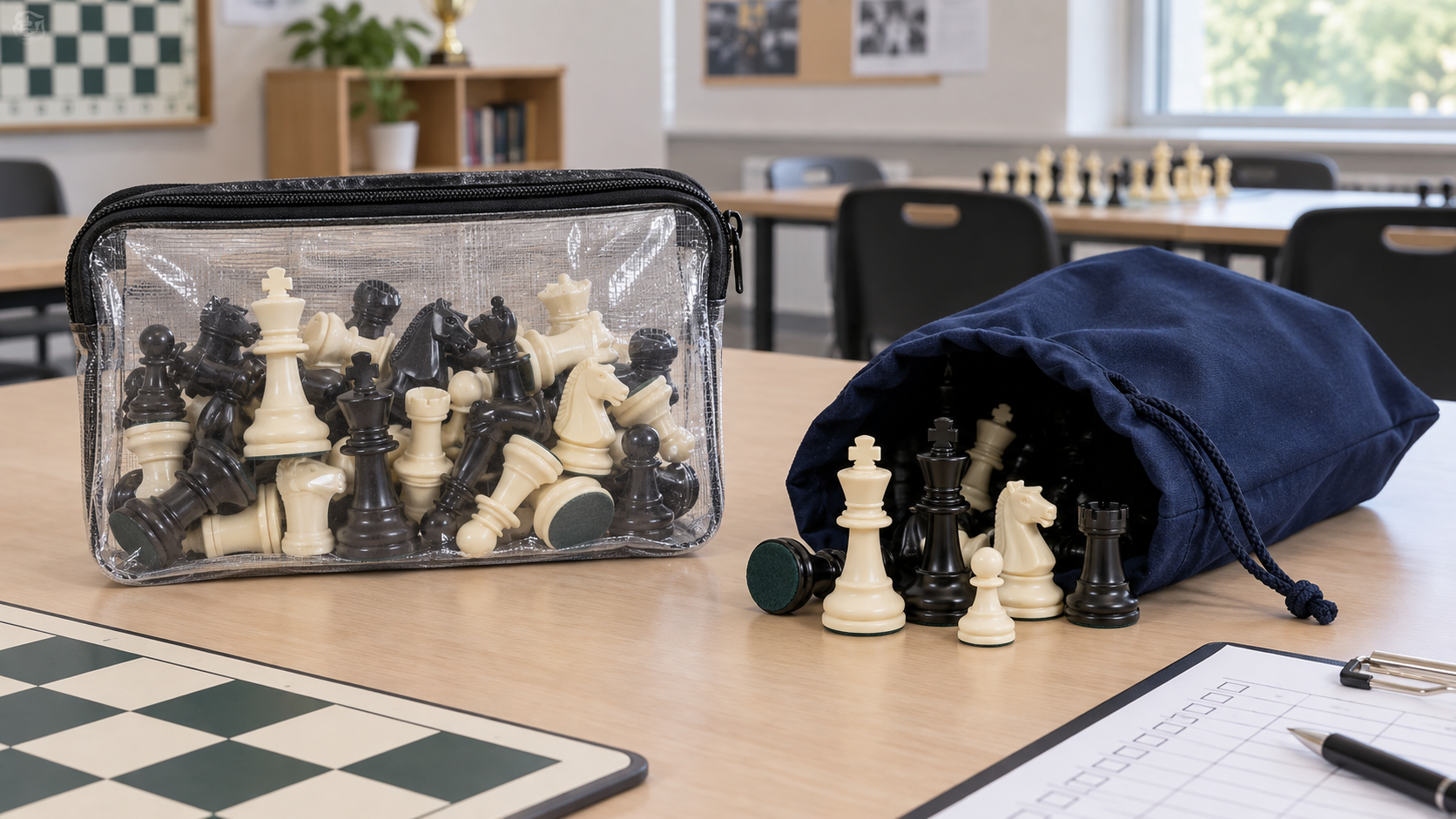
Choose clear pouches when helpers need to spot mixed colors, stray pieces, or an obviously incomplete set before opening it. Choose opaque drawstring bags when quick access, flexible packing, and simple replacement matter more than seeing the contents. Neither container counts pieces for you; the best choice supports a repeatable check.
This comparison is for loose chess or checkers pieces, not a carrier for the board and whole kit. Test one filled sample with the club's actual pieces before standardizing several bags, because usable capacity depends on the pieces, opening, seams, and closure—not the listing photo.
As an Amazon Associate, The Good Chess & Checkers may earn from qualifying purchases.
See the set or simplify the handoff
Compare compact piece-storage formats
For either format, verify the usable opening and filled dimensions with one complete piece set. Check the closure, seams, label area, cleaning instructions, and whether the filled bag fits the club's shelf or larger board carrier.
Quick decision
- Use clear pouches when a helper issues several pre-counted sets and wants a quick first-pass visual check.
- Use opaque drawstring bags when players need a wide, simple opening and the club already uses a checklist or counting tray.
- Use both selectively when ordinary table sets use inexpensive drawstring bags but replacement pieces need a visible pouch.
- Buy neither yet when the current containers close securely and the club has not identified where its count routine fails.
What a clear pouch reveals—and what it does not
A clear front or transparent body can reveal whether light and dark chess pieces are mixed, whether checkers colors have crossed between sets, or whether a non-game item was packed by mistake. It can also help a helper locate the replacement-piece pouch without opening every container.
Visibility is not a complete inventory. Pieces overlap, small pawns hide behind larger pieces, and glare or mesh can obscure details. A pouch that looks full may still be missing one piece. Treat the view as a triage step, then use the same count method for every returned set.
What an opaque drawstring bag simplifies
A soft drawstring bag usually opens into one uncomplicated compartment. Pieces can be swept in quickly, and the empty bag takes little shelf space. A club can also replace one bag without changing its entire storage system, provided the new bag fits the pieces and its label remains clear.
The tradeoff is that every contents check starts by opening or emptying the bag. A cord can loosen if it is not secured, and a narrow gathered opening may catch larger kings or stacked checkers. Verify the real opening rather than relying only on the flat fabric dimensions.
Compare the inventory workflow
First-pass checks
Clear pouches help a coordinator separate obvious exceptions from bags that appear normal. Opaque bags keep every set in the same open-and-count routine. The second approach can be preferable when visual shortcuts cause helpers to skip the actual count.
Labels and set identity
Use a large written set number or name on either bag. Do not rely only on piece color or a colored tag. A clear pouch shows contents, but it does not show which board or table owns them unless the container is labeled.
Chess and checkers
Keep each game's pieces in its own labeled container even when one reversible board serves both games. Chess sets need the expected armies and any club-approved spare queens. Checkers sets need the count and kinging method used by the local ruleset. Do not assume that two apparently full disc bags contain compatible diameters or stackable pieces.
Shelf and carrier fit
Measure a filled bag, including zipper pulls, cords, knots, and bulging pieces. Clear structured pouches may stack consistently but occupy their full shape. Soft drawstring bags can conform to a larger carrier, yet irregular bundles may waste shelf space or press hard pieces into a flexible board.
Run a one-session test
- Fill one candidate of each format with the same type of complete set.
- Add the intended label and place both bags in the real shelf or board carrier.
- Issue, collect, and check them during an ordinary session.
- Record missed pieces, extra openings, spills, snagged pieces, and relabeling problems.
- Choose the format that makes the full return check easier to repeat, not merely the one that packs fastest once.
Buying checks before ordering several
- Usable capacity: measure the complete piece set in a temporary bag and compare filled dimensions, not just nominal length and width.
- Opening: confirm that the largest chess king or a small stack of checkers passes without forcing the zipper or gathered cord.
- Closure: inspect how the zipper ends or drawstring locks; test whether normal shelf handling lets pieces escape.
- Label surface: choose a removable tag, label pocket, or area that stays readable when the bag is full.
- Care: follow the maker's cleaning directions for clear plastic, mesh, lining, cord, and printed labels.
- Replacement routine: keep spare pieces in a separately labeled container so they do not make a playing set look complete when it is not.
Who should skip each format?
Skip clear pouches when glare, scuffing, or overlapping pieces makes the view unreliable and the club counts every set anyway. Skip opaque bags when helpers repeatedly open many containers only to find one specific color or replacement piece. Skip both when a rigid divided box is necessary to separate piece types or reveal exact gaps.
If the real problem is confirming an exact chess inventory, compare a piece counting tray with a checklist. If each table needs a complete board-and-piece kit rather than a loose-piece container, compare numbered set bags with pooled bins.
Bottom line
Clear pouches provide useful visibility for sorting exceptions, while opaque drawstring bags keep access and replacement simple. Neither replaces an agreed count. Test the actual pieces, opening, label, shelf, and return routine before buying multiples, and keep chess and checkers sets separately identifiable.