
Choose drawer dividers when spare pieces stay in one room and you want one visible inventory. Choose lidded small-parts boxes when supplies move between tables, rooms, or events and each group needs its own contained kit. The right choice depends less on total capacity than on whether your replacement supply is a fixed station or a portable service kit.
This is a product-category comparison, not a named-product ranking or hands-on test. Inventory the actual pieces first, measure the tallest and widest item, and verify current compartment dimensions, divider design, lid clearance, materials, and care information before buying.
As an Amazon Associate, The Good Chess & Checkers may earn from qualifying purchases.
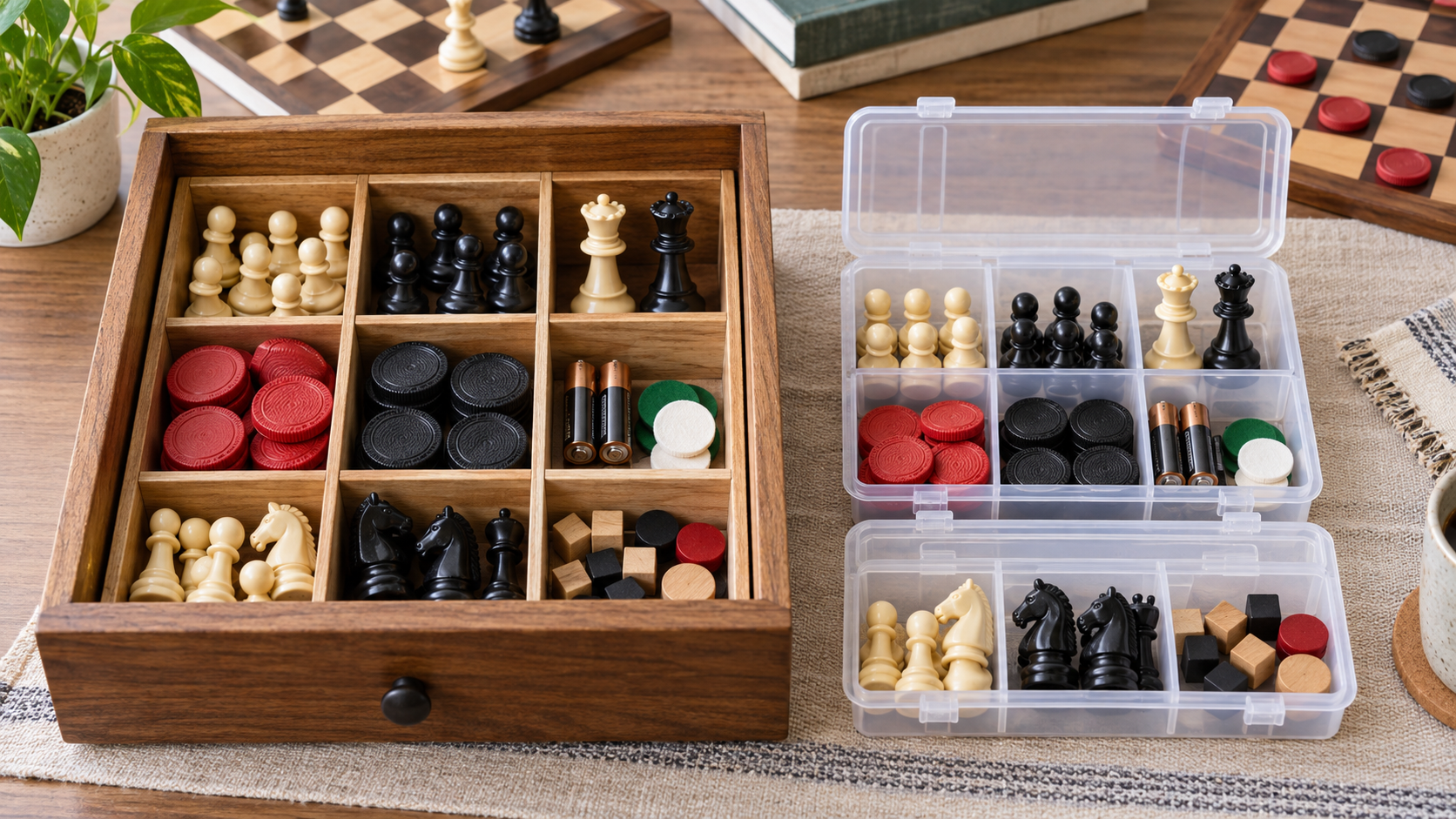
Build around the replacement workflow
Compare fixed and portable compartment storage
For drawer dividers, verify usable drawer width, depth, height, divider range, and the size of every finished compartment. For parts boxes, verify internal compartment dimensions, lid clearance, latch design, removable dividers, filled-box footprint, and label space.
Quick decision
- Choose drawer dividers for a permanent supply cabinet, quick visual counts, and frequent access to many categories at once.
- Choose small-parts boxes when spares travel to the playing area, several helpers need separate kits, or dust and accidental mixing are recurring problems.
- Use both selectively when a central drawer holds bulk replacements and one small box carries the few pieces most often needed during a session.
- Skip dedicated organizers when there are only a few spares; labeled containers already on hand may be clearer and easier to maintain.
Option A: adjustable drawer dividers
A divided drawer turns an existing cabinet into one replacement-parts station. Open it and a helper can scan spare pawns, queens, checkers, markers, and approved clock supplies without opening several containers. Wide compartments can hold large chess pieces; narrow ones can separate colors, games, or set families.
The tradeoff is location. The supply is useful only near that drawer, and an open drawer does not contain pieces during transport. Gaps below or beside dividers can also let small markers migrate when the drawer closes sharply. Before choosing this route, confirm the dividers lock securely enough for the drawer and that their contact surfaces fit the cabinet maker's care guidance.
Option B: lidded small-parts boxes
A parts box makes the replacement supply modular. One box might hold chess pieces, another checkers and king markers, and a third small accessories. A clear lid can support a count without opening every compartment, while separate labels let a helper take only the relevant box to a table.
The lid creates the most important measurement: usable height when closed. A queen or king that fits an open compartment may press against the lid or prevent the latch from closing. Removable dividers can also leave channels underneath. Verify the internal layout, not just the outside dimensions, and do not force pieces or batteries into a compartment that is too short.
Who each format fits
A family with one game shelf
A small drawer organizer works when the drawer is already part of the game area and everyone knows where replacements belong. Keep active-set pieces with their set; the drawer should hold genuine spares, not become the place where incomplete sets disappear. Use plain labels such as “chess light,” “chess dark,” “checkers red,” and “checkers dark” rather than relying only on color.
A single lidded box is better when the shelf has no drawer or is moved for game night. Measure the box beside the boards and complete sets so the replacement supply does not consume the space needed for actual play.
A classroom or club with several helpers
Portable boxes fit a distributed routine: a helper can take one verified kit to the tables, replace a missing piece, record the change, and return the kit. A central drawer fits a controlled checkout station where one person handles all replacements. Neither format fixes a weak count process. Give every compartment a written category and decide who updates the inventory after a replacement leaves the reserve.
For whole-kit accountability, keep replacements separate from the bags issued to players. The numbered-bag versus color-coded-bin comparison covers the different decision of tracking complete playing sets.
Fit and capacity: measure the largest piece first
Do not estimate capacity from the number of compartments. Make a written inventory, then measure the largest base diameter, piece height, checker diameter and thickness, and any battery or marker container you plan to store. Add enough clearance to lift an item out without emptying the neighboring compartment.
- For a drawer: measure usable interior width, depth, and height after accounting for handles, runners, and the drawer above it.
- For dividers: check the adjustment range, finished compartment sizes, intersection pieces, and whether small items can slide through gaps.
- For a parts box: look for internal measurements, divider thickness, lid ribs, hinge area, and the closed height above each compartment.
- For either option: leave expansion space only for categories you actually maintain; empty compartments without a purpose invite mixed returns.
Setup and maintenance
- Count the current reserve by game, color, piece type, and compatible set family.
- Remove unrelated objects and uncertain pieces rather than creating a catch-all compartment.
- Build compartments around the measured inventory, keeping tall or heavy pieces where they sit securely.
- Label the compartment and its expected count. If pieces fit only certain boards or sets, include that identifier.
- Photograph or write down the completed layout so another helper can reset it.
- Recount after replacements are issued and before buying more supplies.
Follow the organizer maker's cleaning instructions. Empty the container before cleaning, avoid exposing wood pieces, felt bases, cardboard markers, or batteries to cleaning liquid, and let every surface dry fully before returning the inventory. Inspect cracked lids, loose dividers, and unreliable latches before carrying a box.
Skip criteria and lower-cost alternatives
Skip drawer dividers if the only available drawer is damp, hard to reach, frequently moved, or too shallow for the tallest pieces. Also skip them when helpers need replacements in several rooms; repeated handfuls of loose pieces defeat the point of organized storage.
Skip small-parts boxes when published internal dimensions and lid clearance are missing, the largest pieces must lie awkwardly across dividers, or the latches and handles do not suit the planned carrying routine. A box designed for tiny hardware may create many compartments but no usable space for chess kings or stacked checkers.
Before buying, trial the workflow with clean labeled food-storage containers, envelopes inside a larger box, or shallow trays already owned. Do not store loose batteries where their terminals can contact metal or one another; follow the battery maker's storage guidance and keep damaged batteries out of the game supply.
Bottom line
Drawer dividers are best for one stable, highly visible replacement inventory. Lidded parts boxes are best for portable modules, dust control, and separate kits for different helpers or games. Inventory first, measure the tallest and widest items, test the checkout routine with containers on hand, and choose the format that makes missing pieces easier to identify—not easier to hide.
The planned classroom-and-club pillar is not built yet. Continue with the chess piece compartment-box guide for box-specific criteria, or use the equipment-label guide to build a consistent identification system.