
An adjustable, lidded compartment box is the most flexible format for clubs sorting pieces from several matching chess sets. It can separate armies, spare queens, and incomplete-kit pieces while keeping the contents visible. The deciding factors are measured compartment space, closed-lid clearance, divider fit, and a labeling system that reconnects every group of pieces to its board.
This is a category guide, not a ranking of named products. We have not tested every box returned by the shopping route and make no claims about current prices, ratings, availability, or load capacity. Measure the club’s actual pieces and verify current maker or seller details before buying.
As an Amazon Associate, The Good Chess & Checkers may earn from qualifying purchases.
Quick decision aid
Start with the largest piece and the full workflow
Measure king height and base diameter, then check usable compartment dimensions, divider height, lid clearance, closure, handle, and the filled box’s shelf footprint. A box is useful only if helpers can return pieces to the right set without guesswork.
Quick decision
- Choose one adjustable box when several matching sets stay in one room and pieces are issued from a shared inventory.
- Choose set-specific boxes or bags when every board travels as an independent kit.
- Reserve one exception compartment when spare, mismatched, or incomplete pieces need a visible next action.
- Skip a compartment box when loose bags already keep each complete set together and centralized sorting adds no value.
What makes a compartment layout useful?
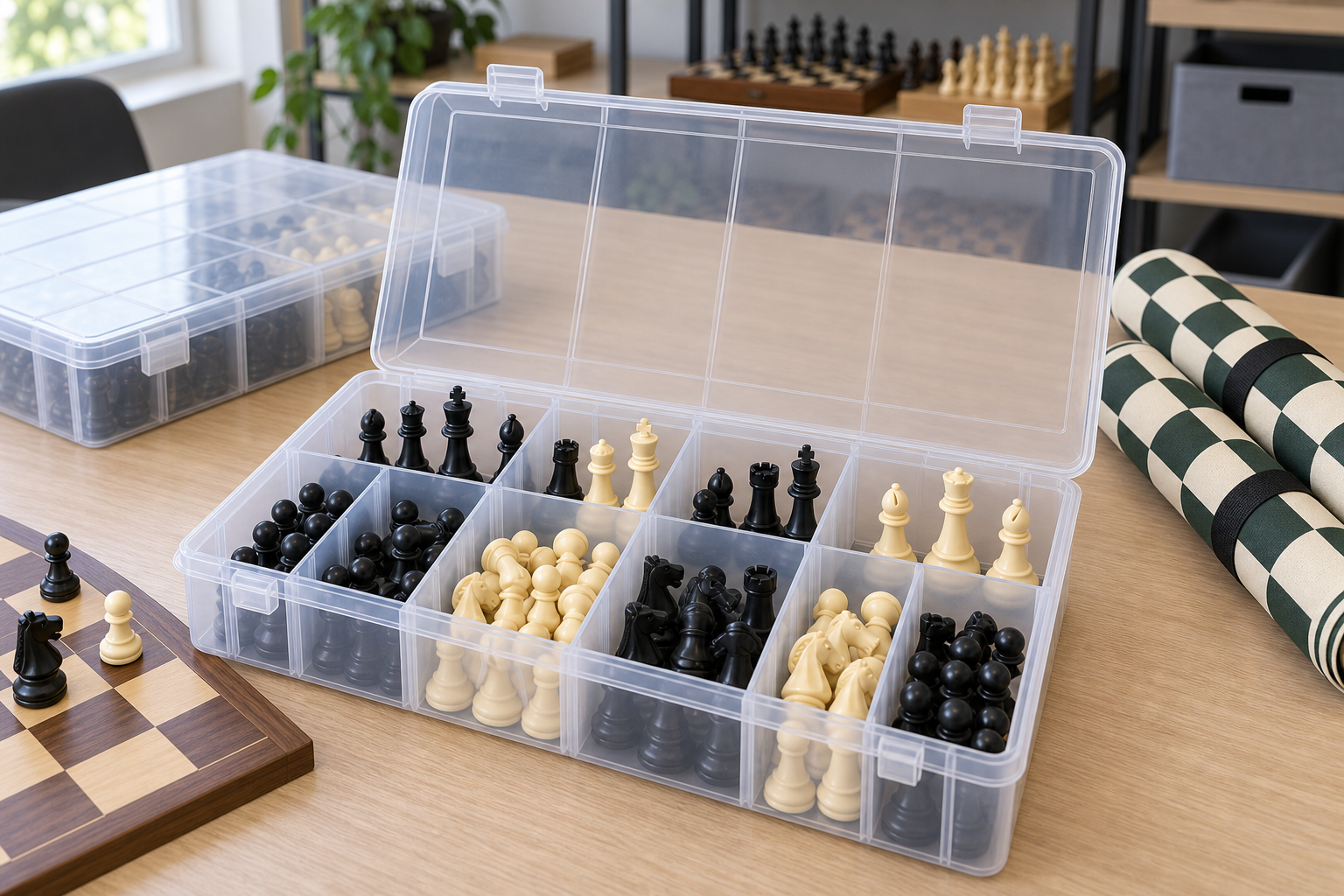
The best layout follows the club’s check-out routine. A simple plan might give one compartment to each light army and one to each dark army, with separate spaces for spare queens and unresolved pieces. That makes each set easier to rebuild than a box that groups every pawn together across the whole club.
Fixed grids can waste space around tall kings and wide weighted bases. Adjustable dividers let the club tune the layout, provided they lock securely and reach close enough to the lid that smaller pieces cannot migrate. Verify the listed interior measurements and divider design rather than inferring them from an exterior photograph.
Measure pieces, compartments, and storage space
Record the tallest king, widest piece base, and space taken by one complete 16-piece army when placed loosely. Include extra queens, different piece styles, and felted weighted pieces in the trial. Exterior box dimensions do not establish usable internal space.
Check the closed box: pieces should not press against the lid, crowns should not catch a divider, and the organizer should fit its cabinet in the orientation helpers will use. If it travels, consider the filled weight and route, but follow the maker’s instructions for loading and handling rather than assuming the handle suits club equipment.
Choose a system for one set or several
Set-by-set separation is easiest to audit. Give each board, light army, dark army, and inventory record the same number. It uses more compartments but identifies exactly which kit needs attention.
Shared piece pools use space efficiently when sets are interchangeable, but can hide an incomplete kit until issue time. Keep a small ready reserve and record how many complete sets the box can assemble.
An exception compartment is for pieces awaiting identification, substitution, or repair. Pair it with a dated equipment note so it does not become permanent clutter.
Run a no-spend layout trial
- Place removable dividers or small open containers inside an existing lidded household box.
- Sort two or three complete sets using the proposed layout.
- Ask a helper to issue one set, receive it, count it, and return it without verbal instructions.
- Note confused compartments, pieces that catch, and labels hidden when the box is open.
- Measure the successful layout before comparing current listings.
The trial may show that numbered pouches inside a plain tote are simpler. It may also show that one box should hold only two or three sets so it remains easy to count and place on the available shelf.
Label without hiding the contents
Use short labels such as “Set 3—light,” “Set 3—dark,” “spare queens,” and “check before issue.” Add a contents card inside the lid only if it does not block closure. Follow the container maker’s surface and cleaning guidance; do not assume every adhesive removes cleanly.
For individual kit labels, compare the set-label inventory guide. A label supports the workflow; it does not replace the final count.
Compartment box, counting tray, or carrying bag?
- A compartment box sorts and stores multiple groups of pieces in one rigid container.
- A counting tray gives every piece a visible position for a fast completeness check, but is less flexible for mixed sets.
- A carrying bag or case keeps the board, pieces, clock, and paperwork together for transport.
- Individual pouches use little space and keep sets separate, but hide the count until opened.
If everything travels together, use the club carrying bag versus hard case guide. If only one home set needs a container, use the replacement storage-box guide. If the real choice is between one fixed reserve and portable modules, compare drawer dividers with lidded parts boxes.
Bottom line
Choose a compartment box only after testing a layout with the club’s real pieces. Adjustable sections, a secure lid, visible labels, and verified clearance matter more than the advertised compartment count. For most multi-set inventories, separating complete armies by kit—and keeping one managed exception space—creates the simplest path from storage to play and back again.