
Choose dry-erase markers when a lesson needs frequent corrections and a fast reset. Consider wet-erase markers when diagrams must survive handling or remain visible between activities—but only if the board maker explicitly allows that ink and cleaning method. Neither label guarantees compatibility with every laminated sheet, coated board, sleeve, or demonstration panel.
The practical choice begins with the surface instructions, not the marker pack. Test one approved marker in an inconspicuous area, follow the stated removal method, and avoid leaving experimental marks on a teaching board you cannot replace.
As an Amazon Associate, The Good Chess & Checkers may earn from qualifying purchases.
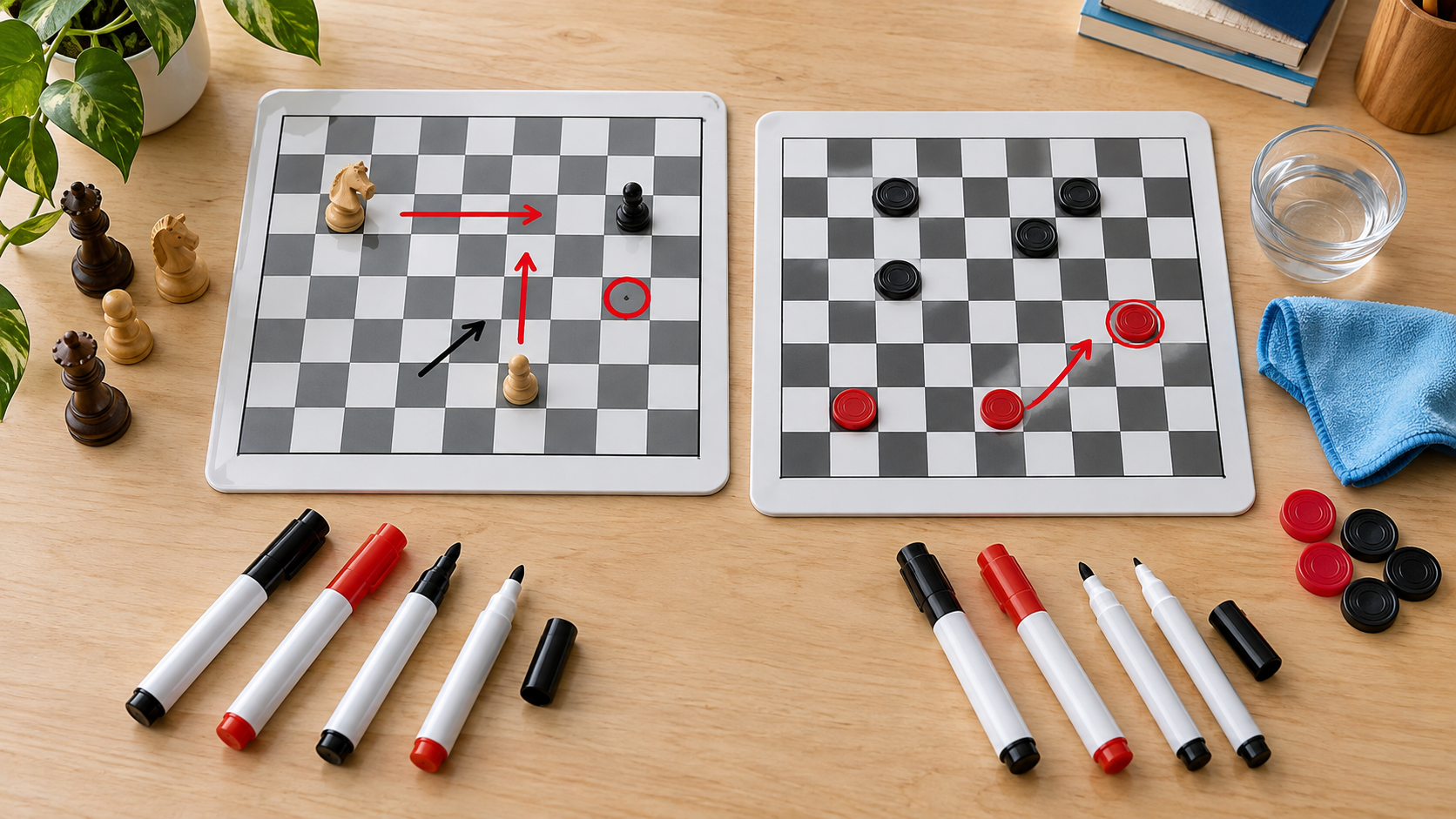
Fast changes or more persistent diagrams?
Verify the surface before buying either format
Check the board or sleeve maker's compatible-ink list and cleaning directions. Then compare tip width, visible colors, cap style, required cleaning supplies, storage, and how long the diagram must stay in place.
Quick decision
- Use dry-erase markers for live explanation, learner guesses, move arrows, and positions that change several times in one session.
- Use wet-erase markers only on a maker-approved surface when a diagram must resist casual rubbing and can be reset with the specified damp cleaning method.
- Use both only with a clear system: separate, labeled storage and a written compatibility note prevent the wrong marker reaching the wrong board.
- Choose neither yet when the board instructions are missing, the coating is already damaged, or ordinary chess and checkers pieces can demonstrate the idea without writing.
What dry-erase markers do well
Dry-erase ink suits a lesson that changes in front of the group. A helper can draw an arrow, circle a destination square, erase it, and show a different line without leaving the teaching surface for a later cleanup. This is useful when comparing legal and illegal moves or asking learners to suggest the next jump.
Easy removal also means easy accidental removal. A sleeve, hand, board eraser, or piece moved across the surface may disturb a diagram. If the position must remain intact while boards circulate between tables, quick erasing can become a drawback rather than a benefit.
What wet-erase markers do well
Wet-erase ink is designed to require moisture for removal on compatible nonporous surfaces. That can help a prepared diagram remain visible while a panel is carried, pointed at, or left between lesson segments. A teacher can prepare numbered routes or a multi-jump path before learners arrive instead of rebuilding it during the explanation.
The tradeoff is the reset routine. The room needs the cleaning method named by the surface and marker makers, enough time to clean completely, and a plan for damp cloths. Do not assume a wet-erase marker belongs on a board simply because the board looks glossy.
Compare the lesson workflow
| Decision | Dry-erase marker | Wet-erase marker |
|---|---|---|
| Best-fit job | Rapidly changing explanations and learner corrections | Prepared or longer-lived diagrams on approved surfaces |
| Reset | Normally uses the maker-approved dry eraser or cloth | Normally needs the maker-approved damp method |
| Handling | Marks may be easier to rub away unintentionally | Marks can remain until deliberately dampened |
| Supplies | Marker plus approved eraser or cloth | Marker, water or named cleaner, and approved cloth |
| Storage risk | Easy to confuse with other whiteboard pens | Must be kept distinct from permanent and dry-erase markers |
| Main gate | The exact board, lamination, or sleeve instructions must approve the ink and removal method | |
Chess and checkers uses
For chess, a fine or medium tip can mark candidate squares, attack lines, or a short move sequence without covering the board coordinates or piece symbols. For checkers, arrows can clarify a capture path or the order of a multiple jump. Keep the underlying position readable: a thick cluster of arrows is not a clearer lesson.
Rules can vary, especially in checkers. Marker color should not silently imply that one capture or kinging rule is universal. State the rules used in the session and link the diagram to a verbal explanation or a visible rule reference.
Setup and maintenance issues
Surface compatibility
Read the instructions for the exact board, pocket, sleeve, or lamination film. “Reusable” does not identify an ink system. If both the surface and marker guidance permit a small test, make it away from the main grid and remove it within the instructed time.
Tip size and contrast
Measure the board squares and test whether a line remains distinct from printed grid lines. Fine tips can preserve small diagrams but may be difficult for a group to see; broader tips improve visibility but can cover coordinates, checker paths, or piece outlines. Use the fewest high-contrast colors the lesson needs.
Caps and storage
Close caps according to the maker's directions and store the markers in the stated orientation. Label the storage container by ink type and compatible surface. Do not rely on barrel color alone, especially when several volunteers reset the room.
Cleaning routine
Follow the surface instructions before the marker instructions when they differ, and use only an approved cleaner and cloth. Clean the board at the scheduled reset, inspect it under good light, and keep damp materials away from books, paper score sheets, and wooden sets.
Run a one-board trial
- Record the exact teaching surface and its maker-stated compatible marker types.
- Select one approved marker of each format with a tip narrow enough for the grid.
- Draw the same short arrow and circle in an inconspicuous test area.
- Leave each mark only for the duration allowed by the current instructions.
- Use the specified removal method and inspect for residue or loss of grid readability.
- Choose the format that fits the real lesson length and reset routine; if either test is uncertain, stop using it on that surface.
Who should skip each option?
Skip dry-erase markers when accidental rubbing would spoil a prepared activity or when the surface maker does not approve them. Skip wet-erase markers when the room cannot manage a damp reset, when a diagram must change every few seconds, or when compatibility cannot be confirmed. Skip a mixed-marker supply when helpers cannot reliably identify and separate the types.
If learners need individual reusable pages rather than a shared board, compare laminated worksheets with a shared dry-erase board or use the reusable worksheet-sleeve guide. For a display-method decision, compare a magnetic demonstration board with a dry-erase chess board.
Bottom line
Dry-erase markers fit fast-changing chess and checkers explanations; wet-erase markers can fit prepared diagrams that should resist casual contact. Compatibility is the deciding constraint. Verify the exact surface, test the approved ink and cleanup method, and choose the smallest marker system the room can label, store, clean, and use consistently.