
A locking equipment cabinet can be worth it when a chess or checkers club keeps several shared sets in a room used by other groups, has permission for permanent storage, and can maintain a simple key routine. It is usually unnecessary for a small club that carries its gear home, already has assigned storage, or cannot give the cabinet a measured, approved location.
The lock is only one part of the decision. A cabinet also changes how the club counts equipment, assigns access, returns sets after play, and uses floor or wall space. It can control casual access, but it does not guarantee security or replace the building's rules.
The Good Chess & Checkers may earn commissions from qualifying purchases.
Quick decision aid
Compare locking steel storage cabinets
Confirm the cabinet's usable interior, door opening, shelf adjustment, assembled size, lock and key details, and the maker's installation and load instructions. Get the building owner's approval before ordering or anchoring anything.
Quick verdict
- Buy when several complete sets stay in one approved shared room and access needs to be limited to a small group of helpers.
- Request existing storage first when the building may already have a suitable closet, cupboard, or assigned shelving area.
- Use labeled open shelves when visibility and quick public access matter more than controlled access.
- Use portable totes or whole-set bags when equipment moves between rooms or leaves the building after every meeting.
- Skip when the club has only one or two sets, no permanent room, no approved installation location, or no reliable key holder.
The three thresholds that justify a cabinet
1. A real shared-room access problem
A lockable cabinet makes the most sense when equipment remains in a multipurpose room between meetings and people outside the club can otherwise reach it. Define the problem plainly: who needs access, who currently has it, and what goes missing or gets mixed up? If the issue is simply untidy shelves, labels and bins may solve it without a new cabinet.
2. Enough inventory to use the footprint
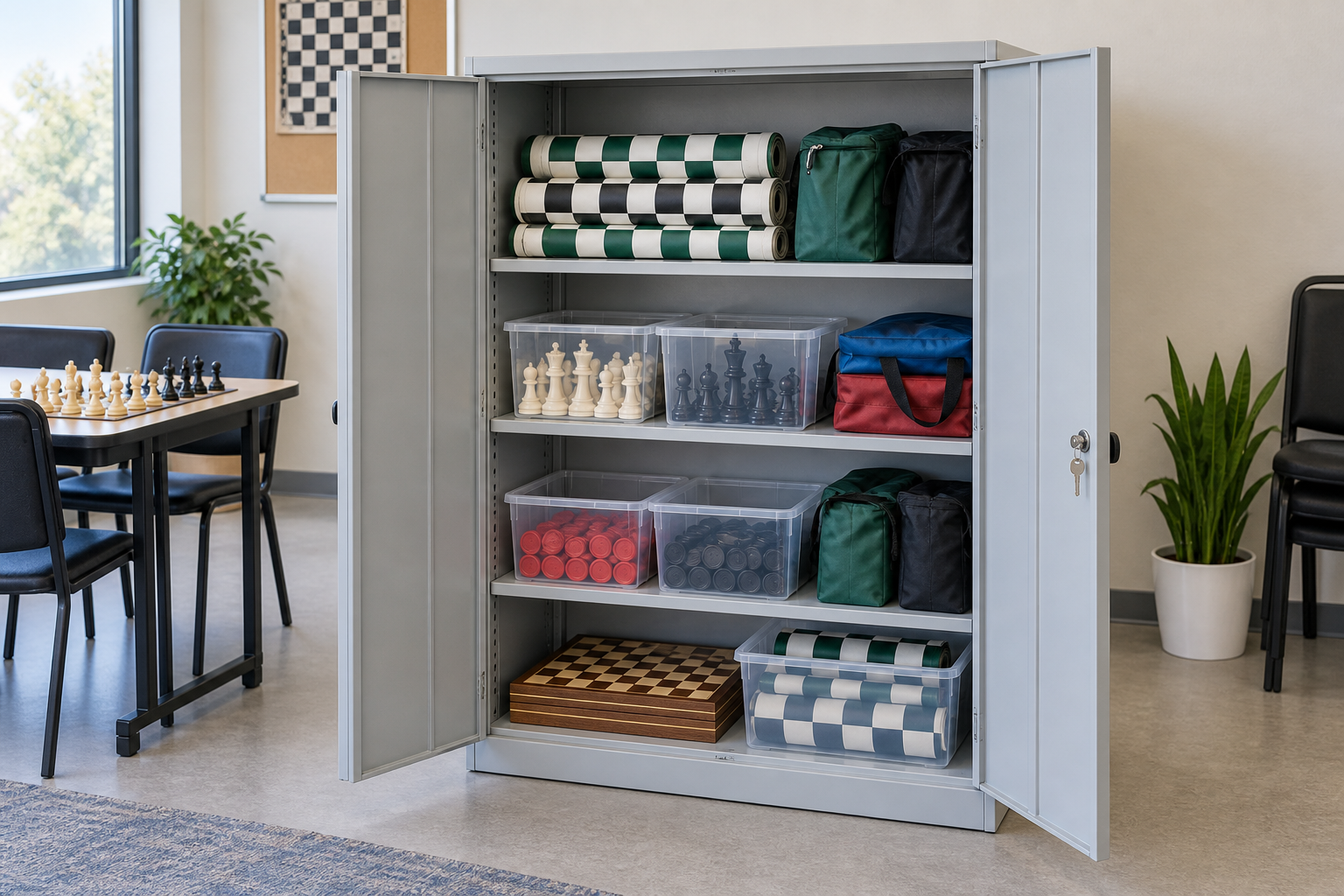
List every board, piece set, clock, scorebook, teaching aid, and spare-parts bin. Record each item's packed width, depth, and height, then sketch shelf groups. Use the cabinet's stated usable interior and door-opening dimensions—not its outside dimensions or a staged product photo—to test the plan.
3. Permission and ownership of the routine
The room owner or manager should approve the location, assembly, anchoring approach, key policy, and any limits on storing equipment. The club also needs named people who can open the cabinet, return items, and handle a lost key. A cabinet nobody can access at meeting time is worse than an ordinary labeled shelf.
Seven checks before buying
Measure the full route
Measure the intended footprint, ceiling clearance, door swing, baseboard interference, nearby switches or vents, and the delivery path through doors, lifts, corridors, and stairs. Confirm whether the product arrives assembled or flat-packed and follow its current instructions.
Plan shelves around packed equipment
Boards and bags often consume more depth than loose pieces. Check usable shelf depth with the doors closed, adjustment increments, and whether a shelf can leave tall space for rolled boards. Keep small replacement pieces in closed, labeled containers rather than loose on a shelf.
Read the maker's load and installation instructions
Do not estimate shelf capacity from the material or appearance. Follow the exact manufacturer's instructions for assembly, leveling, loading, and any required restraint or anchoring. The building owner should decide what installation work is allowed.
Verify the lock, keys, and replacement route
Check how the stated lock operates, how many keys are included, and whether the seller or manufacturer documents a replacement process. Do not assume a basic cabinet lock provides the same protection as the building's secured storage. Avoid storing cash, personal records, or valuable collectibles on the strength of a product-category page.
Keep inventory visible inside
Use one labeled location per set or component category. Clear bins, numbered whole-set bags, and a simple count sheet make missing pieces easier to notice. If the club checks many sets after each meeting, the counting-tray versus checklist guide can help shape that routine.
Check access at the busiest moment
Imagine two helpers issuing boards just before a meeting and returning them afterward. Wide doors and clear shelf labels can matter more than maximum theoretical capacity. Equipment buried behind other gear will slow the routine even if everything technically fits.
Leave room for ordinary upkeep
Dust shelves, inspect bags and bins, and keep damp outdoor equipment out until it is ready for storage. Follow the cabinet and equipment makers' care instructions. Do not add unapproved electrical charging arrangements inside a closed cabinet.
Cabinet versus lower-cost alternatives
Existing building storage: often the best first request because it avoids another large object. Confirm who shares it, how access works, and whether the club can label a dedicated section.
Open shelving: makes counts and retrieval easy, but anyone with room access can reach the gear. It fits supervised rooms where loss or mixing is not a recurring concern.
Stackable totes: group equipment cheaply and can move between rooms. Deep totes may hide incomplete sets, so give each tote a defined inventory and label. A rolling cart may help with room-to-room movement, but only after verifying the cart's and building's instructions.
Individual set bags: keep each board and piece set together and work well for mobile clubs. Read whether numbered equipment bags are worth it when set-level check-in is the main problem.
Run a no-spend cabinet test
- Mark the proposed cabinet footprint with removable painter's tape only if the room owner permits it.
- Place the club's packed equipment in labeled boxes that represent proposed shelves.
- Run two normal setup-and-return cycles and note congestion, missing pieces, and who needs access.
- Count the people who genuinely need a key and name a primary and backup key holder.
- Ask the building manager whether suitable existing storage is available and what installation rules apply.
- Buy only if controlled fixed storage solves a documented problem that the temporary system does not.
Who should skip it?
- Clubs that transport all equipment to every meeting.
- Groups with one or two sets that already fit in a labeled tote or shelf space.
- Renters or shared-space users without written permission for the location and installation method.
- Clubs without a dependable key and inventory routine.
- Buyers who cannot verify usable dimensions, shelf details, current instructions, or a workable delivery route.
Bottom line
A locking cabinet is worth considering when a club has enough equipment, a permanent approved room, a genuine shared-access problem, and people willing to own the keys and check-in routine. Its value comes from giving equipment a controlled, consistent home—not from a promise that a lock makes every item secure.
Measure the inventory and room, request existing storage, and test a labeled temporary system first. If that test confirms a fixed cabinet would reduce mixing and simplify access, compare products by usable dimensions, shelf layout, current instructions, and serviceable key details. Otherwise, portable bags, totes, or open shelves are the more flexible answer.
The planned classroom-and-club pillar is not yet built. For the broader setup path, continue with the beginner-friendly chess and checkers station guide.