
A silicone chess board is worth it for a family that wants a flexible board with a grippy table feel and a cleanup routine supported by the maker's instructions. It is not automatically the best family board. Vinyl often costs less, mousepad-style boards usually lie flat with less fuss, and a folding or rigid board may feel tidier on a permanent game table.
Buy the format for a repeated household problem—not because “washable” or “premium” appears in a listing. If you are choosing a complete first set rather than replacing only the board, begin with our chess and checkers set buying pillar.
The Good Chess & Checkers may earn commissions from qualifying purchases.
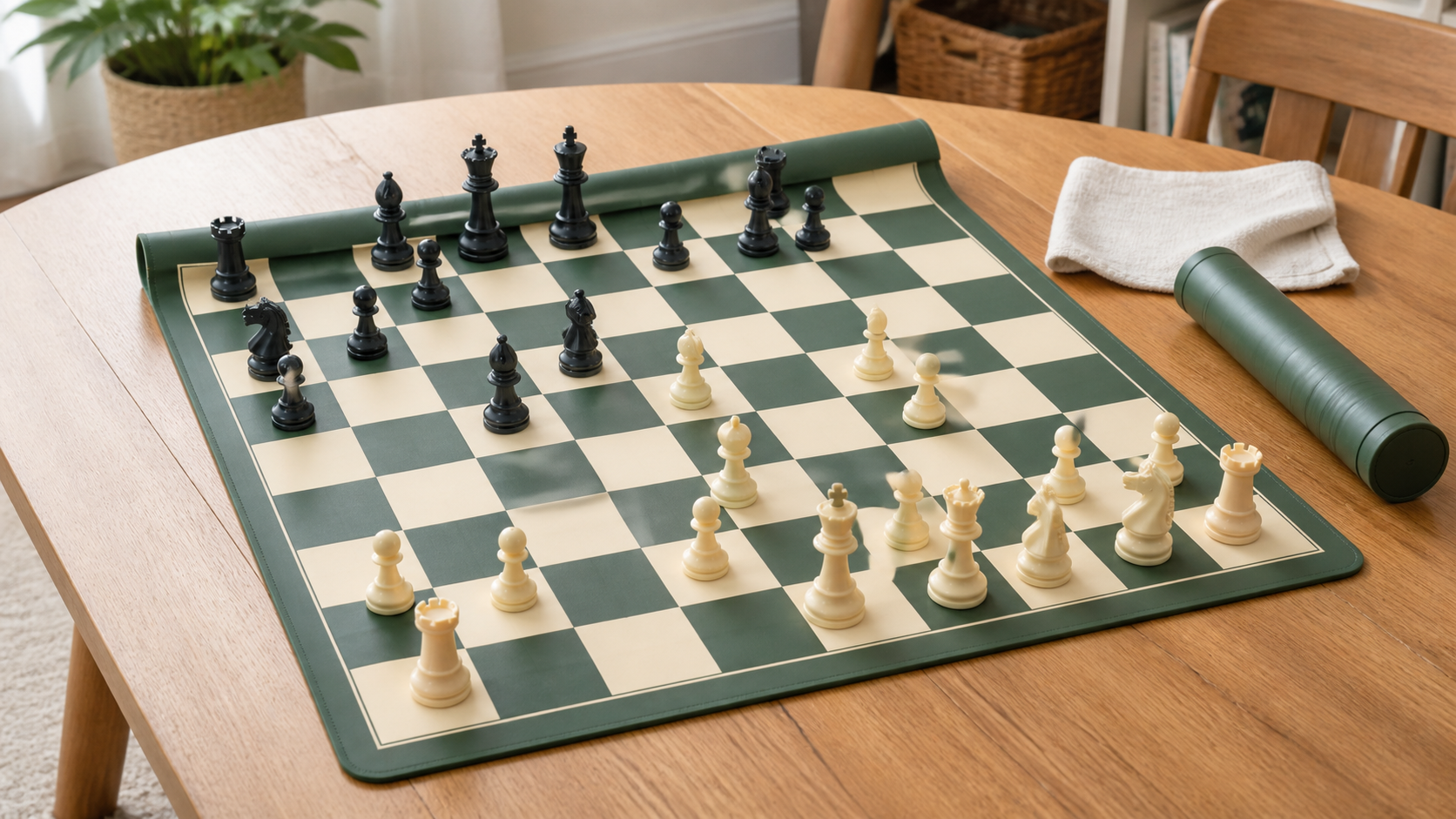
Quick decision aid
Compare silicone chess boards by fit and routine
Check material wording, board and square dimensions, contrast, included contents, storage method, and the seller's care directions. We have not tested the products returned by this shopping link.
Quick verdict: buy, skip, delay, or choose an alternative
- Buy when spills or frequent table changes are normal, a flexible board stores more easily than a rigid one, and the listed care method fits your routine.
- Skip when the current board is clear, flat, and easy enough to maintain.
- Delay when you do not yet own compatible pieces or have not measured the table, storage space, and piece bases.
- Choose vinyl when low initial cost and familiar roll-up club-style storage matter most.
- Choose mousepad-style when lying flat quickly and a cushioned surface matter more than compact rolling.
- Choose folding or rigid when the board stays on display, needs self-contained piece storage, or should feel structured during setup.
- Escalate to the organizer before buying several matching boards for a classroom, club, or event.
Five criteria that decide whether silicone earns its place
- Real cleanup need: frequent crumbs, fingerprints, or ordinary family-table spills make care more important than it is for an occasional game.
- Verified care directions: follow the maker's instructions for wiping, washing, drying, and products to avoid; silicone wording alone is not a universal care guarantee.
- Square and piece fit: compare the widest piece base with one square and leave visible room around crowded positions.
- Flatness and grip: a soft board should rest without stubborn edges or ripples on the table you actually use.
- Storage routine: plan whether the board will roll loosely, travel in a tube or bag, or share space with pieces without being sharply folded.
Red flags before buying
- The listing says “silicone-like,” “rubber,” or “washable” without clearly identifying the material or care method.
- Board dimensions are given but square size is missing, making piece compatibility hard to judge.
- Photos hide cropped edges, ripples, or the relationship between piece bases and squares.
- The bundle does not clearly list all pieces, extra queens, bag, or tube shown in photos.
- Very low contrast, ornate coordinates, or unusual colors make the position harder for a beginner to read.
- Claims such as “indestructible,” “stain-proof,” or “tournament approved” appear without useful support.
- The only storage plan is a tight fold that may leave the board awkward to set up.
Cost, maintenance, and setup tradeoffs
Silicone boards may cost more than basic vinyl boards, but price alone does not establish better printing, flatness, or longevity. Compare the total setup: board, compatible pieces, storage, and any bag or tube. A complete set can be simpler when the family owns none of those items.
Maintenance is usually simple only when it matches the actual instructions. Remove pieces, clean the board as directed, let it dry fully, and keep grit away from both board and piece bases. A matte surface may show lint or dust differently from vinyl or cloth-topped mousepad material.
For setup, unroll the board on a clean, level table and smooth it without stretching it. Keep hot dishes, sharp objects, and food service away from the playing area. Store pieces separately enough that hard bases do not press into a tightly rolled board.
Who should skip a silicone chess board?
- Families happy with an existing board that already fits the pieces and table.
- Gift buyers wanting a display object rather than practical flexible equipment.
- Players needing one self-contained box for board and pieces; a folding set may organize better.
- Very small-space players who need a compact magnetic or peg set rather than a rolled full-size board.
- People bothered by lint or soft surfaces who may prefer vinyl or a rigid board.
- Families mainly playing checkers unless they have confirmed that the squares, checker diameter, contrast, and king stacking work well.
Try a no-spend fit test before deciding
- Measure the table area available after plates, homework, or other shared-table items are removed.
- Measure the widest base among the chess pieces you plan to use.
- Mark the proposed board footprint with paper or removable tape.
- Decide where a damp board would dry and where it would be stored after play.
- Count how often cleanup, sliding, or rigid-board storage caused a real problem in the last month.
- Buy only if silicone addresses that repeated problem better than the alternatives.
Better alternatives by situation
For the lowest-cost flexible format: compare vinyl boards and confirm the listed square size, contrast, and storage method.
For fast flat setup: consider a mousepad-style board, accepting that its thicker material may take more storage volume.
For one-box storage: a folding chess or chess-and-checkers set can keep compatible pieces with the board. Compare the tradeoffs in our folding set guide.
For a permanent game table: a rigid board may offer the structured look and setup you want without any rolling routine.
For a first family kit: choose the board and pieces together using the board-size guide rather than solving compatibility afterward.
If a rigid board is still in the running, use the wooden versus silicone chess board comparison to weigh table presence, piece fit, cleaning, and storage side by side.
Bottom line
A silicone chess board is worth buying when flexible storage, table grip, and a verified cleanup routine solve recurring family-play problems. Confirm the material, dimensions, contrast, piece fit, care directions, and storage plan before choosing one.
Skip or delay when the current board works, compatible pieces are still missing, or a lower-cost vinyl board, flatter mousepad-style board, self-contained folding set, or permanent rigid board better fits the household.