
A silicone chess board can make sense when spills, fingerprints, classroom tables, or frequent packing make a rigid board inconvenient. The useful choice is not simply the board labeled “washable.” It should also lie flat, keep its printing clear, fit your pieces, and store without collecting lint or sharp creases. Families still deciding whether this material is the right format should first use our silicone-board worth-it verdict.
This is a product-category comparison, not a named-product ranking or hands-on test. Listings and care instructions change, so confirm the material, dimensions, included contents, and maker’s cleaning directions before ordering or washing a board.
As an Amazon Associate, The Good Chess & Checkers may earn from qualifying purchases.
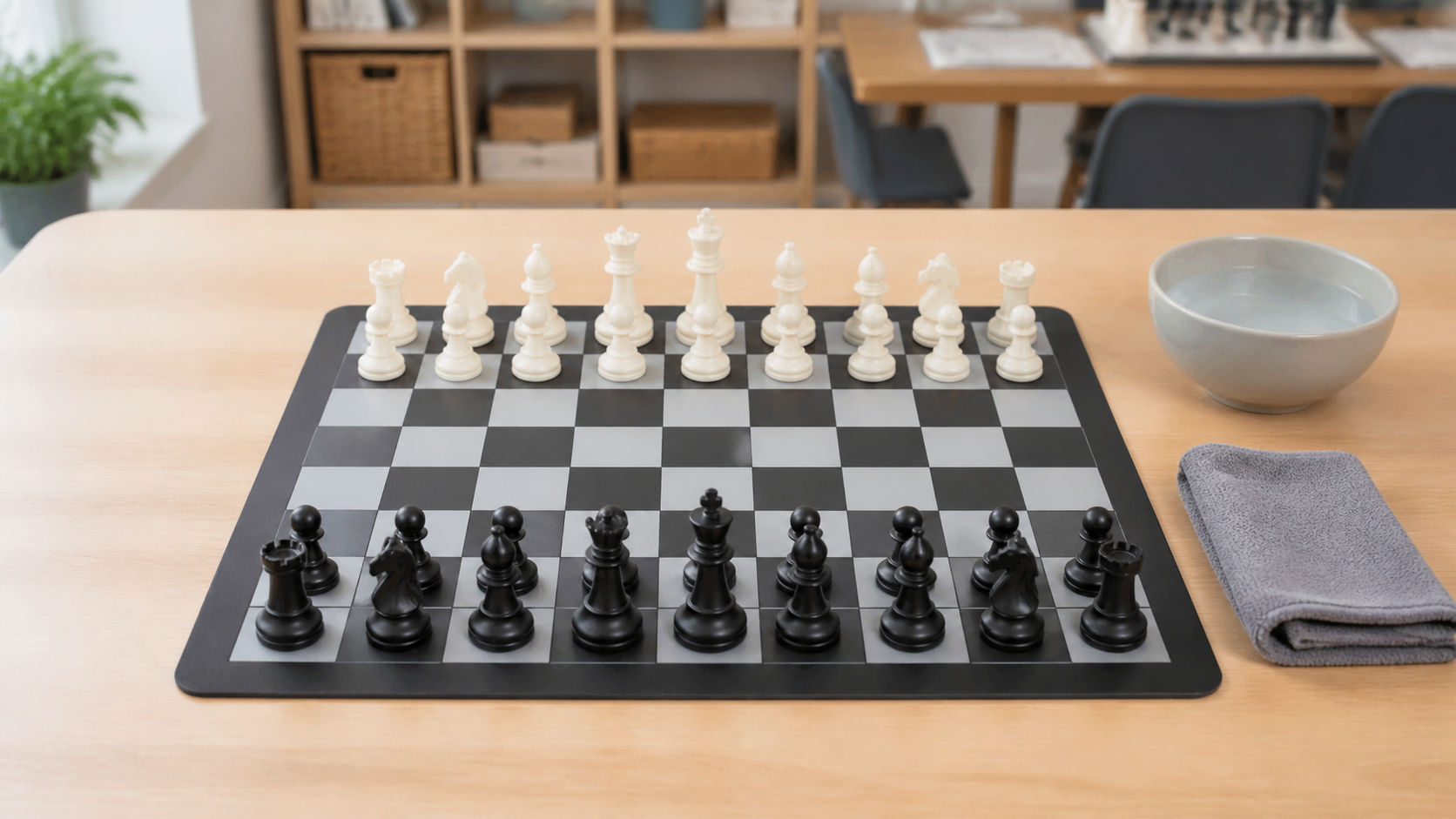
Product-category guide
Start with fit, flatness, and care instructions
Match square size to your pieces, look for a matte high-contrast surface, and verify the seller’s cleaning method instead of assuming every flexible board can be treated the same way.
What to check before buying
- Material wording: verify that the listing actually identifies silicone rather than using “rubber-like” as a broad description.
- Square size: compare the square measurement with the base of your king. Crowded pieces are harder for beginners to read and move.
- Flatness: look for a board intended to lie flat after rolling. A heavy border is less important than an even playing surface.
- Contrast and finish: matte, distinct square colors are easier to read under ordinary room lights than glossy or low-contrast printing.
- Cleaning directions: check whether the maker recommends wiping, hand washing, or another method, including any restrictions on soap, heat, soaking, or drying.
- Included contents: confirm whether the listing is board-only. A low board price may not include chess pieces or a carrying tube.
Best simple choice: a full-size board-only mat
A full-size silicone board is the cleanest category fit for someone who already owns usable chess pieces. It provides a familiar playing area without adding duplicate pieces. Prioritize clear coordinates only if the learner uses them; otherwise contrast, square fit, and flatness matter more.
Best for: homes, clubs, or classrooms that already have matched pieces and want a wipeable shared surface.
Skip it if: you still need pieces, a bag, or a self-contained set. Buying each part separately can create fit and storage problems.
Best ready-to-play format: board, pieces, and bag
A bundled silicone board can reduce compatibility guesswork when its listing gives exact board, square, and king-base measurements. Check that the bag holds pieces separately from the board so hard bases do not press into tightly rolled material during storage.
Best for: a first portable kit where the buyer wants one order and one storage system.
Skip it if: the listing omits measurements, shows unfamiliar piece shapes, or treats the bag as a substitute for organized piece storage.
Best for teaching: a board with clear coordinates
Coordinates around the edge help beginners follow books, videos, lesson cards, and recorded games. Labels should be large enough to read from both sides without crowding the playable squares. Coordinate printing does not make a board better for every family; it is useful only when lessons actually refer to files and ranks.
Best for: students practicing notation or following position-based instruction.
Skip it if: the labels make the border visually busy or the board is mainly for casual, notation-free play.
Best for repeated group use: high-contrast matching boards
For a club or classroom, consistency is often more valuable than a novel color. Matching boards make setup instructions easier and help replacement pieces fit across tables. Choose colors that separate light and dark pieces clearly, then establish one cleaning and drying routine for the whole set.
Best for: groups buying several boards for shared tables.
Skip it if: the seller cannot confirm consistent measurements or the program needs rigid boards that students can carry without rolling.
Silicone compared with other roll-up materials
- Choose silicone when a flexible, grippy surface and straightforward wipe-down routine are the main goals.
- Choose vinyl when low-cost club standardization matters more and you have a reliable way to store boards loosely rolled.
- Choose a mousepad-style board when cushioning and a fabric-like top matter more than the simplest wet cleaning.
- Choose a rigid or folding board when you want a display-ready surface or storage that does not involve rolling.
The broader roll-up chess board guide compares those formats as a first-board decision. This page is narrower: it helps readers decide whether silicone specifically earns its place through cleaning and handling.
A safe cleaning and storage routine
- Remove every piece and shake off loose crumbs without scraping the printed surface.
- Follow the board maker’s directions for water, cleaner, and washing method; do not assume heat or a machine cycle is allowed.
- Use a soft cloth rather than an abrasive pad, especially over coordinates and printed square edges.
- Dry the board completely on a clean flat surface before rolling it.
- Roll it loosely with the orientation recommended by the maker. Avoid sharp folds and do not trap damp pieces inside it.
Who should skip a silicone chess board?
Skip this format if you want a decorative board that stays on display, a rigid surface that can be moved with a position intact, or one box that stores both chess and checkers pieces in fitted compartments. Silicone also may not suit a very lint-heavy storage area unless the board has a separate sleeve or tube.
If you need one shared set for both games, compare beginner chess and checkers sets. If the main issue is choosing the correct playing footprint, use the board-size guide before selecting a material.
Bottom line
The best silicone chess board for easy cleaning is one whose care instructions match your routine and whose board geometry fits the pieces you will actually use. Verify material, square size, contrast, flatness, cleaning directions, and included contents. Choose board-only, bundled, coordinate, or group-use formats by the job they need to do—not by unsupported claims that one board is universally best.