
Choose a handheld label maker when each identifier needs words, game names, or changing locations. Choose preprinted sequential number labels when the club mainly needs fast, consistent set numbers. A label maker is more flexible; a numbered sheet is simpler to hand out and replace. Neither option fixes an inventory unless the same code appears on the board, piece container, outer bag, and record used at return.
This comparison is about how identifiers are created, not whether they stick better than tags. If the club is still deciding how a label should attach to fabric bags and rigid boxes, first compare adhesive labels with hanging tags.
As an Amazon Associate, The Good Chess & Checkers may earn from qualifying purchases.
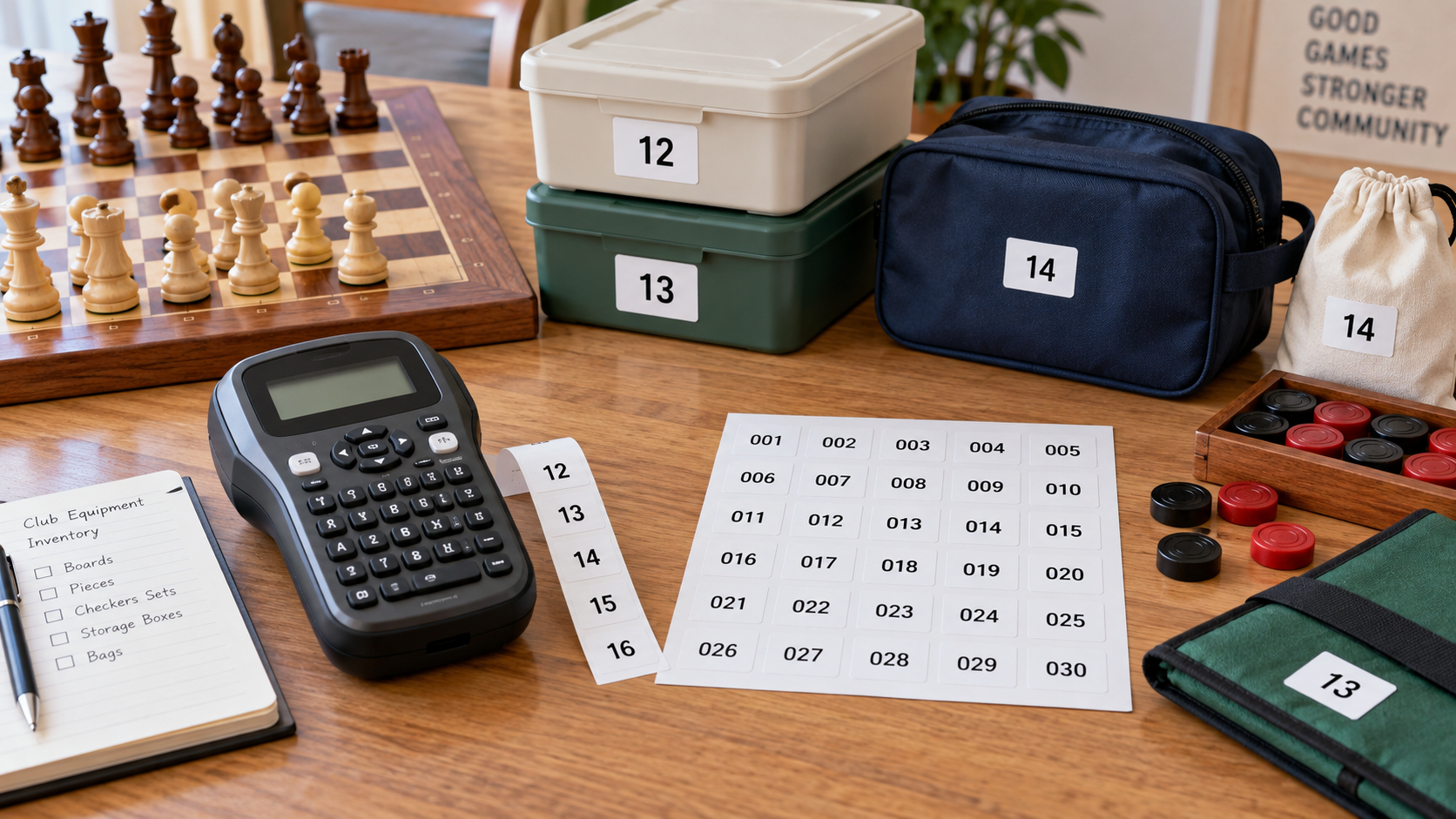
Start with the identifier workflow
Compare custom printing and ready-numbered labels
For a label maker, verify supported tape widths, character options, power source, replacement-tape route, and the tape maker's surface guidance. For ready-made labels, verify number range, label dimensions, legibility, material, quantity, and the seller or maker's surface and removal guidance.
Quick decision
- Use a label maker when codes need game names, room names, contents, or another short custom field.
- Use preprinted numbers when every kit follows the same pattern and speed matters more than descriptive text.
- Use a small hybrid when sequential numbers identify playing sets while a label maker marks shared clock, teaching, and replacement-piece boxes.
- Buy neither yet when temporary paper labels can still test the numbering scheme and return routine.
Where a handheld label maker helps
On-demand printing lets a helper create short identifiers such as “Chess 12,” “Checkers 4,” or “Clock Kit B.” That can prevent the same number from being confused across different equipment categories. It also makes a changed shelf or room assignment easier to describe without starting a new numbered sequence.
The flexibility adds decisions and supplies. Someone must choose a readable format, keep replacement tape available, and re-create the same style later. Tape widths, materials, power arrangements, character functions, and suitable surfaces vary, so check the current product information rather than assuming every machine and cartridge work together.
Where preprinted sequential labels help
A numbered sheet removes most formatting choices. Helpers can apply 001, 002, and 003 in order, record the same values on the inventory list, and keep unused numbers together for expansion. Large repeated numerals can also be easier to scan than a mix of custom abbreviations.
Numbers alone need a key. “014” does not reveal whether the object is a chess set, checkers set, clock, or supply bin. Duplicate the identifier on every component that belongs together and keep a plain-language inventory record. Confirm the label size fits the intended surface and that the number range leaves room for realistic growth.
Compare the decision that matters
Customization
A label maker earns its place when a short word prevents ambiguity. Keep the format consistent: for example, use the game plus a two-digit number rather than letting every helper invent a code. Preprinted labels are stronger when a plain numeric sequence is already enough.
Setup time
Preprinted numbers can move quickly from sheet to equipment. A label maker requires typing, printing, trimming when applicable, and checking each result. Time the entire task for a small batch before scaling it to every board, bag, clock, and piece box.
Readability and label size
Measure the flat label area and decide how far away the code must be read. More custom text usually means smaller characters or a longer strip. Preprinted numerals may offer better consistency, but only if their actual dimensions and contrast suit the containers.
Replacement and expansion
A label maker can reproduce a lost custom code if the same tape remains available and the format is documented. A numbered sheet makes replacements easy only while matching spare numbers remain. Save a few unused labels and record retired codes rather than casually assigning one number to two active kits.
Ongoing supplies
Compare the whole supply path, not just the starter purchase. A label maker may require compatible tape and batteries or another stated power source. Preprinted labels require replacement sheets with the right size and sequence. Do not assume compatibility, adhesion, removal, or surface performance beyond the maker's current instructions.
Build a numbering system before buying
- List the categories that need identities: chess sets, checkers sets, clocks, teaching boards, and replacement supplies.
- Choose one short format, such as CH-01 and CK-01, or separate numeric ranges with a written key.
- Test temporary versions on one board container, one piece pouch, and one outer bag.
- Run a normal issue, play, return, count, and shelf cycle.
- Ask a helper who did not design the system to match the components and find an exception.
- Only then choose the label method and record the format, number range, and spare-label location.
Surface and removal cautions
Clean and prepare only as the equipment and label makers direct, then test an inconspicuous area when appropriate. Textured plastic, fabric, coated board surfaces, unfinished wood, and frequently flexed bags can behave differently. Do not place a label where it covers board coordinates, rules, vents, controls, closures, or manufacturer information. If adhesive is unsuitable, a replaceable tag or label window may be the better attachment even when the identifier itself is custom printed.
Who should skip each option?
Skip a label maker when the club needs only a short run of plain numbers, has no plan for compatible replacement tape, or cannot standardize the format. Skip preprinted labels when several categories would produce confusing duplicate numbers, the available dimensions do not fit, or equipment assignments change often. Skip both when the real problem is incomplete piece counts: a counting tray or checklist addresses that different task.
Bottom line
A handheld label maker is the better tool for short custom identifiers and changing categories. Preprinted sequential labels are the cleaner choice for a stable, number-only inventory. Test the code system first, check the actual label and surface specifications, duplicate each code across the complete kit, and keep one simple record that volunteers can maintain.