
Choose adhesive labels for equipment with a suitable smooth surface and a stable kit assignment. Choose hanging tags for fabric bags, handled cases, or equipment that is reassigned often. Most mixed club inventories need both: fixed identifiers on rigid boxes and short, reusable tags on bags whose contents change.
This is a product-category comparison, not a named-product ranking or hands-on test. Before buying, verify label dimensions, adhesive and surface guidance, tag attachment, writing method, and any care instructions on the current listing. Test one identifier through a normal issue-and-return cycle before labeling every set.
As an Amazon Associate, The Good Chess & Checkers may earn from qualifying purchases.
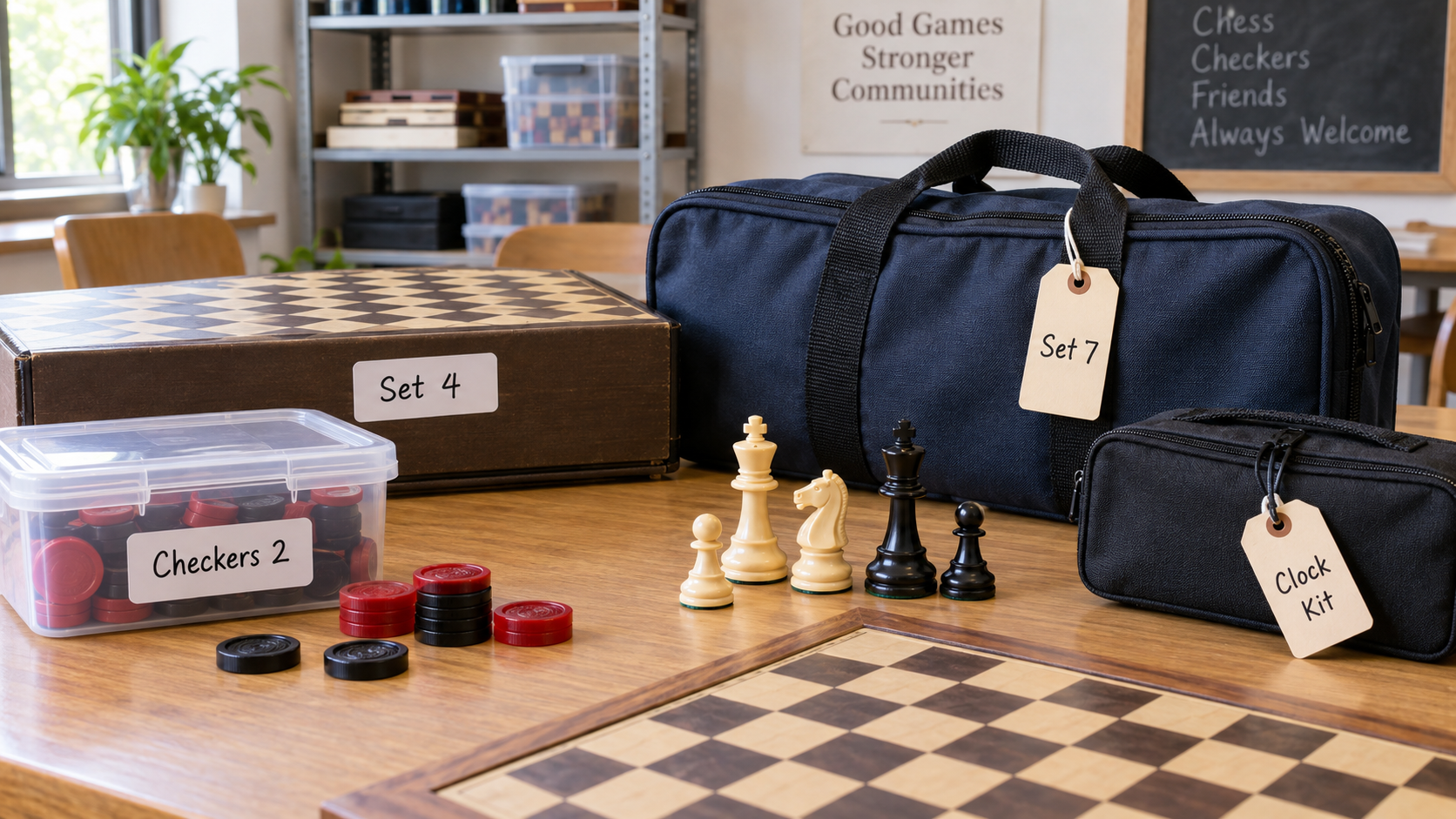
Match the identifier to the surface
Compare fixed labels with reusable tags
For adhesive labels, verify the intended surface, label size, removal guidance, writing method, and exposure limits. For hanging tags, verify the loop or fastener, attachment point, tag size, edge shape, clearance, and whether the tag stays readable in storage.
Quick decision
- Choose adhesive labels for smooth boxes, rigid cases, folders, or bins that keep the same set number.
- Choose hanging tags for handles, zipper pulls, and equipment that moves between kits, provided the attachment does not snag or block use.
- Use both when a rigid inner piece box has a permanent kit number but the outer carrying bag is reassigned.
- Skip new supplies when built-in label windows, existing numbered cases, or a simple shelf map already make every kit easy to return.
Option A: adhesive set labels
An adhesive label makes the identifier part of the container. It stays visible without a dangling fastener and can be placed consistently on the same corner of every comparable box. That is useful when Board 4, its chess-piece pouch, its checkers container, and its inventory card should remain one stable kit.
The tradeoff is surface compatibility. A label that holds on smooth plastic may lift from woven fabric, textured cases, dusty wood, or a flexible board sleeve. Removal may also leave residue or affect a finish. “Removable,” “repositionable,” and “permanent” describe different expectations; use the maker's current surface and removal guidance rather than assuming a familiar-looking label will behave safely.
Option B: reusable hanging tags
A hanging tag attaches through a handle, tag loop, or other suitable point instead of relying on the container surface. It can move when a bag changes from a chess kit to a checkers kit, and a larger tag may be readable while several bags sit on a shelf.
The tradeoff is movement. A long loop can tangle with a zipper, catch on shelving, hide behind another bag, or let the tag drag across a board. The attachment point must be intended to carry the tag without affecting the closure or handle. A tag also identifies the container, not its actual contents, so reassignment must include a physical count and a rewritten inventory record.
Who each format fits
A club with standardized, permanent kits
Adhesive labels fit a club where each outer box and its inner containers keep one number throughout the season. Put the same short identifier in a consistent location, then store incomplete sets in a separate review area rather than borrowing parts silently. Avoid putting adhesive on playing squares, piece bases, felt, hinges, zipper tracks, vents, or manufacturer information.
A shared program that reassigns bags and accessories
Hanging tags fit loan bags, clock kits, demonstration equipment, and mixed carrying cases that change hands or contents. A tag can show the current kit number without layering new stickers over old ones. Keep the visible identifier short; put dates, condition notes, and borrower details in the club's separate checkout record rather than crowding the tag.
A classroom or club with mixed container materials
A hybrid is usually clearer than forcing one format onto every surface. Use an appropriate fixed label on rigid containers and a short tag or built-in label window on fabric bags. Repeat the same code across the board carrier, chess pieces, checkers pieces, and outer storage only when those items genuinely form one kit.
Compare the complete check-in workflow
- List each inventory unit: complete player set, demonstration board, clock kit, lesson-material case, or spare-parts container.
- Assign one short text-and-number code. Do not rely on color alone.
- Identify the real attachment surface or point and read the label or tag maker's current instructions.
- Check the identifier at normal shelf distance and in the actual lighting, not only while holding it.
- Issue the equipment, set it up, pack it, carry it along its normal route, and return it once.
- Confirm that the identifier stayed readable and did not lift, snag, hide, block a closure, or slow the piece count.
- Only then repeat the system across the remaining inventory.
A label or tag answers “where does this container belong?” It does not prove that all 32 chess pieces or the correct checkers inventory is inside. Keep the contents count and exception record as separate steps.
Setup and maintenance
For an adhesive label, prepare the surface only as the container and label makers allow. Let any permitted cleaning step finish and the surface dry before application. Place labels away from flex points, stacking contact, lids, latches, and grip areas. Replace a curling or unreadable label instead of covering it with another code.
For a hanging tag, choose the shortest practical attachment that remains easy to read. Close the loop fully and keep it clear of zippers, hinges, handles used for lifting, and the playing equipment inside. At each inventory review, remove obsolete tags so one bag never displays competing assignments.
Use large, plain writing with enough contrast. A color cue may speed sorting, but pair it with text or a number. Maintain a simple master list that maps each code to its expected contents and storage location.
Skip criteria and no-buy alternatives
Skip adhesive labels when the maker does not support the intended surface, removal matters but is undocumented, the container is frequently washed, the surface flexes heavily, or the only available placement covers useful instructions. Do not assume a label is suitable for finished wood, fabric, leather-like material, or a printed board.
Skip hanging tags when there is no suitable attachment point, the fastener interferes with opening or carrying, the tag can snag during transport, or bags are packed so tightly that tags remain hidden. Avoid a long decorative tag when a compact label window already exists.
Before buying, test the code with paper cards in existing label windows, removable notes used only according to their instructions, or a temporary shelf map. If the real failure is an incomplete return count rather than container identity, improve the checklist first. The counting-tray versus checklist comparison covers that separate decision.
Bottom line
Adhesive labels are the straightforward choice for stable assignments on compatible rigid surfaces. Hanging tags earn their place on fabric bags and equipment that is deliberately reassigned. A mixed chess and checkers club will often be better served by a small hybrid system than by declaring one format the universal winner.
Start with one complete issue-and-return test, keep identifiers short, and separate container identity from the contents count. The planned classroom-and-club pillar is not built yet, so continue to the beginner-friendly classroom and club station guide. If the attachment format is settled but the club still needs to create its codes, compare a label maker with preprinted sequential number labels; for moving whole kits through check-in, compare numbered set bags with color-coded bins.