
Choose a padded pouch when one clock needs a compact, repeatable container and you can verify a close fit. Keep the original box when its insert holds the exact clock well, shelf space is available, and the package still survives regular opening. For a small casual club, the useful choice is the one helpers can identify, retrieve, check, and return consistently.
This is an individual-clock storage decision. Clubs packing several clocks together should use the multi-clock carrying-case guide instead.
As an Amazon Associate, The Good Chess & Checkers may earn from qualifying purchases.
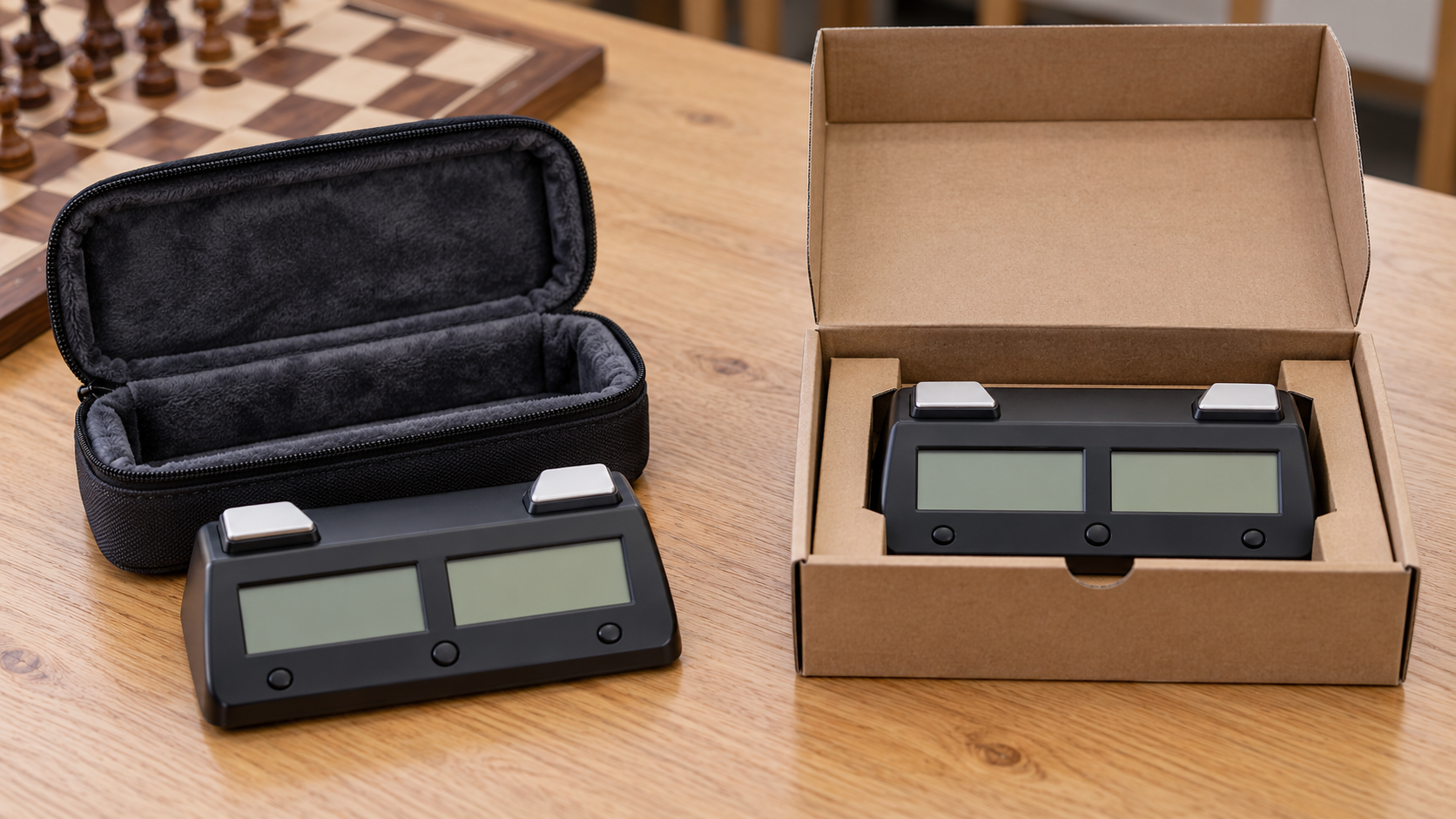
Measure the complete clock before changing its container
Compare a reusable pouch with the box you already have
Measure the clock at its widest, tallest, and deepest points, including buttons and feet. For a pouch, verify listed internal dimensions, padding, closure, and room to remove the clock without pressing its controls. For the original box, inspect the fitted insert, closure, label, and remaining shelf life.
Quick decision
- Choose a padded pouch when the measured interior fits one clock, frequent access is important, and a compact labeled container suits the shelf.
- Keep the original box when its model-matched insert still holds the clock correctly and replacing free storage would solve no real problem.
- Buy neither when the clock already has a stable numbered position in a suitable drawer or cabinet.
- Use a larger case when several clocks travel as one counted batch.
Where a padded pouch fits
A zippered pouch can reduce wasted shelf volume and make one clock easy to assign to a board bag or numbered kit. A carry loop, internal pocket, or writable tag point may help the club's return routine, but only when those features are documented for the exact pouch. Generic photos do not establish internal size or padding.
Fit should be close without being tight. Leave room for raised paddles, rocker switches, feet, and protruding controls. A pouch that requires force to close or lets the clock move freely is a poor match. Padding may separate equipment during ordinary storage, but it does not justify claims about drops, impacts, water, or travel conditions.
Where the original box fits
The original package begins with one major advantage: its insert was shaped for that clock model. It may also preserve setup notes, cable information, or model identification. Keeping it costs nothing, and the rectangular form may stack neatly when the shelf is deep enough.
Cardboard and folded inserts can wear with repeated club use. Check crushed corners, loose tabs, torn finger cutouts, and whether the clock can fall out when a helper lifts the box. Oversized retail packaging may also waste space. Do not assume every original box remains the best storage simply because it once shipped the clock.
Compare the club routine, not just the container
Access and return
Run the real sequence: identify the clock, remove it, set it beside a board, switch it off after play, and return it. A pouch usually opens from several angles but may look like every other black accessory bag. A box is easier to label on broad faces but may need two hands and more table space.
Labels and counting
Give the container and clock the same number or symbol. Put the label where it remains visible on the shelf. Neither option replaces an inventory count; an empty closed pouch and a closed box can both look complete from a distance.
Cables and batteries
Follow the clock maker's storage instructions. If the model has a removable cable, keep it in a separate pocket only when it cannot press against controls or the display. Follow the maker's battery guidance rather than storing loose batteries against the clock or inventing one routine for every model.
Shelf and stacking space
Measure the closed container, not only the clock. A soft pouch may fit a shallow shelf but can be awkward to stack. A box usually stacks more predictably, provided its walls and insert remain sound. Keep controls free from shelf pressure and leave enough finger clearance to retrieve the container.
Run a no-spend trial
- Measure the clock with all paddles, buttons, feet, and attached parts included.
- Inspect its original box and insert for fit, wear, closure, and label space.
- Use an existing suitably sized pouch for one or two sessions if the club already owns one.
- Time the ordinary retrieve, setup, shut-down, count, and return routine without turning the trial into a speed contest.
- Check whether helpers can identify a missing clock without opening every container.
- Change storage only if the pouch solves a repeated access, space, or organization problem.
Buying checks for a padded pouch
- Usable internal dimensions: compare these with the complete clock, not a guessed screen size.
- Closure path: confirm the zipper or flap does not press paddles or controls.
- Documented materials: use the current listing for padding, lining, pocket, and care facts; do not infer protection performance.
- Retrieval clearance: fingers should reach the clock without pulling on its buttons or display.
- Label position: add a removable tag or club identifier without covering operating information.
- Complete shelf fit: test the closed pouch in its real storage position before buying several.
Who should skip each option?
Skip a padded pouch when its internal dimensions are missing, the clock has controls that snag the opening, or the club needs several clocks counted and carried together. Skip the original box when it is torn, its insert no longer holds the clock, or its bulk causes repeated storage trouble. Skip both when a measured drawer organizer already gives each clock a visible assigned compartment.
If the actual decision is which clock to buy, start with beginner chess clocks. For a club establishing the whole play area, continue with the classroom and club station guide.
Bottom line
A fitted original box is a sensible free baseline. Replace it with a padded pouch only when measured fit and the club's real access routine support the change. Label the clock and container together, follow the clock maker's storage guidance, and avoid treating ordinary storage as a guarantee against travel or impact damage.