
Choose a portable whiteboard when a teacher needs to change, correct, and reuse one visible prompt during a lesson. Choose a flip chart when the group benefits from prepared pages, a visible sequence, or notes that remain available after the page turns. Neither format replaces the playable board; each manages the words, diagrams, pairings, and questions around it.
This is a reusable-live-surface-versus-retained-paper-sequence decision. If you already want an erasable board and only need to choose its size or support, use the portable whiteboard guide.
The Good Chess & Checkers may earn commissions from qualifying purchases.
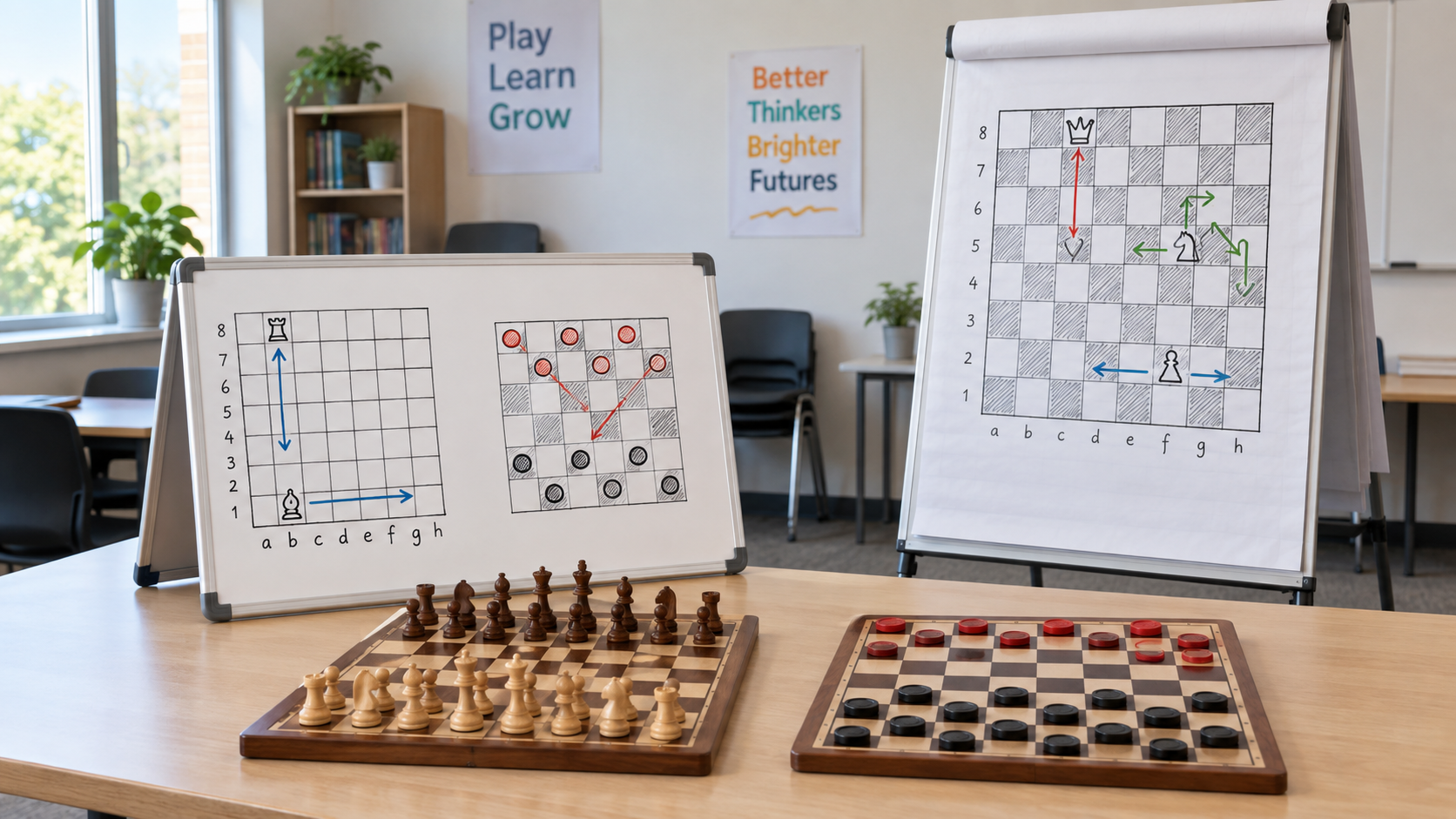
Quick decision aid
Compare an erasable surface with retained pages
Verify the usable display area, supported footprint, packed dimensions, compatible supplies, replacement-paper fit, and current care instructions for the exact format.
Quick decision
- Choose a portable whiteboard for changing move prompts, quick corrections, pairings, and repeated short lessons.
- Choose a flip chart for a prepared lesson sequence, pages the group may revisit, or notes that should survive the session.
- Use both only for separate jobs: prepared flip-chart pages for the lesson path and a small whiteboard for live answers.
- Buy neither yet when a rule card, printed worksheet, or ordinary paper already makes the prompt clear.
Where a portable whiteboard fits
A dry-erase surface is strongest when the content changes quickly. A teacher can write a coordinate, ask for a legal move, erase an incorrect line, or update pairings without consuming another sheet. That makes it useful for short activities repeated across several beginner groups.
The tradeoff is impermanence. Erasing removes the earlier step, and photographing every board can create more administration than the lesson needs. Markers, erasers, and compatible cleaning supplies also require one storage routine. Confirm the maker's surface and care guidance instead of assuming every marker or cleaner is suitable.
Where a flip chart fits
A flip chart can hold a planned sequence: board setup, movement reminder, practice position, then recap. Turning a page reveals the next stage while earlier pages remain available to flip back to. A teacher can also prepare large diagrams before learners arrive.
Paper adds consumables and bulk. Check the pad dimensions, attachment pattern, sheet count, bleed-through guidance, and replacement-pad route for the exact stand. Used pages need a keep, recycle, or discard decision. A page that is valuable for one class can become clutter if nobody files or labels it afterward.
Compare the complete lesson workflow
Visibility and usable area
Measure the writable or paper area inside the frame, then test the smallest intended diagram from the farthest seat. A portable tabletop board may suit one table but not a room. A tall flip chart may offer more area but still need clear sight lines and a suitable position.
Live correction versus lesson sequence
Choose the whiteboard when answers should change in front of learners. Choose the flip chart when page order matters or the group needs to revisit an earlier explanation. Do not draw a full game position on either surface merely because it is available; a purpose-built demonstration board usually makes pieces and legal moves clearer.
Setup and room footprint
For a tabletop whiteboard, measure the support depth after the chess or checkers board, pieces, and any clock are in place. For a freestanding flip chart, measure the open legs, display height, access around it, and folded storage length. Follow the exact product's setup and placement instructions.
Supplies and maintenance
A whiteboard needs compatible markers, an eraser, and approved cleaning supplies. A flip chart needs paper that fits, suitable markers, and a plan for used sheets. Store each display with its complete supply kit so the lesson does not start with a search through unrelated drawers.
Reuse and records
Whiteboards minimize paper when prompts can disappear. Flip-chart pages can preserve a lesson outline, but only when someone labels and stores useful pages. If every page is thrown away immediately, test whether a reusable board can do the same job with less handling.
Run a no-spend trial
- List the exact notes or diagrams that sit outside the playable board during one lesson.
- Mark which items must change live and which should remain available later.
- Mock up the display with an existing board or taped-together sheets of paper.
- Test readability from the farthest intended seat and measure the open footprint.
- Rehearse setup, page changes or erasing, supply retrieval, and pack-away.
- Buy only if the trial shows a repeated problem the new display solves.
Who should skip each option?
Skip a portable whiteboard when the lesson depends on returning to earlier pages, the program cannot maintain the correct markers and cleaning supplies, or the display must be readable beyond its tested distance. Skip a flip chart when storage is tight, replacement paper is uncertain, most notes are corrected repeatedly, or there is no useful plan for finished sheets. Skip both when learners need individual practice sheets rather than one shared display.
Next steps
For the full equipment path, use the beginner-friendly classroom and club station guide. If reusable individual exercises are the real need, compare sheet protectors with laminated worksheets. If one large game position must change move by move, compare a magnetic demonstration board with a dry-erase chess board.
Bottom line
A portable whiteboard is a live, reusable scratch surface; a flip chart is a sequence of pages that can stay visible or be retained. Match the format to what should happen to the notes, then verify viewing distance, open and packed dimensions, supplies, care, and storage before buying.