
Choose sheet protectors when the chess exercise changes often; choose individually laminated worksheets when the same activity returns regularly and needs to be handed out on its own. Both can make a printed page reusable, but they create different page-changing, writing, cleaning, filing, and replacement routines.
This comparison covers generic classroom-supply categories, not named products we tested. Verify the actual interior dimensions, supported marker type, cleaning guidance, closure or edge finish, quantity, and filing features before ordering.
As an Amazon Associate, The Good Chess & Checkers may earn from qualifying purchases.
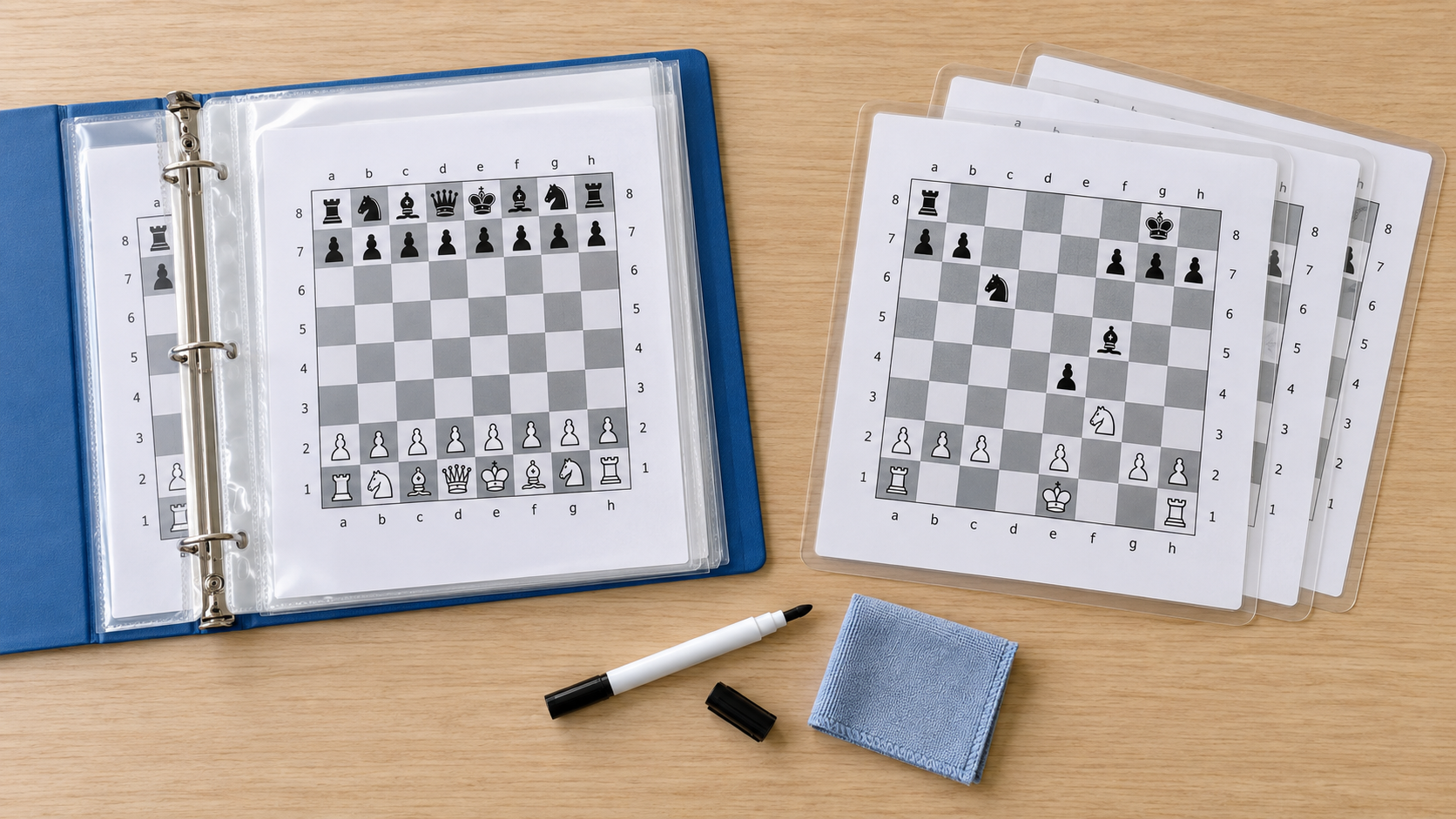
Match the finish to the lesson cycle
Compare both reusable worksheet formats
Measure the complete page, confirm the maker's writing and cleaning guidance, and test one real diagram before preparing a class quantity.
Quick decision
- Choose sheet protectors when you swap positions, notation sheets, or answer pages often and want to reuse the outer sleeve.
- Choose laminated worksheets when a checked activity will stay in rotation and learners need individual sheets without a binder.
- Use both selectively when a changing instructor library and a small set of frequently repeated student stations serve different jobs.
- Skip both when learners need to save their work, take it home, or move physical chess pieces rather than mark a diagram.
The real difference is replaceable insert versus finished page
A sheet protector separates the reusable writing surface from the printed lesson. Remove one page and insert another when the group advances or when an error is found. Protectors can also live in a binder, which keeps a sequence together but adds rings, seams, and page-turning to the table setup.
Lamination turns each worksheet into a finished reusable item. There is no loose insert to shift, but changing a prompt means printing and laminating another copy. That extra preparation can make sense for a position-identification station used repeatedly; it makes less sense for material revised every week.
Neither format makes the chess content accurate. Before preparing duplicates, check the 8-by-8 board, coordinates, side to move, piece placement, legal answer, notation, and instructions against the lesson goal.
Compare the classroom workflow
| Criterion | Sheet protector | Laminated worksheet |
|---|---|---|
| Changing the lesson | Swap the paper insert and reuse the protector | Prepare a newly laminated page |
| Distribution | Loose sleeve or binder page; confirm the insert stays aligned | One finished sheet can move directly to a learner or station |
| Visible area | Opening, seam, holes, or binder edge may cover margins | Sealed edge adds a border around the printed page |
| Filing | Often binder-ready without another step | Needs a folder, tray, clip, or compatible punched edge |
| Replacement | Replace the insert or protector separately | Replace the complete finished sheet |
| Best fit | Changing lesson libraries and short trials | Stable, frequently repeated activities |
When sheet protectors fit better
Protectors suit a teacher who adjusts the sequence as learners progress. One week may use coordinate matching; the next may use legal-move choices or a simple notation prompt. The same outer sleeve can hold each new page if the dimensions and writing routine still fit.
Measure the usable opening rather than relying only on “letter size.” Confirm that the seam, colored strip, binder holes, or page above it does not hide board coordinates or answer boxes. If the protector remains in a binder during use, set the open binder beside a real chessboard and check whether the rings consume too much table space.
Skip sheet protectors when inserts slide or wrinkle during use, learners need to carry individual sheets between stations, or the binder itself becomes the main obstacle. A purpose-made dry-erase pocket may offer a closure or marker loop, but those features still need to fit the page and routine.
When laminated worksheets fit better
Lamination suits a stable activity that has already been checked with real learners and will be reused. Separate finished sheets are easy to divide among pairs, place at stations, and collect into labeled stacks. A consistent edge can also make the set quicker to count.
Confirm the finished page dimensions, edge seal, corner shape, surface guidance, and storage fit. Do not trim into a sealed edge unless the laminating material's instructions explicitly allow the planned finish. Follow the maker's supported marker and cleaning directions instead of assuming every glossy surface behaves the same way.
Skip lamination when the content is still changing, the sheet must be written on permanently, or a protector already solves the problem. Avoid preparing a full class batch until one finished worksheet has survived the complete distribute-write-erase-file routine.
Run a one-page classroom trial
- Choose one representative beginner exercise with coordinates, pieces, and a small answer area.
- Print two identical copies; place one in the candidate protector and laminate the other according to the material and equipment instructions.
- Check both from the learner's seated angle under the room's usual light for glare, contrast, hidden margins, and shifting paper.
- Use only the marker types supported for each surface, then complete the same circles, arrows, and short notation response.
- Collect, erase, inspect, count, and file both formats exactly as the real class requires.
- Change the exercise in the protector and estimate whether the laminated activity will recur often enough to justify preparing more copies.
Record the actual friction: slow page swaps, curled edges, crowded binder rings, hard-to-see squares, stray markers, incomplete cleanup, or a filing system that does not fit the finished pages. The better format is the one that removes the repeated problem without creating a larger one.
Plan the complete supply count
Count by simultaneous users, not total enrollment. A class working in pairs may need fewer writable pages than a class completing individual notation practice. Include a small replacement allowance only after the trial shows what gets lost or damaged; do not assume either format lasts for a particular number of sessions.
Keep markers and cloths in a visible counted container. Label the worksheet set by lesson and version so an outdated answer key does not remain paired with a revised position. If the pages travel between rooms, compare a ring binder with an accordion file before adding another storage system.
Who should use a different format?
Use ordinary paper when learners need a permanent record, written feedback, or a page to take home. Use a shared display when one teacher is explaining a single position to the whole group; the site's laminated worksheet versus dry-erase board comparison covers that individual-versus-group decision. Use a physical board when the lesson goal is piece handling, legal movement, or seeing how a position changes move by move.
Bottom line
Sheet protectors are the flexible choice for a lesson library that changes; laminated worksheets are the tidy standalone choice for exercises that have earned a permanent place in the rotation. Test one identical chess page in both formats, measure the full table and filing routine, and prepare a class quantity only after the better workflow is clear.