
Choose a vertical rack when people need to retrieve one rigid board without moving the others. Choose a flat shelf when the board maker calls for flat storage, the stack is small and uniform, or the available shelf does not have safe vertical clearance. The right answer begins with the construction and measured size of every board—not the advertised capacity of a generic organizer.
This is a product-category comparison, not a named-product ranking or hands-on test. Confirm each board maker's storage guidance, then measure complete board width, height, thickness, hinges, frames, feet, and hardware before choosing a rack or shelf.
As an Amazon Associate, The Good Chess & Checkers may earn from qualifying purchases.
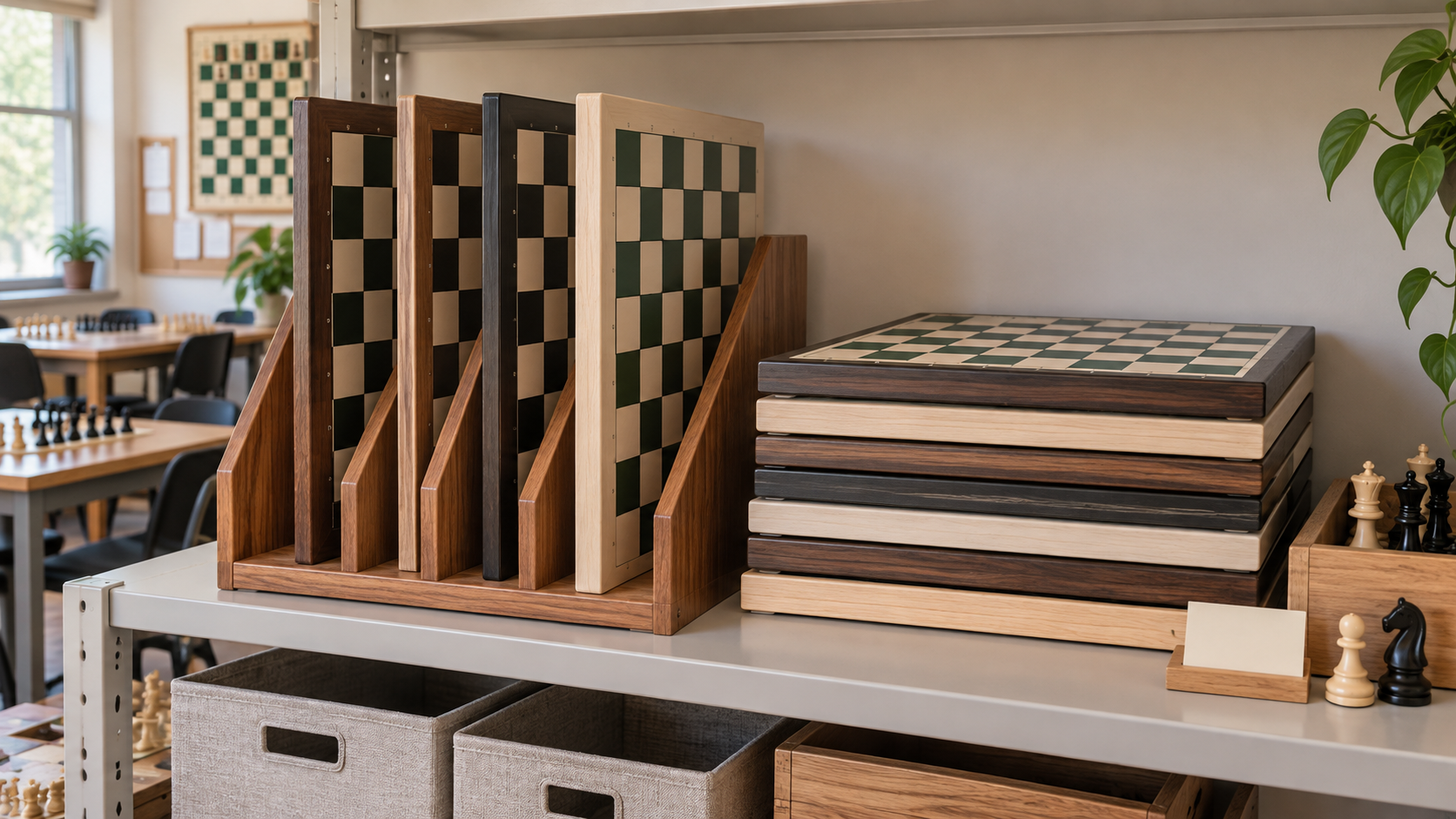
Measure the boards and storage opening
Compare separate slots with a supported flat stack
For a rack, verify usable slot width, contact surfaces, base depth, divider height, total footprint, and overhead lift clearance. For a shelf, verify usable depth, opening height, support across the full board, retrieval order, and what may be placed above the stack.
Quick decision
- Choose a rack for several compatible rigid boards that are issued individually and need visible labels or fast access.
- Choose a flat shelf when documented care favors flat support, only a few boards are stored, or vertical edge storage would press on hinges, frames, or hardware.
- Use both only when boards can be separated by construction and care needs: compatible boards in slots, flat-storage boards on a clear shelf.
- Skip new storage if one existing shelf already supports every board fully and the real problem is missing labels or unrelated gear piled on top.
Option A: a vertical rack with separate slots
A slotted rack gives each board a defined position. A helper can remove Board 3 without lifting Board 1 and Board 2 first, and a label at the slot or exposed edge can make returns easier. The footprint may use less shelf width than boards laid flat, but the complete rack still needs a stable base and enough clear height to lift the tallest board out.
The tradeoff is edge and contact fit. A slot that accepts a thin panel may not accept a framed or folding rigid board at its thickest point. Narrow dividers can press against trim, hinges, feet, or latches. A board may also lean if the slot is much wider than its edge. Do not assume vertical storage suits every wooden, veneered, composite, glass, or folding board; follow the board maker's current care guidance.
Option B: a flat shelf with boards stacked horizontally
A flat shelf can support a board across its broad face and avoids standing it on an edge. It is the simpler no-specialty-hardware choice when the shelf is deep enough, level, clean, and clear of projections. A small stack of similar boards may work well when the same set is normally taken from the top.
The tradeoff is retrieval order. Removing the bottom board means moving every board above it, creating extra handling and a temporary landing-space problem. Frames, feet, closures, or other raised parts can create uneven contact between boards, and unrelated boxes placed on top can turn the board stack into a hard-to-access base layer. Keep pieces and clocks in their own labeled containers rather than between playing surfaces.
Who each storage method fits
A club that issues one numbered board at a time
A compatible rack makes the strongest case when volunteers select one board by number, move it to a table, then return it to the same slot. Labels can sit on the rack rather than on a finished playing surface. Leave enough hand clearance to grasp the board without dragging it across the divider.
A small teaching program with two or three similar boards
A flat shelf may be all that is needed when the boards are used together, retrieved as one short stack, and supported according to their care guidance. Put the stack at a practical lifting height and keep a nearby clear surface available so upper boards are not leaned against a wall while someone reaches the bottom one.
A mixed inventory of framed, folding, and unusual boards
Do not force a mixed inventory into one format. Record the complete dimensions and storage guidance for each board. Boards with protruding hardware or uncertain edge-storage guidance may belong flat; compatible plain rigid boards may use measured slots. Roll-up and flexible boards need a separate workflow covered by the rack-versus-tube guide for roll-up boards.
Measure before choosing either option
- List every rigid board and note whether it is one-piece, folding, framed, or fitted with feet, hinges, latches, or handles.
- Read the maker's current storage and care guidance. Keep a board flat if that guidance requires it or remains uncertain.
- Measure each board at its widest, tallest, and thickest points, including all hardware.
- For a rack, compare those measurements with usable slot width, slot depth, divider height, base footprint, and lift-out clearance.
- For a shelf, compare board dimensions with usable shelf depth, width, opening height, and uninterrupted support area.
- Map one real retrieval and return: where the other boards wait, how labels remain visible, and whether one person can complete the sequence without improvised leaning.
- Test one compatible board before filling the rack or building a larger stack.
Setup and maintenance issues
Place either storage method on a stable, level surface and follow the rack or shelving maker's assembly, placement, and load guidance. Keep board faces away from loose pieces, metal corners, fasteners, marker tips, moisture, direct heat, and cleaning products not approved for the board material.
For a rack, check that dividers remain secure and that contact padding—when supplied and compatible—has not shifted, collected grit, or exposed hard edges. Do not widen or modify slots unless the maker supports that change. For a flat shelf, keep the support surface clean and do not let cords, labels, loose parts, or raised hardware become pressure points between boards.
Use short shelf or slot identifiers and keep a separate inventory record for pieces, clocks, and accessories. A board's storage position does not confirm that its full set is complete.
Skip criteria
Skip a vertical rack if the board maker does not support edge storage, the slots contact hinges or trim, boards wobble in oversized slots, the rack lacks a stable base, or there is not enough overhead clearance for safe removal. A rack designed for plates, cutting boards, files, or laptops is not automatically suitable for the dimensions and weight of a chess board.
Skip a flat stack if frequent access to lower boards causes repeated lifting, the shelf does not support the full board, hardware creates uneven contact, or people routinely put heavy unrelated items on top. Avoid a tall mixed stack whose order changes every session.
Skip both for roll-up mats, magnetic wall boards, oversized demonstration boards, or a single decorative board that already has a suitable case or permanent table. Match storage to the actual format instead of buying a generic organizer because its photo looks similar.
Bottom line
A measured vertical rack is usually the more convenient workflow for several compatible rigid boards that must be selected individually. A clean, fully supporting flat shelf is the more conservative choice when care guidance favors flat storage or the collection is small and retrieved together. Neither format wins without complete board measurements and a realistic retrieval test.
The planned classroom-and-club pillar is not built yet, so continue to the beginner-friendly classroom and club station guide. For broader room planning, use the board-game shelving guide; for complete-kit movement rather than board-only storage, compare rolling carts with stackable totes.