
Choose a rolling cart when equipment travels along one smooth, level indoor route and needs to stay visible during setup. Choose stackable totes when supplies must remain closed, split into manageable modules, or travel by vehicle. Neither format fixes an awkward route: measure doors, thresholds, turns, shelves, and the filled containers before buying.
The useful comparison is the whole session—loading, moving, distributing, counting, returning, and storing—not how tidy either option looks in a product photo.
As an Amazon Associate, The Good Chess & Checkers may earn from qualifying purchases.
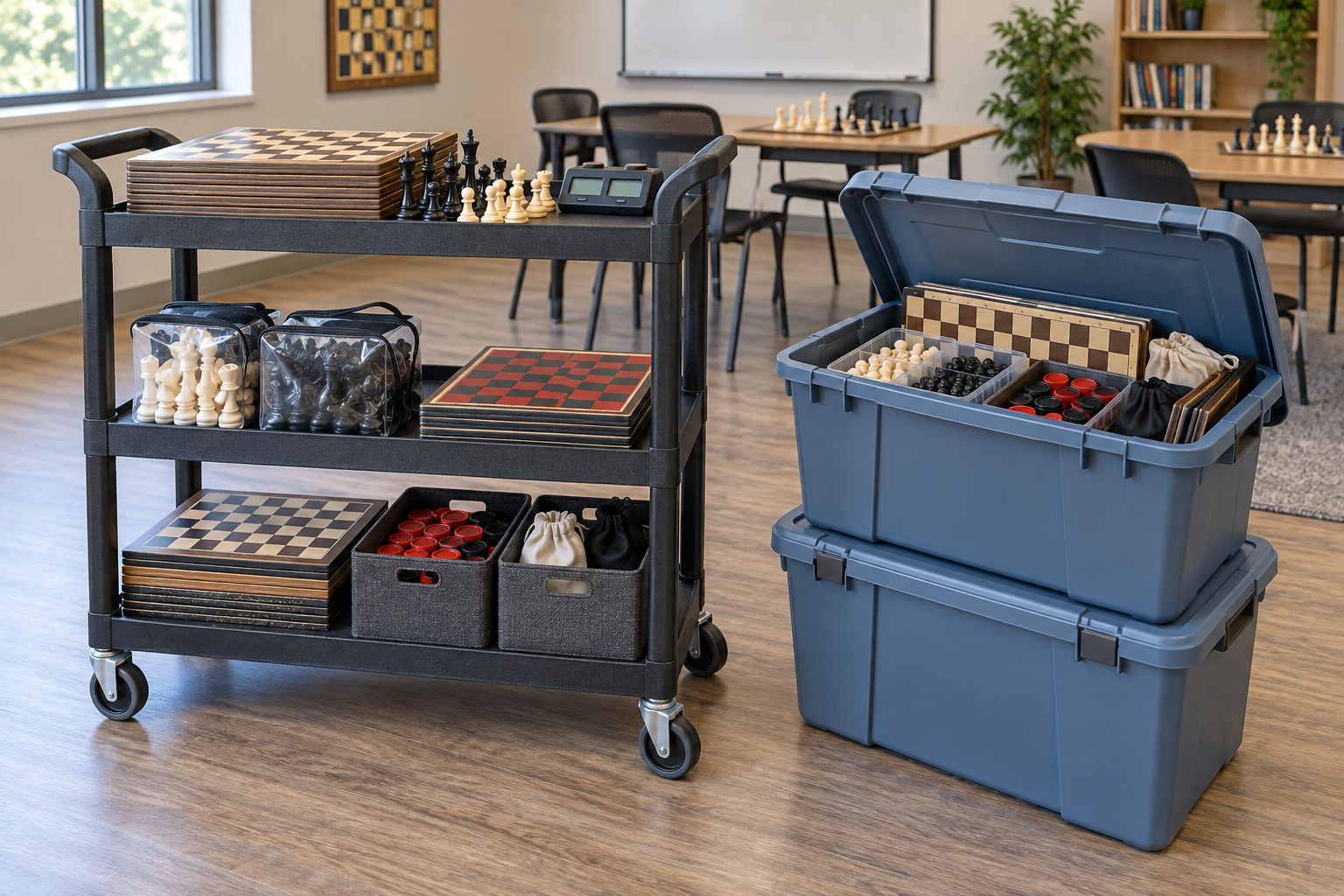
Measure the route before the container
Compare roll-in access with closed modular storage
For a cart, verify external dimensions, shelf clearances, caster details, handle height, and the maker's stated load limits. For totes, verify usable internal dimensions, lid and handle design, nesting or stacking instructions, and the filled lifting plan.
Quick decision
- Use a rolling cart for a short indoor route with a suitable floor, wide-enough doors, room to park the cart, and supplies that helpers need during the session.
- Use stackable totes when gear moves in separate loads, rides in a vehicle, sits in shared storage, or benefits from closed lids.
- Use a hybrid when labeled totes remain the inventory units but ride on an existing cart for the room-to-room trip.
- Buy neither yet if one cabinet serves a few nearby tables or the club has not mapped its actual route.
Where a rolling cart earns its space
A cart keeps several categories visible at once. Boards can occupy one tier, pre-counted piece bags another, and clocks or lesson materials a third. Helpers can roll the station into place and distribute from it without repeatedly opening containers.
That advantage depends on the route. A cart also needs turning room, a parking position that does not obstruct normal room use, and shelf openings that fit the equipment. Thresholds, uneven outdoor surfaces, stairs, and vehicle loading can erase the benefit. Compare the maker's dimensions and instructions with the real route rather than assuming that wheels make every load portable.
Where stackable totes work better
Totes divide the inventory into labeled modules: chess sets, checkers sets, clocks, teaching materials, or replacement pieces. A closed tote can move independently and may fit shelves or vehicle space more predictably after its external dimensions are checked.
The tradeoff is repeated opening and lifting. Stacking also hides lower containers, so frequently used supplies can end up under less-used gear. Keep each tote's contents and filled handling plan simple. Do not infer a comfortable filled load from the container's volume, and follow the maker's stacking and load guidance.
Compare the route, not just capacity
Doors, turns, and thresholds
Measure the narrowest clear doorway and the tightest turn, then include handles, wheel housings, lids, and anything that projects beyond the container. Walk the route from storage to every play area. A cart that fits the room but not the storage door is not a workable system.
Setup access
Open cart tiers make frequently used supplies easy to see. Totes make grouped inventory easy to isolate, but lids and stacking add steps. Put high-frequency items where a helper can reach them without unloading unrelated gear.
Return counts
Use pre-counted piece pouches or trays inside either format. The outer container moves equipment; it does not prove that a chess army, checkers set, clock, or rule-card pack is complete. A short contents card on each tier or tote makes the closing check repeatable.
Chess and checkers together
Give both games deliberate space. Separate chess pieces from checkers discs even if some boards serve both games, and label each inventory unit with words or symbols rather than color alone. If the program uses a particular checkers kinging method, store the required pieces or markers with that checkers unit.
Run a no-spend route test
- List the boards, piece sets, clocks, references, and replacement supplies used in a normal session.
- Group them in existing boxes or bags as they would sit on cart tiers or in totes.
- Measure the grouped equipment and the narrowest door, shelf opening, turn, and vehicle space on the route.
- Move the test groups through setup and return using an existing trolley only if one is already approved for the space.
- Count openings, lifts, trips, repacking steps, and incomplete sets.
- Choose the simpler workflow, then confirm the shortlisted product's dimensions and manufacturer instructions.
Buying checks that prevent a mismatch
- Use external dimensions for the route: include handles, lid overhang, bumpers, and caster housings.
- Use internal dimensions for the gear: tapered tote walls and cart lips reduce usable space.
- Protect flexible boards: store them according to their maker's rolling or folding guidance and keep hard items from pressing into them.
- Check retrieval order: the most-used item should not require unstacking every tote or emptying a cart tier.
- Use replaceable labels: name the game and contents; do not rely on color alone.
- Follow stated limits and care guidance: verify product instructions instead of making assumptions about load, stacking, wheels, or cleaning.
Who should skip each format?
Skip a cart when the route includes stairs, difficult thresholds, cramped turns, vehicle loading, or nowhere sensible to park it. Skip large totes when helpers would need to unpack several boxes for every session or when the filled units are impractical for the people using them. Skip both when a small club can keep complete sets in individual carriers beside the tables.
If the main issue is the club handoff rather than room-to-room transport, compare numbered kit bags with pooled bins. If loose pieces are slowing the final audit, compare a counting tray with a checklist. If a classroom is deciding whether equipment should move at all, compare a rolling lesson cart with a fixed cabinet.
Bottom line
A rolling utility cart fits a repeatable level indoor route and an open, accessible setup station. Stackable totes fit closed modular storage, separate loads, and vehicle transport. Test the full route with current containers, keep chess and checkers inventory distinct, verify every dimension and instruction, and purchase only after the workflow reveals which format removes real handling steps.