
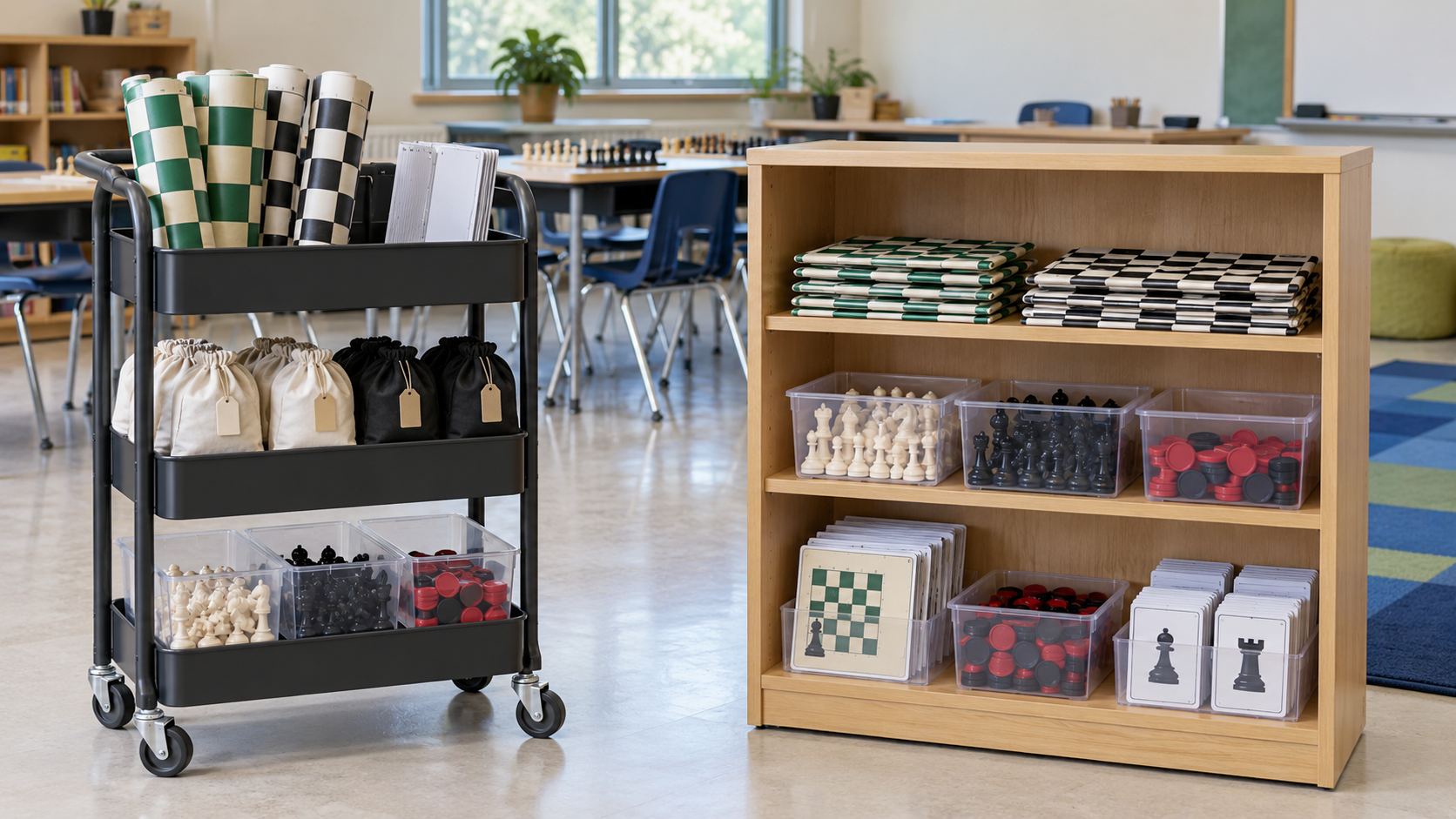
Choose a rolling cart when the same chess and checkers equipment regularly moves between rooms and can follow a measured, suitable route. Choose a fixed cabinet when lessons happen near one approved storage point and consistent shelf locations matter more than mobility. The right answer depends on where the equipment waits, how it reaches players, and how it returns after every lesson.
This is a mobile-staging-versus-store-in-place decision. If you already know equipment must move and are choosing its containers, compare a rolling utility cart with stackable totes instead.
As an Amazon Associate, The Good Chess & Checkers may earn from qualifying purchases.
Map the lesson route before buying storage
Compare mobile staging with a fixed equipment home
For a cart, verify the assembled outside dimensions, usable tier openings, caster and handle details, parking footprint, and current maker instructions. For a cabinet, verify the usable interior, shelf spacing, door clearance if applicable, assembled footprint, and placement or installation guidance.
Quick decision
- Choose a rolling cart when equipment must serve multiple nearby rooms, the complete route works for the cart, and the cart has an approved parking place.
- Choose a fixed cabinet when lessons happen near one storage point and boards, pieces, clocks, and teaching aids benefit from assigned shelf positions.
- Use both only for separate jobs: a cabinet for the reserve inventory and a small cart for the measured lesson batch.
- Buy neither yet if existing room storage and labeled containers can support the same workflow.
Where a rolling cart fits
A cart can stage one lesson in order: boards on one tier, pre-counted piece containers on another, and rule cards or worksheets on the third. That reduces return trips when a teacher serves more than one space. Open tiers also make missing supplies easier to notice before the cart leaves storage.
Mobility creates new constraints. Measure the narrowest doorway, tightest turn, thresholds, lift access, and the final parking position. Include caster housings, handles, shelf lips, and supplies that project beyond a tier. Follow the product maker's assembly, use, placement, and stated load guidance; wheels do not make every route or load suitable.
Where a fixed cabinet fits
A fixed cabinet gives every set a repeatable return address. Shelf labels can match board bags, piece bins, clocks, and lesson folders, making the end-of-session count easier to divide among helpers. Doors may hide visual clutter, while an open cabinet can make incomplete returns obvious.
The tradeoff is distance. If games happen in another room, every set still needs a carrier or repeated hand trips. Use interior shelf dimensions and door-opening clearance—not only the cabinet's outside size—to test the inventory. Obtain permission for the location and follow the maker's placement or installation instructions rather than assuming any cabinet can go anywhere.
Compare the workflow that happens every lesson
Distribution
Count the normal lesson batch, not the entire collection. A cart can arrive as one staging point, but players may crowd it if distribution is not assigned. A cabinet works well when tables are close and helpers can take one numbered kit at a time.
Return and missing-piece checks
Neither format proves that a set is complete. Give each board and piece container the same number or symbol, and keep chess pieces separate from checkers. Use a visible return position for incomplete sets so one missing checker does not turn into a search through every shelf or tier.
Lesson materials
Store rule cards, demonstration pieces, score sheets, pencils, and cleaning supplies in their own labeled locations. Keep any product care supplies with their instructions, and do not place liquids where a spill would reach boards, books, or clocks.
Parking and access
A cart needs a defined between-session footprint. A cabinet needs enough clear space for access and any doors. The room owner or program manager should approve the location and access routine; this guide cannot determine a particular building's rules.
Run a no-spend storage trial
- List the boards, piece sets, clocks, and teaching materials used in one ordinary lesson.
- Measure every item in its actual bag, bin, tube, or folder.
- Mock up cart tiers or cabinet shelves with existing tables, shelves, or boxes.
- Walk the real storage-to-table route and record doors, turns, thresholds, and interruptions.
- Run distribution, the final piece count, and the return routine with the people who normally help.
- Choose only after the trial identifies whether movement or fixed organization is the larger problem.
Buying checks
- External dimensions: test the room, doorway, route, and parking footprint.
- Usable dimensions: compare the real tier openings or cabinet interior with packed boards and bins.
- Retrieval order: frequently used sets should not sit behind or beneath the whole reserve inventory.
- Labels: use words or symbols as well as color, and make labels replaceable when the inventory changes.
- Current instructions: confirm assembly, placement, caster, shelf, loading, cleaning, and care guidance for the exact product.
Who should skip each option?
Skip a rolling cart when the route includes stairs, unsuitable thresholds, cramped turns, no approved parking place, or equipment that cannot fit fully within the measured tiers. Skip a fixed cabinet when the program changes rooms often, cannot obtain a suitable permanent location, or needs equipment to travel off-site. Skip both purchases when a few complete sets already fit in labeled bags on an existing approved shelf.
If the central issue is controlled access rather than classroom movement, use the locking equipment cabinet guide. If boards alone are consuming the available shelf, compare a rigid board rack with flat shelf storage.
Bottom line
A rolling cart is a mobile lesson station; a fixed cabinet is a stable inventory address. Map the route, measure packed equipment, rehearse distribution and return, and confirm the exact product instructions. Choose the option that removes a repeated classroom problem without creating a new storage or access problem.