
A parent teaching checkers needs a different kind of book from a child studying alone. The best fit gives the adult a quick answer, a clear board diagram, and a short way to demonstrate one rule before play resumes. It should also name its checkers variant so a family does not mistake one ruleset for a universal rule.
This guide compares rule-reference categories, not named winners. It does not claim hands-on testing, current prices, ratings, or availability. Preview the exact edition and inside pages before choosing.
As an Amazon Associate, The Good Chess & Checkers may earn from qualifying purchases.
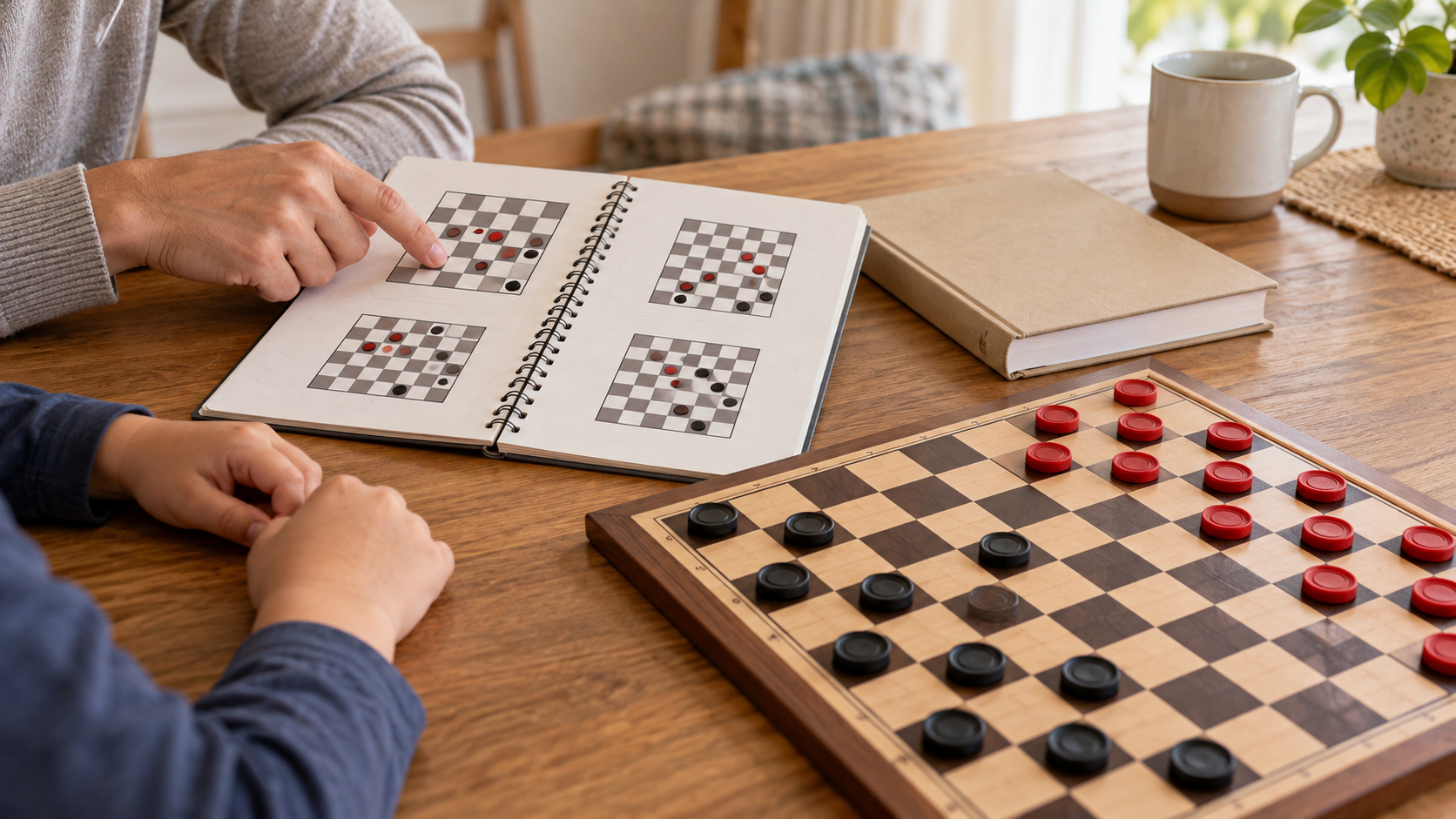
Best starting category
Choose a visual American-checkers rules reference
For most US families, start with a concise 8-by-8 American-checkers reference that visibly covers setup, diagonal movement, required captures, multiple jumps, crowning, king movement, and winning conditions. Confirm the ruleset and sample pages in the exact listing.
What Parents Should Check First
- Named ruleset: the book should say whether it teaches American or English checkers, international draughts, or another variant.
- Complete first-game rules: look for setup, ordinary movement, captures, multiple jumps, crowning, king movement, and how a game ends.
- Readable diagrams: the dark squares, moving piece, landing square, captured piece, and order of a multiple jump should be easy to distinguish.
- Parent prompts: short demonstration ideas or questions help an adult teach without reading a page aloud as a lecture.
- Fast lookup: a contents page, index, tabs, or strong headings should make “Do I have to jump?” easy to settle during play.
- Reading fit: preview a middle page. A child-friendly cover does not guarantee plain language or diagrams a new player can follow.
Compare the Main Book Formats
Compact illustrated rule book
Best for: a parent who wants quick table-side answers and one-rule-at-a-time demonstrations. Favor frequent diagrams and a visible section on common questions.
Skip it when: the format is so small that two people cannot read a diagram beside the board, or the book gives only a one-page rule summary.
Parent-and-child lesson guide
Best for: families that want a sequence of short sessions, prompts, and mini-games. Check that the lessons use physical pieces and explain what the parent should demonstrate.
Skip it when: the lesson structure adds a lot of reading but still leaves captures, multiple jumps, or kings ambiguous.
Activity book with rules pages
Best for: a child who already enjoys pencil activities and needs extra practice after learning legal moves.
Skip it as the main reference: puzzles and coloring pages do not replace a complete rules source. Use the checkers activity-book guide for that separate decision.
General beginner or strategy book
Best for: a learner ready to continue beyond the first games into patterns, problems, and planning.
Skip it for first-week teaching: notation and longer analysis can hide the simple rule a parent needs. The broader beginner checkers book guide compares those self-study formats.
Preview the Exact Edition
- Confirm the title, author, publisher, format, and edition shown in the sample match the listing.
- Find the board size and named variant before relying on any movement or capture explanation.
- Inspect one ordinary-move diagram and one multiple-jump diagram. Each should identify the moving side and sequence clearly.
- Check how the book explains mandatory captures, choosing between captures, crowning, and whether a newly crowned piece continues moving.
- Look for a short teaching activity that can be rebuilt on the family’s actual board.
- Measure the open book against the table space left after the board and spare pieces are set out.
A Simple Teaching Framework
Teach one visible action at a time: first place pieces on the playable squares, then move ordinary pieces, then capture, then practice a multiple jump, and finally crown and move a king. After each explanation, let the child move the pieces. A book earns its place when it helps the parent prepare and answer questions; it should not turn the first game into a reading assignment.
When a disagreement appears, separate the printed rule from the family’s teaching choice. Allowing reminders, undoing an accidental move, or playing a capture-only mini-game can make a lesson gentler, but those choices do not redefine the underlying ruleset.
Try This Before Buying
Play two short sessions using the free how-to-play guide and write down every question that interrupts the game. If the same rules are hard to find, a compact printed reference has a clear job. If the child needs movement practice rather than lookup help, family checkers teaching aids or a few homemade position cards may solve the problem better.
Who Should Skip a Checkers Rule Book?
Skip the purchase when the set already includes a complete, readable leaflet or the family is comfortable using a bookmarked rules page. Also skip a rules-only book when the learner already finishes games without legal-move questions and wants puzzles or strategy instead. A book aimed at independent child reading is not automatically the right tool for a parent-led lesson.
Bottom Line
For most parents teaching kids, the strongest category is a concise visual reference for the exact checkers variant the family plays. Prioritize complete capture and king rules, diagrams that work beside a real board, quick navigation, and useful adult prompts. Preview the exact edition, run a free two-session trial, and buy only when print solves a repeated teaching problem.