
A useful checkers activity book gives a child something specific to solve between games: find a required jump, choose a safe move, finish a king path, or rebuild a position on a board. The best format is not the one with the most pages. It is the one whose diagrams, instructions, answers, and difficulty fit the learner.
This is a category comparison, not a ranking of named books or a claim that we completed every exercise. Listings and editions change, so preview sample pages and confirm the game variant, reading level, answers, and physical format before buying.
As an Amazon Associate, The Good Chess & Checkers may earn from qualifying purchases.
Product-category guide
Preview the inside pages before choosing
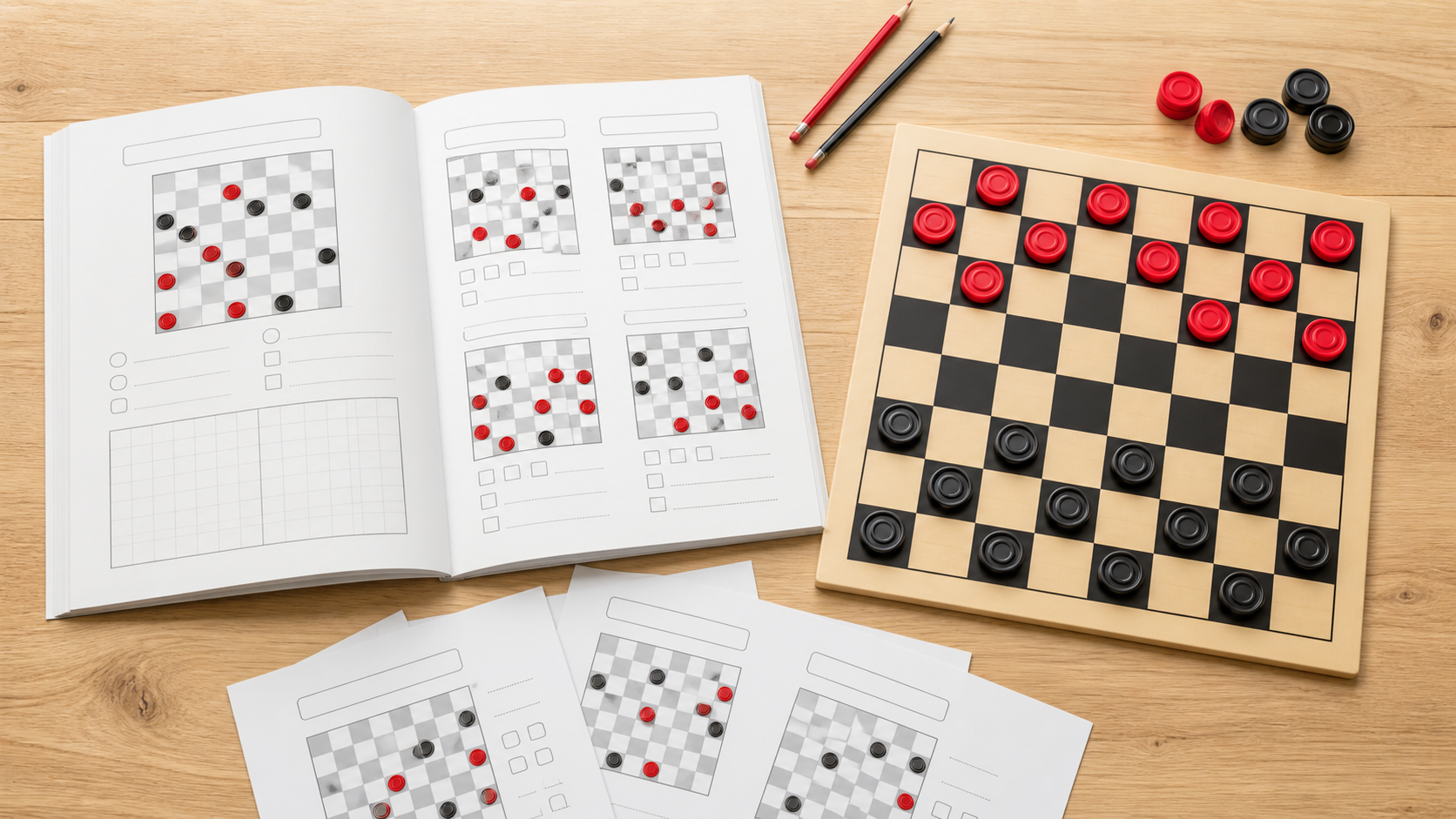
Look for large board diagrams, short instructions, a clear difficulty path, and answers that explain more than a move number. Confirm that the activities match the checkers variant your family plays.
What to compare
- Variant: confirm whether the book teaches American checkers or English draughts on an 8-by-8 board. Other draughts variants may use different boards, movement, captures, or kings.
- Starting level: some books teach setup and legal moves; others begin with tactics. Match the first activity to what the child can already explain.
- Diagram clarity: pieces, playable dark squares, move arrows, and coordinates should remain distinct at the printed page size.
- Activity variety: a useful mix can include legal-move checks, forced jumps, king routes, position reconstruction, move choices, and short game challenges.
- Answer support: answers should be easy for an adult or independent reader to find and should explain why a move works when possible.
- Writing space and binding: check whether the child is meant to write in the book, use separate paper, or keep the pages reusable. A book that stays open beside the board is easier to use.
- Board requirement: decide whether page-only puzzles are enough or whether positions need to be rebuilt with physical pieces.
Best for a first activity book: rules plus simple positions
Choose a beginner workbook when the learner still needs reminders about diagonal movement, playable squares, required captures, multiple jumps, and crowning. The early pages should use one idea at a time and avoid long move sequences.
Best for: children who can play parts of a game but still ask frequent rule questions.
Skip it if: the child already plays complete games confidently and wants harder move-choice puzzles rather than rule review.
Best for short practice: diagram puzzle books
A puzzle-led book suits five- or ten-minute sessions. Look for one position per exercise, a visible side to move, and a clear goal such as “find the jump” or “reach the king row.” Difficulty should increase gradually instead of mixing elementary and advanced positions without labels.
Best for: learners who know legal moves and enjoy solving one concrete problem at a time.
Skip it if: the diagrams are too small, the book omits solutions, or the child needs a teacher to translate dense notation.
Best for family lessons: guided workbook formats
Choose a guided format when an adult and child will work together. A good lesson gives a short explanation, a position to set up, a question, and an answer or follow-up move. A physical board lets the child test alternatives instead of treating the printed answer as a guess.
Best for: families, homeschool sessions, or informal clubs using one book as a lesson prompt.
Skip it if: you need independent quiet work, multiple simultaneous copies, or reproducible classroom pages that the listing does not explicitly permit.
Quick comparison framework
- Choose rule-and-activity pages for a child still learning legal movement and captures.
- Choose large diagram puzzles for short independent practice after the rules are secure.
- Choose a guided workbook when an adult will discuss each position and set it up on a board.
- Choose a strategy book later when the learner is ready for notation, longer explanations, and connected move sequences.
- Choose free homemade position cards when you already know the child’s exact weak point and do not need a full book.
Pre-purchase page check
- Confirm the exact title, author, edition, language, and physical format.
- Find a sample activity, not only the cover or contents page.
- Check that the board shown has the expected size and that the book names its checkers variant.
- Make sure the diagrams remain readable without zooming and clearly show whose turn it is.
- Locate the answers and see whether they explain the idea or only list a move.
- Check whether pencils, a separate notebook, or a physical board and pieces are needed.
- For shared or group use, confirm binding, page durability, and any copying permissions from the publisher; do not assume a consumer workbook may be reproduced.
Use activities with a real checkers board
For each diagram, ask the child to rebuild the position, name the side to move, check for required captures, choose a move, and explain the reason before opening the answer. If a rule is uncertain, return to the beginner checkers rules guide or the focused explanation of required jumps in checkers.
The planned beginner-checkers rules and strategy pillar is not yet built. Until it is, those rules pages form the clearest learning path. If a full workbook is more structure than the family needs, compare shorter checkers teaching aids. If the physical pieces make kings hard to recognize, compare flat and stackable checkers pieces before blaming the activity.
Who should skip an activity book?
Skip the purchase for now if the child mainly needs a few relaxed games, cannot yet identify legal diagonal moves, or dislikes paper puzzles. A board, twelve pieces per side, and three handmade positions may be a better first lesson.
Also skip books whose samples hide the interior, mix chess and checkers without enough depth for either game, use a different draughts variant without explanation, or promise improvement without showing a usable teaching method.
Bottom line
The best checkers activity book for a child matches the variant, starts at the right rule level, uses readable diagrams, offers a deliberate range of activities, and provides useful answers. Preview the actual pages, decide whether a board is required, and choose the simplest format the learner will use consistently.