
Buying a first chess and checkers set should feel simple, but the choices can get oddly confusing. Some sets look beautiful but are hard for beginners to read. Some are cheap and portable but too small for young players. Some include chess pieces only, while others include both chess and checkers pieces but use a board that is frustrating to store or clean.
The best beginner set is usually not the fanciest one. It is the set people will actually use: clear squares, recognizable pieces, comfortable checkers, easy storage, and a size that fits the table where games happen. If board size is the main question, pair this starter advice with how to choose the right chess and checkers board size.
As an Amazon Associate, The Good Chess & Checkers may earn from qualifying purchases.
Product-first guide
Shop beginner-friendly sets first
Start with complete, readable combo sets, then use the checklist below to reject boards that are too cramped, decorative, or hard to store.
If connected move recording or online play with physical pieces is part of the plan, first decide whether an electronic chess board is worth the added setup. Most beginners should establish a regular playing habit on a standard board before paying for device and software integration.
Helpful product path
Start With Where the Set Will Be Used
A good family-room set is different from a good classroom set. Before comparing materials or styles, decide where the board will live most of the time.
For home and family game night
Look for a board that feels pleasant to use and can survive being set up often. A folding board with built-in storage is practical if the set needs to disappear between games. A wooden board can feel nicer on a coffee table, but only if there is a reliable place to keep all the pieces.
For classrooms and clubs
Durability matters more than decoration. Vinyl roll-up boards, plastic pieces, and stackable checkers are often easier to manage in groups. If several children are learning at once, readable pieces and consistent board colors are more important than a premium finish.
For travel
Choose magnetic or pegged pieces if the board will be used in a car, on a train, or outside. Very tiny sets can be annoying for beginners, so aim for portable rather than miniature.
Choose a Board Size That Is Easy to Read
Chess and checkers both use an 8-by-8 board with alternating light and dark squares. That shared board is one reason combination sets are so useful. The main question is size.
For most beginners, a medium board is easiest. A board that is too small makes the chess pieces crowded and the checkers harder to pick up. A board that is too large can be awkward for children or for small tables.
As a simple rule, the chess pieces should sit comfortably inside the squares without touching neighboring pieces. The checkers should be easy to stack, slide, and crown without wobbling. In checkers, crowning means placing one checker on top of another when a piece reaches the far side and becomes a king.
Make Sure the Chess Pieces Are Recognizable
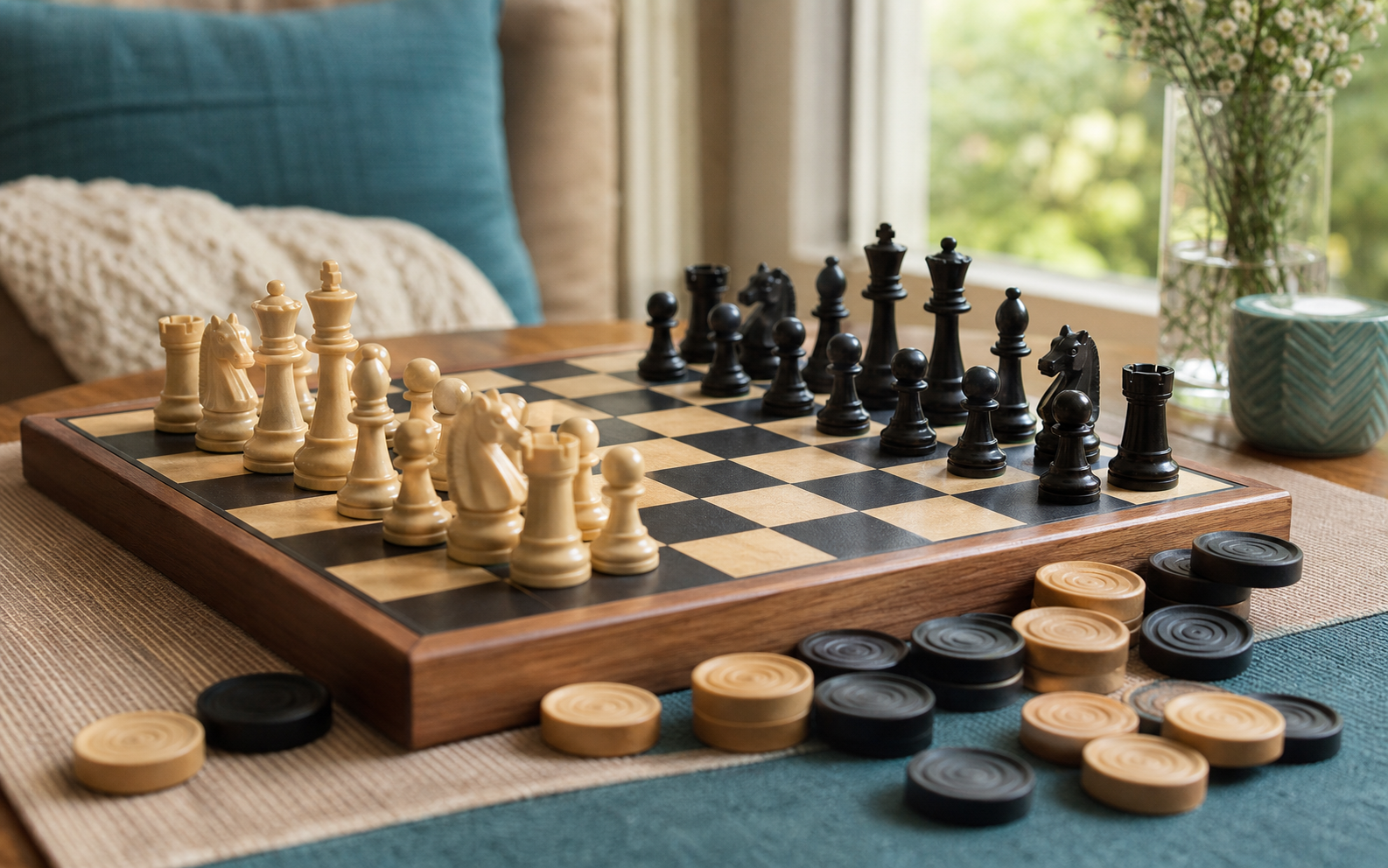
Beginners need to identify pieces quickly. A classic Staunton-style chess set is usually the safest choice because the pieces are familiar: tall king, slightly shorter queen, bishop with a cut top, horse-shaped knight, castle-shaped rook, and smaller pawns.
Decorative themed sets can be fun as gifts, but they are not always ideal for learning. If a child cannot tell the bishop from the queen at a glance, the set may slow down practice. For a first set, clarity beats novelty.
Check the Checkers Pieces Too
Checkers pieces should be comfortable to move and easy to stack. Thin pieces can be harder for small hands to manage. Very light pieces may slide around too easily. If the set is for children, classrooms, or older relatives, choose pieces with enough thickness and contrast to see clearly.
Some sets include checkers pieces that are also used as backgammon pieces. That can be fine, but make sure there are enough pieces for a standard game: 12 dark pieces and 12 light pieces for American checkers, also called English draughts. Rule variations exist in different countries, so check the rules you plan to teach if you are buying for a specific tradition.
Compare Materials Without Getting Distracted
Materials affect feel, storage, durability, and price. There is no single best material for every beginner.
Wood
Wooden sets can look attractive and feel substantial. They make good gifts and can encourage people to leave the board out. The tradeoff is that wooden pieces may be easier to lose if there is no storage, and some decorative boards are less readable than simpler designs.
Plastic
Plastic pieces are practical for learning, clubs, and classrooms. They are usually light, replaceable, and easy to clean. Weighted plastic chess pieces can feel better than very hollow pieces, especially for regular play.
Vinyl and silicone boards
Roll-up boards are common in clubs because they are durable and easy to store. They are not as gift-like as wood, but they are excellent for repeated use. Silicone boards can lie flatter than vinyl in some settings, though they may attract dust depending on the finish.
Magnetic sets
Magnetic sets are useful for travel, but magnet strength and piece size matter. A travel set should keep pieces in place without making them difficult to move.
Look for Storage That Matches Real Life
Lost pieces are the fastest way to ruin a useful set. Storage should be part of the buying decision, not an afterthought.
For families, a folding board with internal storage can work well. For classrooms, labeled bags or stackable containers may be easier than individual boxes. For travel, choose a set that closes securely and keeps chess pieces and checkers from mixing into a messy pile.
Age-Fit Matters More Than the Box Says
A set that is technically safe for a child may still be frustrating if the pieces are too small or the symbols are hard to understand. Younger beginners usually do better with larger pieces, bold color contrast, and a board that does not shift during play.
For adults learning chess or checkers, readability still matters. Avoid boards with busy patterns, low contrast, or overly stylized pieces. Good beginner equipment quietly removes friction.
When a Combination Set Makes Sense
A chess and checkers combination set is a smart choice when space, budget, or simplicity matters. It lets families switch games without buying multiple boards, and it gives beginners a gentler path into strategy games. Checkers is often easier to learn first because every starting piece moves the same way, while chess introduces six different piece types.
A combination set is especially useful for grandparents, babysitters, classrooms, after-school programs, and gift buyers who want one dependable board for several situations.
When Separate Sets May Be Better
Separate sets make sense if someone is joining a chess club, hosting many players, or wants a tournament-style practice setup. A roll-up chess board with clear coordinates can help learners discuss squares like e4 or c6. For checkers-focused players, larger stackable pieces and a board with strong contrast may be more comfortable.
You do not need tournament equipment to enjoy either game. But if the set has a specific job, choose the tool that fits that job.
A Simple Buying Checklist
- The board has 64 clear alternating squares.
- The chess pieces are easy to recognize, especially the king, queen, bishop, knight, and rook.
- The checkers include 12 pieces for each side and stack well for kings.
- The board size fits the table where it will be used.
- The pieces are not too small for the intended players.
- The colors have enough contrast for comfortable viewing.
- The set includes storage that people will actually use.
- The material matches the setting: durable for classrooms, attractive for gifts, secure for travel.
Best Practical Picks by Situation
For a first family set, choose a medium folding chess and checkers set with clear Staunton-style chess pieces and built-in storage. For classrooms or clubs, choose durable plastic pieces, stackable checkers, and roll-up boards that can be packed quickly. For travel, choose a magnetic set that is large enough to play without squinting. For a gift, choose the nicest readable set within budget rather than the most decorative one.
The right set does not make anyone a better player by itself. It does something more useful: it makes people want to sit down, learn the rules, and play another game.